Wednesday, February 15, 2012

Angkor Wat Temple Complex


Along the outside of the central temple complex is an 800 m long series of beautiful bas-reliefs. One portion depicts a battle scene from the Hindu Mahabarata epic. Another is of a triumphal battle march of Suryavarman II’s army. Our guide pointed out the mercenary Thai army (who wore headdresses, skirts, and carried tridents), the Khmer troops (with breastplates and spears), and the king riding an elephant, shaded by 15 umbrellas and fanned by scores of servants. Part of the south gallery depicts the punishments of hell and rewards of heaven. Another section shows the famous churning of the Ocean of Milk. Some of the relief figures were quite black and shiny, polished by the many hands rubbing their surface. From the top of the temple, we had a panoramic view of the forested area, the libraries with rather intact roofs, gates, and the many tourists walking up the causeway. Despite its popularity, Angkor Wat definitely was not my favorite.

Monday, February 13, 2012

Angkor Wat - Arrival


Finally we reached Angkor Wat. Arguably the most famous of structures in Cambodia, it is the pinnacle for many tourists. The largest within Angkor, it may even be the largest religious structure in the world. Never completely abandoned, Angkor Wat is the best preserved temple in Angkor. Built by King Suryavarman II from around 1113-1150, Angkor Wat was actually dedicated to the Hindu god Vishnu. In the 16th century, it was converted into a Buddhist Monastery and temple, which still functions to this day.

Symbolism abounds at Angkor Wat. The moat (still containing water) symbolizes the seven oceans. The bridge represented a link from the kings to the gods. Its inner wall and towers represent the seven mountains which were home to the gods. The three towers of the Wat represent the three Hindu gods - Shiva, Vishnu, and Brahma. The central tower is meant to be like the mythical Mount Meru, surrounded by smaller peaks and the continents (courtyards). 
Angkor Wat was built on this location due to its proximity to a sandstone quarry, large lake, and fertile land. Over 500,000 volunteers built the structures, believing that their service would provide them a better life. Around 200,000 elephants transported rocks to the site using rattan rope. Sadly, only around 300 wild elephants remain in Cambodia.

Terrace of the Leper King


Next door was the Terrace of the Leper King. According to our guide, the name is actually inaccurate. Rather than being a king with leprosy (toes and fingers are missing), the statue, for which the place was named, is likely Yama, the god of death. This 12th century terrace had five tiers of beautifully carved figures. Female figures dance gaily about, while male figures look rather stern, whose swords are firmly grasped. Some of my favorite carvings were found on an inner terrace. Although unfinished and containing topographical carving marks, these pieces had a beauty unique from all the others.

Friday, February 10, 2012

Terrace of the Elephants


The Terrace of the Elephants was used as a stadium for public ceremonies, tightrope acts, and acrobatic stunts. Foreign delegations would come here after meetings, enjoying performances. Decorating its wall were garudas, lions, and a parade of elephants, whose trunks resembled columns. 

Phimeanakas


Next to a walled area once housing the royal palace was Phimeanakas. It was a 10th century Shiva temple, built entirely of laterite. Meaning “Palace of the Air,” it is theorized that perhaps the structure was once topped with a golden spire. Although the pyramidal structure is in not the best condition, I did enjoy the elephant statues found on the corners and lions by the stairway.

Thursday, February 09, 2012

Baphuon


The pyramidal Baphuon was next on the agenda, just a short distance from The Bayon. Symbolizing the mythical Mount Meru, the 11th century Buddhist structure was constructed of sandstone and volcanic stone, transported from the quarries through the assistance of elephants, bamboo, and ferries. Compared to The Bayon, it appeared to be quite plain and non-decorative. The French have just completed restoration work on Baphuon, to the tune of around 4.5 million euros.

Tuesday, February 07, 2012

The Bayon


Once through the south gate of Angkor Thom, our first destination was The Bayon located in the exact center of the city- one of Angkor’s most popular sites and the favorite of our guide. Here, one can find around 50 towers decorated with 216 massive faces. It is thought that those faces signified keeping watch over the greater kingdom. In addition to the omnipresent faces, a highlight of The Bayon had to be its impressive bas-reliefs. Comprising a surface of over 1.2 km are over 11,000 figures depicting everyday life from the time period. Examples included cock &boar fighting, playing chess, a woman crying over her husband, fishing nets, picking out lice, fighting the Chams (Vietnamese), barbecuing fish, and victory meals. 

Monday, February 06, 2012

Angkor Thom Gate


Leaving Siem Reap early in the morning, we were ready for another day of temple visiting. Our first destination was the fortified city of Angkor Thom, meaning “Great City.” Spread over a 10 sq km area, it was built by the great Jayavarman VII. Around 200,000 people once lived within the city and around 1 million in the surrounding area during its height. We entered through the South Gate- one of five monumental gates into the city. Surrounded by an 8 m high wall and a moat, 54 gods greeted us one one side of the causeway and an equal number of demons on the other side, portraying the mythical story of the Churning of the Sea of Milk. Many sported lighter-colored heads, indicating that they were not the originals. Some tourists chose to ride through the 20 m high gate on the back of an elephant - quite likely the mode of transport used by the elite back around 1200 AD. A series of carved stone elephant trunks below huge heads could be seen on the gate. 

Chau Say Tevoda and Thommanon


Under the glow of the late afternoon light, we visited the twin temples of Chau Say Tevoda and Thommanon. Dedicated to Shiva but with many statues of Vishnu, only the central part remained of the 12th century Chau Say Tevoda site. Just north of its twin was Thommanon. Built around 1113-1150, this structure is similar in look but has more buildings. Once again, Vishnu and Shiva are featured in the sculptures and reliefs. 

Saturday, February 04, 2012

Ta Keo


After mingling about the vibrant Ta Phrom, the 50 m very plain Ta Keo was a bit of a let-down. Built of sandstone, this undecorated step pyramidal temple dedicated to Shiva was surrounded by four towers. Although reasons for the sudden construction abandonment are not certain, our guide said it was because workers were killed by lightning; other sources speculate that it was due to the death of king Jayavarman V (reigned 968-1001 AD).

Ta Phrom


Built in 1186, the temple of Ta Phrom has been left much as it had when European explorers first laid site on the ruins. The giant spung trees had massive roots which appear to swallow the rock structures, paying little heed to the beauty of the bas-reliefs they have enveloped, breaking apart the temple rock by rock. In some areas, the thick roots reminded me of a huge boa constrictor, squeezing out the life of its man-made victim. What the trees haven't claimed, the lichen has covered. The deafening constant noise of the cicadas and the call of the green parrots overhead were additional reminders that the jungle around us was still very much alive.


Wednesday, February 01, 2012

Land Mine Bands


On the walk from the parking lot to the atmospheric ruin of Ta Phrom, we passed by a band -one of several we'd see in the next few days that were comprised of victims of land mines. Some were missing one or several limbs, while others were blinded by explosions. Like much of what we saw in Cambodia, these band members are a testament to the resiliency that has led to the rapid turnaround in the country. 

Estimates are that there still are around 9 million land mines remaining from the civil war, with about 400 injured last year (down from 700 in 2000). How many more will be maimed or killed due to these cowardly devices?

Tuesday, January 31, 2012

Banteay Kdei, Cambodia


Next we visited Banteay Kdei, a Buddhist temple and monastery constructed in 1181AD. Having the place mostly to ourselves, we enjoyed walking though the ruins, past the entrances decorated with sculptures of Garuda, and past massive tree roots. Inside the structure, the domain belonged to bats, while the skies were home to the calls of green parrots. 

Sunday, January 29, 2012

Prasat Kravan, Cambodia


True of most tourists to Cambodia, our main destination within the country was found just outside the town of Siem Reap the temples of Angkor. Due to the sheer numbers and spread-out locations of some of the many Buddhist and Hindu sites ranging from the reign of King Jayavarman II (802-850AD) to the mid 1200's, visitors focus on a certain number, depending on their length of stay and temple "stamina." 
The first site we visit was known as Prasat Kravan. Built for Hindu worship in 921AD, the five brick towers had some particularly nice bas-relief carvings inside the central tower of the god Vishnu.

Adding to the destruction wreaked upon the temples by jungle nature and centuries of abandonment, the temples suffered further destruction in Civil War. The Khmer Rouge took statues from the sites and sold them to other countries.

Saturday, January 28, 2012

Flaming Coconuts and Riverside Exercising


We also had the opportunity to walk around the riverfront and a bit of Phnom Penh's downtown. Numerous weddings were taking place on side streets. Similar to tradition in India, cut banana plants and flowers adorned the weddings, whose festivities averaged around $5,000. One could see fewer people walking and certainly less busses than in Chennai, but motorcycles remained popular, as did (more comfy-looking) rickshaws pulled by motorcycles. The riverfront became a hub of activity at nightfall. Buddhist devotees lit incense, brought flowers, and placed placed candles inside hollowed-out coconuts, chanting to music by a temple. Further onward, both young and old were doing line dancing to various music styles emanating from large speakers. For those wanting even more action, exercise equipment was available. Not exactly your average playground! After a pleasant dinner at a restaurant located in a well-kept colonial building, we went into a few of the many cute shops. ATM machines abounded, spitting out US$, the preferred currency of the country.

Thursday, January 26, 2012

The Killing Fields


Still rather stunned by the haunting scenes at S-21, we proceeded in the late afternoon to Choeung Ek. It was here that after being detained and tortured at S-21, enemies of the Khmer Rouge were transported, executed, and buried. Our guide told us that the site was once a Chinese cemetery, a perfect guise for continued burying, albeit at a vastly larger scale. On what appeared to be a slightly postmarked landscape (there are around 130 identified mass graves, of which about a third have been exhumed), small signs revealed the horrors that took place here. One had contained the remains of over 100 women and children, the majority of whom were naked; another had 450 victims; still another contained bodies without heads. 

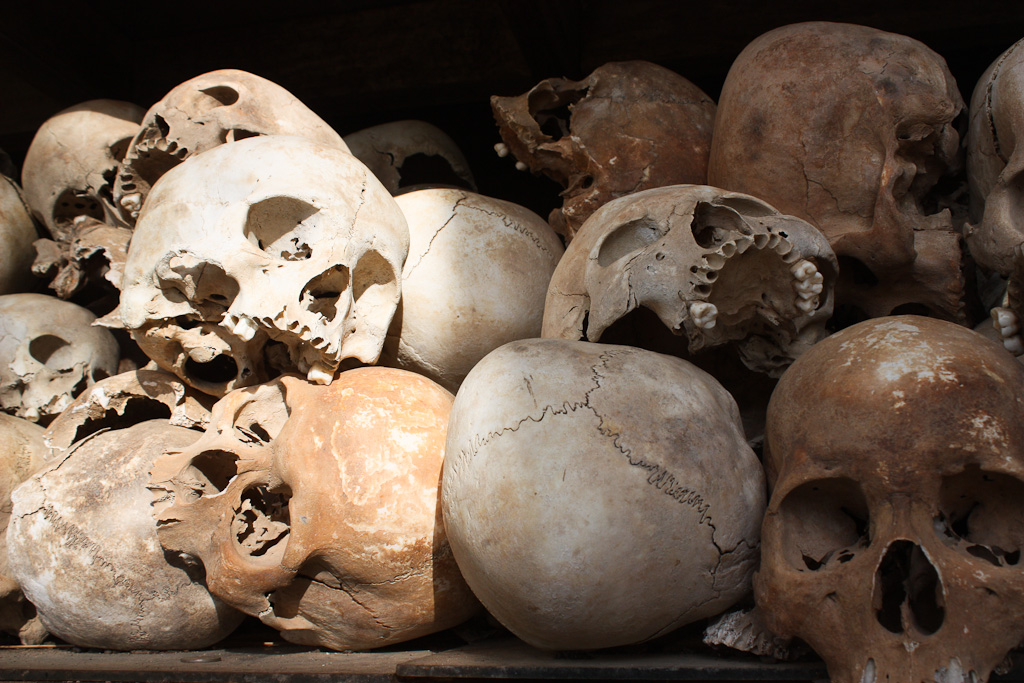
From the branches of a large tree hung a loudspeaker, whose increasing volume of sound served to drown out the moaning and shrieks of those being executed. Flowers were placed against a tree against which babies were slammed. Even on the pathways, fragments of cloth and teeth protruded from the ground. A glass Memorial Stupa erected in 1988 served as a very vivid reminder of the horrors that took place here. Spanning over 12 levels were the skulls of nearly 9,000 victims clearly visible for all to see. A large collection of clothing gathered from the graves, including a pair of a young child's shorts, further humanized the memorial. 

Tuesday, January 24, 2012

S21: From School to Prison


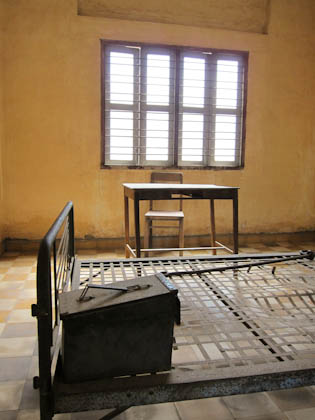
While in Phnom Penh, we visited a very sobering site known as S21. Just years after it was built as a school (Tuol Svay Prey High School), the Khmer Rouge transformed the site into a prison where "Enemies of the Revolution" were detained, tortured, and killed. Aside from the barbed-wire meshed fence covering some entrances and balcony openings on the second floor, it still retained the resemblance of a school. Upon entering a classroom, however, things  looked much different. In place of desks and chairs, several rooms contained a single bed, a box for bodily functions, and iron devices used to secure the hands and feet to the bed. Some also contained a chair and desk, from where a member of the Khmer Rouge would meticulously document about the current prisoner, including the torture process. 

In another room, large panels displayed the photos of some of the 12,000 -20,000 individuals that went through the prison. Amongst the stark black&white photos were the faces of children. Hanging on the walls of some rooms were large photos of the decomposing bodies of tortured prisoners still shackled the bed when the prison was liberated, with pools of dried blood staining the floor beneath. Corners of the rooms also bore signs of torture, as did the blood spatters on the ceiling. Going up a very normal school stairway, we walked though rooms subdivided into crude cells the width of a toilet stall and other rooms subdivided with bricks. 

According to our guide, the barbed wire covering the balcony openings was to prevent prisoners from jumping to kill themselves. In another room I read some of the excerpts written by the seven survivors, including an art teacher who believed he was answering the request for an art professor position. Of the two alive today, one was on-site, selling his book. One can only imagine the horrors he experienced within these walls.

Monday, January 23, 2012

National Museum, Phnom Penh


Our next stop was to the National Museum, located just north of the Palace. Although photography of most objects was not allowed, we did enjoy viewing the Hindu statues (some dating back to the 6th century), a statue of the leader responsible for some of the grandest structures within the Angkor period, and some post-Angkor Buddha figures. Wings of the museum opened to a central garden, complete with water gardens, tropical vegetation, and a Buddhist sculpture in the middle. Although the museum was interesting to look at and contained information in English, it would have had more impact had we come after touring Angkor Wat. 


Sunday, January 22, 2012

Royal Palace, Phnom Penh


With blue skies and pleasant sunshine, the morning started in a positive way by visiting the Royal Palace grounds in Phnom Penh. One of the dominating buildings in the well-maintained grounds was the Throne Hall. On top of the colonnaded concrete structure (replaced the wooden one built in 1866) was a tall golden spire with four faces, reminiscent of those at Bayon in the Angkor Thom complex. Another building, the Silver Pagoda, so-named for the 5,000 silver tiles each weighing 1 kg lining the floor, is equally popular. Carpeting covers most of the floor surface, so only a small number of these are visible. Two main Buddhas are found inside - the Emerald Buddha made out of Baccarat Crystal, and a life-size one made out of gold and decorated with over 9,500 diamonds. Within the palace grounds, I also enjoyed the extensive mural scenes depicting the Ramayana and the well-manicured bushes, some in the shapes of whimsical animals. 


Saturday, January 21, 2012

Off to Cambodia


For Christmas break, I traveled with two friends through the. Countries of Cambodia and Myanmar (Burma). I was looking forward to see the countries' ancient sites, natural beauty, and hopefully meet some local people. 

After flying from Chennai to Bangkok and then to Siem Reap, we left the cute airport there reminiscent of traditional Cambodian architecture and headed into the town to pass some time while waiting for the flight into Phnom Penh. Here we toured a workshop where village people learned apprenticeship for traditional crafts in wood and stone carving, painting on silk, lacquer designs, and tooling on copper.