Thursday, January 12, 2017

Sunrises (and Sunsets) of Arizona

With my time in Arizona setting like the sun, I thought it would be appropriate to dedicate this post to its sunsets (and sunrises). Although I've seen some beautiful sunset(rises) elsewhere, the dramatic colors and frequency of such brilliant displays seems to occur at a much higher frequency.

So what causes these brilliant skies? When the sun sets, light shines through more of the atmosphere, when compared to when the sun is higher in the sky. The light is bent, refracted, and reflected from tiny particles in that atmosphere. A lower frequency results in more warmer colors. 


Beyond the basic science, what makes Arizona's sunset(rises) so spectacular? Due to less moisture in the air, the clouds here are much higher. Such higher clouds reflect more light, with dramatic colors. 

With reduced levels of pollution, more variation in visible light can be seen, particularly those vibrant colors at the far end of the spectrum. It seems that dust (and pollution) actually diffuses or scatters color, resulting in a dull or muted sky. 


The presence of high clouds also greatly chances the chance of  dramatic sunset. These higher (and middle) clouds help intercept unadulterated light. 
I like how the higher clouds in the photo above reflected the orange color, making it appear as if those clouds were on fire.

For those willing to get up earlier and deal with the cooler early morning temperatures, the winter and fall months provide rewarding painterly effects.

Boo - back to the frozen tundra of Wisconsin!


Wednesday, January 11, 2017

Celebrating Western and Native American Art: The Eddie Basha Collection

When a friend of my parents recommended that we visit the Eddie Basha Collection, I wasn't sure what to expect. It was free, and the collection was in the corporate office building of Basha's, a supermarket chain in Arizona. Upon entrance into the first gallery room, I could see that this was not going to be a dusty collection with a few kitche pieces.

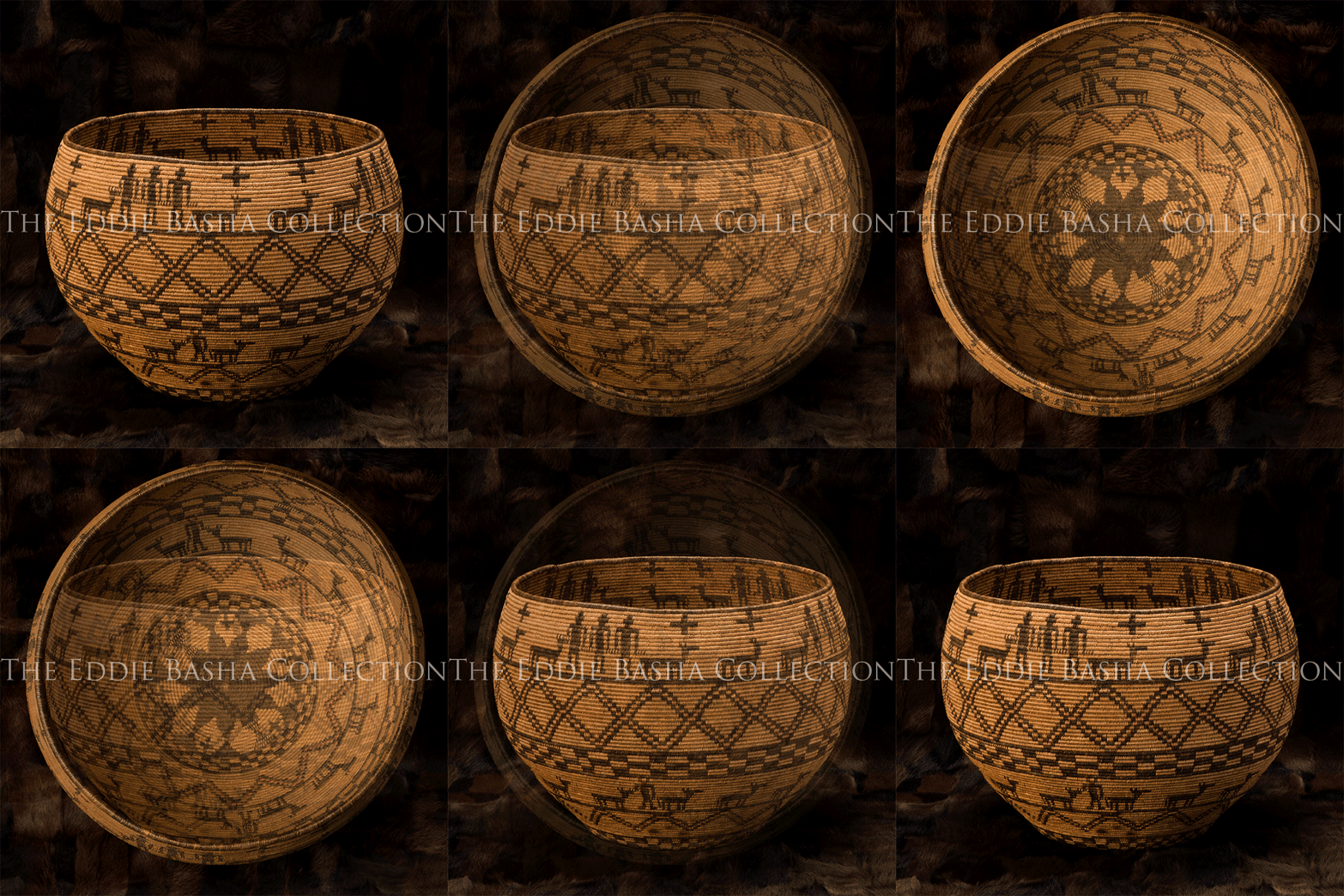
One room alone was dedicated to an expansive collection of woven baskets of varying sizes, mostly between the 19th and 20th centuries.
Apache baskets from the Eddie Basha Collection
Yet another expansive room was filled with over 40 years of over 3,500 collected pieces - paintings, sculptures, jewelry, katsinas, and drawings. 
Horse Pirates by Ted Long - Eddie Basha Collection
The collection is considered to be one of the largest private collection of Contemporary Western American and American Indian art. Originally encouraged and guided by his Aunt Zelma, Basha began visiting studios of contemporary artists, kindling friendships and supporting them. He sought to collect pieces of artists he actually met; cowboy artists such as Joe Beeler, John Clymer, David Halbach, and Martin Grelle, as well as contemporary American Indian artists such as David Johns and Larry Yazzie. Absent in his collection are deceased Western artists such as Charles Russell and Frederic Remington, since Basha wanted to focus on contemporary artists he actually met.
Geronimo by Harley Brown - Eddie Basha Collection 
Some of the pieces had rather lengthy descriptions. I especially liked the ones written by the artists, vividly describing historical events seen in the images.


Although we spent nearly three hours in the gallery, we did not have enough time to see all artwork. Actually, it was too much to see in one visit. Perhaps it would have been better to focus on one aspect of the collection, such as the bronzes one day, Native American pieces another day, etc.
The gallery is open to individuals or groups (above 25 people requires an appointment) but it is self-guided. We happily placed some money in the donation box, pleased that the proceeds helped support initiatives within the community, including the arts. 

The Eddie Basha Collection is located at:
22402 S. Basha Road
Chandler, Arizona 85248
Phone: 480-895-5230

It is open Monday - Friday 9-4 pm

Sunday, January 08, 2017

A visit with an Apache Family

This past weekend, we took a 3 1/2 hour drive from Apache Junction to the Fort Apache Reservation in the upper elevations of Arizona. While there, we had a special opportunity to visit an Apache couple. Bonnie is the kindergarten teacher at East Fork Lutheran School. Her husband Francis is an evangelist within the Apache reservation. 
Steps in making a cradeboard
First Bonnie showed us how she makes a cradleboard. The slats are made from the stalk of a yucca plant. For the canopy part, the wooden pieces are bnt through heat; sturdy wire is on the underside. The cradleboard fame is made from local wood and is bent with moisture. She uses foam for padding, but traditionally local fibers were used. 

Cradleboard with Cabbage Patch Baby
The baby was typically secured with two sets of ties; the lower pair could be loosened to change the baby's diaper without much disruption. Bonnie recalled that most infants were quite content within the cradleboard, finding the swaddling nature very comforting. Mothers either strapped the cradleboard over their shoulders or on their foreheads. This baby carrier enabled mothers to continue their chores while maintaining close contact with their infants.
Beaded Bolo Ties with Christian theme
Bonnie then brought out some beaded pieces; some were done by her, while many others were gifts to her and her husband. 
Jesus Wept bolo tie
Bonnie was especially proud of the Christian-themed bolo ties  - a beautiful indication of the Christian faith she and her husband shares. 


Burden Basket with family name

Bonnie also showed us a few other pieces, including a "burden basket" with the family name. Bonnie explained that the metal "tassels" at the ends once served as alarm signals. While the women were gathering berries or other items with the basket, if the metal began clanking excitedly, the men would know the women might be in some sort of danger (i.e. from warring tribes). 

With the football game completed, Francis joined in the conversation, sharing with us his experience coming to faith, as an evangelist to his community, and being a fan of the Green Bay Packers. Both shared some touching personal experiences and their concerns for their Apache brethren. When I later found out that our visit within the home on the reservation was quite unusual, I felt quite honored. Such a personal touch made the experience so much more powerful.

Monday, January 02, 2017

My latest Artwork: Bhunga and Bandhani, Gujarat (Color Pencil)


Here is my latest artwork, a color pencil composition of a Gujarat woman inside a Bhunga home in the Gujarat, whose walls were covered with mirror-work known as Lippan. She was wearing a heavy silver necklace, anklets, bangles, and gold earrings and nose ring. Her clothing is in Bandhani tie-dye. 

Friday, December 30, 2016

The Saguaros of Arizona

If there was one symbol that defined the Sonoran Desert of Arizona, it would have to be the Saguaro. (Yes, that's me in the photo above, hugging the saguaro. Not something I'd normally do, but this one's base was decaying and had lost its needles). 
Here are some interesting facts about the saguaro. Although the cactus can reach up to heights of 40-60 feet (12-18 meters), it is actually rather slow-growing. In its first 8 years of life, the saguaro might only be 1 1/2 inches (3.81 cm) tall. It often starts its life under the protection of an ironwood or mesquite "nurse tree." Once it begins growing, it absorbs the nutrients and water from the nurse tree, thus killing it. The Saguaro has a very shallow root system (4-6 inches), with one root stem going two feet. The root system typically is as wide as the height of the cactus. It can weigh up to 4,800 pounds (2,177 kg). 
A Saguaro typically grows its first "arm" at around 50-70 years of age. Up to 25 arms may be found on a saguaro. It first bloom appears around 30 years. At only around 125 years of age is it considered and "adult" saguaro. They generally die around 150-175 years of age, but may reach 200 years. Once the cactus dies, its interior woody ribs can be used to build furniture, fences, or roofs. 


Wednesday, December 28, 2016

Petroglyphs of Superstition Mountain

On this beautiful December day, we went on a hike in the southwest corner of Superstition Wilderness, a short ride east of Apache Junction. The well-traveled path took us past a wide variety of cactus, shrubs, and rock formations. Still within the Christmas break, people of all ages were returning from a hike - a good indication that the trail's rating of easy-to-moderate was accurate. 

As we neared the Hieroglyphics Canyon, the rocks on the path became larger and some climbing was needed. The sounds of rushing water mingled with the squeals of laughter and excitement of kids who were enjoying splashing in the water.

The petroglyphs, etched into the rock by the Hohokam Native Americans who lived in the area from 500-1450 AD. The dark desert varnish patina found on these rocks made an excellent surface for carving the imagery. (Early settlers mistakenly called them hieroglyphics in reference to those linguistic symbols in Egypt, but they are in fact petroglyphs, or rock paintings)

Some of the lower rocks also contained more modern carvings– or should I say, graffiti. 

Any symbolic meaning of the petroglyphs has not been determined. I saw what looked like snakes, lizards, and goats.


Sunday, December 25, 2016

Remembering our Savior

A blessed Christmas to all! Remembering the birth of our Savior on this Christmas Day.
For to us a child is born, to us a son is given, and the government will be on his shoulders. And he will be called Wonderful Counselor, Mighty God, Everlasting Father, Prince of Peace. 
- Isaiah 9:6 (NIV)

Saturday, December 24, 2016

Nativities Around the World

A few of the Nativity scenes on display in Mesa. Merry CHRISTmas!
Bali

France

Japan

Philippines

Scotland

Tibet

Zulu (South Africa)

Friday, December 23, 2016

Pizza and a Wurlitzer

This past week we went to Mesa for a double-treat; pizza and music. Our destination was Organ Stop Pizza. Waiting for our pizza to be finished wasn't a hardship, with plenty of awesome music to pass the time. From our balcony table, we had a good view of the veteran organist (who was named "Organist of the Year" in 2000 by the American Theatre Organ Society) who commanded mastery over the instrument and its plethora of keys, stops, and buttons. Being right before Christmas, he played plenty of holiday songs. It was amazing to hear him play Mannheim Steamroller's version of "Carol of the Bells" in such a way that he was nearly able to replicate Chip Davis' entire band. Nary a sheet music could be seen, as he expertly switched between a variety of music styles, rhythms, etc.

This is no ordinary organ. Known as a theatre pipe organ, this 1927 Wurlitzer was originally designed to provide background music for silent movies and stage shows. Once an integral part of theatres of every size, these orchestral organs (with plenty of theatrical sound effects) fell out of fashion when talking picture movies became emerged. This particular organ started with 15 ranks/set of pipes, but was rebuilt with parts from other Wurlitzers in the early 1970s to have 23 ranks. In 1997, it was further expanded and now has 78 ranks, 17 tuned percussions, lots of sound effects, and 6,000 pipes. Four large turbine blowers provide the needed wind. The walls of the expansive restaurant are adorned with the pipes and lots of different percussive instruments and lighting designed to complement the music. The curtain in front was opened a couple times to reveal dancing marionette-style cats - perfect for the song "Alleycats." The ornate organ was perched on top of an 8,000 lb rotating hydraulic elevator, enabling all to catch a view of the maestro tickling the keys.

Oh, by the way, the pizza was excellent as well.

Wednesday, December 21, 2016

Texas Meets Arizona

The Superstition Mountains of Arizona are quite picturesque and have many hiking opportunities and of varying levels of difficulty.
Despite less-than-optimal weather conditions, we went further on our hike and were rewarded with some pretty scenes.

Near the end, we saw several longhorn cattle freely roaming about within the park lands. It made me feel like I should have been in Texas! I wondered what the process was for rounding up all the cattle - and what precautions the ranchers must take to protect themselves against those horns. Somehow, within all those prickly cactus and scrubby bushes, the cattle (who looked very well-fed) must find enough to eat. Gosh, if that would have been the Holstein cows we had on our farm in Wisconsin....


Thursday, December 15, 2016

Artwork: Tuareg Couple Dancing (Color Pencil)

In anticipation of an art exhibition, I wrote a short story about each painting, as if written by the person in the painting. These are all real people, and the stories are based on experience, observation, and representative/factual information typical of someone from that region/profession. Some of these paintings are still available, so if you are interested in purchasing one, please contact me.
My husband and I have been invited to perform at the American Ambassador’s residence, along with fellow Tamascheck tribal musicians. Such events give me the opportunity to dress in my flowing Indigo robes and adorn my hair with silver pieces handed down from my grandmother. Most of all, it’s a chance to dance to the slow, flowing, repetitive melodies that are so much a part of our nomadic Saharan heritage. When I close my eyes and focus intently on the music, I almost forget that we are over a thousand kilometers away from our homeland. It is rather fascinating to see Westerners join in on the dancing or even give some of our traditional percussive instruments a try. In this way, we can share our culture with others far beyond our isolated desert village. 

See more artworks on www.melissaenderle.com.

Tuesday, December 13, 2016

Artwork: Kampong Phluk Woman with Purple Scarf (Watercolor)


In anticipation of an art exhibition, I wrote a short story about each painting, as if written by the person in the painting. These are all real people, and the stories are based on experience, observation, and representative/factual information typical of someone from that region/profession. Some of these paintings are still available, so if you are interested in purchasing one, please contact me.

Every week I take my basket of vegetables to sell at a small market  outside of Kampong Phuk. I look forward to this time, when I can gossip with my other friends who also spread out their goods to sell. It helps me forget, at least for a little while, all the terrible things I saw and experienced as a young woman when the Khmer Rouge extended their reign of terror over my homeland. It is nice to see smiles once again on the faces of children, who can play games and go to school instead of slaving away and seeing loved ones being killed. The money I make from my little garden isn’t much, but it’s enough for me to buy rice, fish, and a little oil. Today my sales were even better, enough for me to buy some chicken and even a Hello Kitty pouch for my granddaughter. I am happy again.

See more artworks on www.melissaenderle.com.

Sunday, December 11, 2016

Artwork: A Long Night's Catch (Watercolor)


In anticipation of an art exhibition, I wrote a short story about each painting, as if written by the person in the painting. These are all real people, and the stories are based on experience, observation, and representative/factual information typical of someone from that region/profession. Some of these paintings are still available, so if you are interested in purchasing one, please contact me.

I live in a densely populated fishing village in Besant Nagar, Chennai. During the December 2004 tsunami, the majority of the thatched huts in our village were either washed away or damaged. The wooden catamarans and fiberglass boats didn’t fare any better, and most had to be replaced. Even though we received funding to buy new boats and fishing nets, we were given no assistance in addressing sanitation issues. Our homes still lack access to clean drinking water, toilets, and drainage. Despite these challenges, the Christian faith of my family, which we can trace back to the apostle St. Thomas, enables us to remain optimistic. We know God is in control and will work even these challenges for our benefit.

See more artworks on www.melissaenderle.com. 

Friday, December 09, 2016

Warm Glow of the Saguaro

Yup, this is a far different scene from the last nature photo posted on Monday. I successfully escaped the Wisconsin winter (for a few weeks at least) and am down in sunny Arizona. This morning, I took this photo, just a short distance from the "silver" park where my parents stay for the winter. It's a lonely, single saguaro cactus with Superstition Mountain in the background, but it is what I could access on short notice. Within a few minutes of this photo, the warm glow of the sunrise was gone. 

Wednesday, December 07, 2016

Artwork: Haegeum Player, Changdeokgung Palace (Watercolor)


In anticipation of an art exhibition, I wrote a short story about each painting, as if written by the person in the painting. These are all real people, and the stories are based on experience, observation, and representative/factual information typical of someone from that region/profession. Some of these paintings are still available, so if you are interested in purchasing one, please contact me.

A lover of music, the prince has invited his guests into the garden area of Changdeokgung Palace for a concert. The other musicians and I sit on embroidered mats arranged on the grass between  the prince’s dwellings. With my legs in a lotus position, I balance the barrel of my instrument on my right foot and anticipate my entry with a hint of nervousness. Taking a deep breath, I rest my left hand over the neck and its two silk strings, while the right hand deftly grasps the horsehair bow. Easing a bit of tension, I gently glide the bow over the strings in order to create a delicate sound. Soon my haegeum is transported into a bird.

See more artworks on www.melissaenderle.com. 

Monday, December 05, 2016

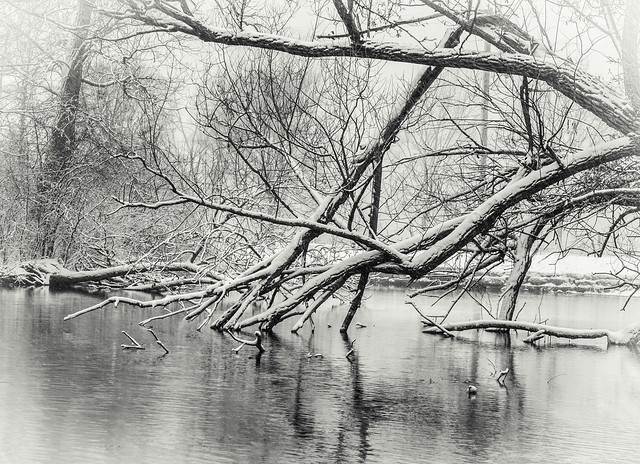
Into the icy water


Snow into the Water.jpg
What a difference a few months makes. Tenney Park is now a stark winterland, the branches of the fallen tree blanketed in snow and a bit timid about dipping its tips into the frigid waters.

Sunday, December 04, 2016

Artwork: Rabari Farmer, Gujarat (Watercolor)

In anticipation of an art exhibition, I wrote a short story about each painting, as if written by the person in the painting. These are all real people, and the stories are based on experience, observation, and representative/factual information typical of someone from that region/profession. Some of these paintings are still available, so if you are interested in purchasing one, please contact me.

Greetings, a blessed Ram-Ram to you! After a long, hot day in the sun with my sheep, goats, and a few water buffalo, I walk along the dusty path that will take me to my village. It’s amazing that my white tunic isn’t dirtier! The lack of rains requires my herd to walk even further in order to find water and grazing land, and now . With the support of my fellow Rabari clan and blessings of the gods, somehow we will persevere through the oppression of industry and capitalization.

See more artwork on www.melissaenderle.com.

Thursday, December 01, 2016

Thai Village Handmade Crafts: Sewing for Sustainability

The other week when walking up the stairs at church, I noticed a colorful display of handicrafts.  Couldn't pass that up, now could I? In front of me were well-crafted handmade jewelry, bags & purses, an adorable stitched Noah's Ark, tin ornaments, and much more. The embroidery designs were characteristically Hmong, reminiscent of what I had seen in Thailand and Myanmar.

 A young woman standing nearby told me more about the non-profit organization based in Thailand and initiated by WELS Kingdom Workers. She shared with me a brochure which stated the mission: "Through the production of handicrafts, we seek to develop long-term relationships with artisans and encourage self-sufficiency by providing opportunities for vocational training, Christian education and higher education, made possible by not-for-profit sales." The organization also helps support community health and development, literacy and children's programs, and Bible education.

Bible Cover - Hmong design
Each item is designed and produced by local Thai artisans who earn living wages in fair-working conditions. The products are a team-effort, involving several people to create each piece. 100% of each donation is tax-deductible as a charitable contribution.
Over my years of traveling internationally, I have sought out cooperatives and other organizations that promote self-sustainability, empowering and training locals and promoting their unique crafts. A win-win for all!
Hmong Coin Purses
Nativity Set 


If you're looking for a unique gift or simply want to donate, check out the Thai Village website