Thursday, March 20, 2014

Korean Traditional Dance: Buchaechum


Buchaechum (Fan Dance)
Known as the Fan Dance, Buchaechum is perhaps the most famous of Korean dances. This beautiful dance utilizes large fans, forming patterns such as a sea wave, butterflies, mountains, and a flower in full bloom. Originally part of a shamanistic nature rite, it has evolved into a highly refined national dance. 

Tuesday, March 18, 2014

Traditional Korean Dance: Kanggang-Suwollae

Kanggang-Suwollae, meaning Moon Dance, traditionally took place on the full moon of the first and eighth lunar months. At this time, women, wearing a blouse & skirt and hair tied back with ribbons, gathered in the field and joined hands to sing and dance. Performed only by women, the dance sought to bring about a good harvest. The dance begins rather slowly incorporating a solo call and choral response,  but the pace quickens to a whirlwind pace at the end.

Sunday, March 16, 2014

First Signs of Spring: Violets

What a beautiful day in Seoul for a walk. Such temperatures might help coax rather dormant-looking trees and ground to bear forth blooms and blossoms. These violets are the first flowers I've spotted this spring. Can't wait for more!


Saturday, March 15, 2014

Traditional Korean Dance: Gaseum ei pin ggok

Gaseum e pin ggok (A Flower bloomed in your heart)
This information comes from the handout received at the dance performance. 
Movements in this dance are meant to imitate flower petals fluttering through the air. In the performance I witnessed, it was danced as a solo. 

Thursday, March 13, 2014

Traditional Korean Dance: Samgo-Mu


Samgo-Mu (Three Drums)
A very energetic dance, it is a popular crowd-pleasing performance. The three drums are arranged in a way that the drummer can hit all of them while dancing. I've seen this dance several times, and enjoyed seeing the syncopation and flexibility of the drummers as they bend backwards to hit the drum in back. In Sangmo-Mu, the beat gets progressively faster and stronger as it reaches the end of the song. Despite the graceful costumes, these performers show their strength and percussive oomph. This court dance originated in the Goryeo Dynasty and celebrates victory.

Tuesday, March 11, 2014

Traditional Korean Dance - Gakshi

Gakshi (or Gaksi?)
Danced as a duet, Gakshi is a reminiscent of a traditional puppet dance. Interactive movements are performed to the cheery and rather fast-paced music.

Sunday, March 09, 2014

Traditional Korean Dance - Geommu

In the next few posts, I'll feature some different types of traditional Korean dances I've seen. 
Geommu (Knife Dance)
Performed with a short, dull sword, Geommu is a militaristic, but graceful traditional Korean dance. The costume, particularly the sleeves, is to be in harmony with the dancer. Traditional Geommu hanbok costumes are blue, black, red, yellow, and green. Although the legend seems to originate around 660AD with a boy performing his beautiful sword dancing in front of the court, this court dance typically is performed by 6-8 females.

Monday, March 03, 2014

Yearning for Spring

Now that it's March, I anticipate the coming of spring with not-so-patient anticipation. On my walk, I scanned for signs of spring. A few small green plants starting to peek up through the fallen leaves, but mostly the ground and trees look brown and bare. How much more beautiful the scene from this pavilion would have been with some spring blossoms. Guess I'll have to wait several more weeks yet for any action.

Saturday, March 01, 2014

Part of the Korean Walking Gear

Walking and hiking is a favorite past time for Koreans. I love to see people of all ages out in the nature around Seoul for their health, and not just sitting in the many coffee shops. In addition to the prerequisite special hiking jackets, walking sticks, back packs, and hiking shoes, many Koreans have added another item to their walking gear - the dust mask. For most of this past week at school, recess was canceled, due to high levels of dust and pollution in the air. During the few recess times the kids were able to get out, pint-sized masks donned a number of their faces. China had another terrible week of unbreathable air, and some of this comes on down to Korea.

Pollution is everyone's problem.

I also checked the air quality prior to going on my morning walk. Some hikers were wearing their masks, while this woman carried hers as she ascended up the gentle slopes of Amnsan mountain. 

Friday, February 28, 2014

Celestial Beings and Trompe l'oeil

These angelic-like celestial beings appearing on the Bongwonsa Temple are similar to those I've seen on other Buddhist temples in Korea. I like the combination of relief woodwork along with the mural paintings. The wooden column has a nice example of a Trompe 'oeil effect, made to look like an actual curtained fabric.

Wednesday, February 26, 2014

Celestial Snowy Scene

Yet another white sculpture found at the Bongwonsa Temple in Seoul. Leaving it up to my interpretation, it looks like a goddess on a lotus calmly subduing a beast. I'd love to hear the actual story.

Monday, February 24, 2014

Exaggerated Buddhist Faces


Amongst the row of sculptures at the Bongwonsa Buddhist Temple in Seoul, I found these three particularly expressive. I'd love to hear the story behind the figures and the reasons for their exaggerated expressions. They'd make a great creative writing stimulation and are wonderful examples for art students studying figure drawing. Seeing the snow piled up on them, I'm sure some captions involving the seeming never-ending winter season could be penned by some suffering Midwesterners of the USA. What would you write?

Thursday, February 20, 2014

Behind the Layers

Bongwonsa Temple, Seoul
Although I find the highly intricate paintings on temples to be exquisitely beautiful, the faded scenes also attract my attention. What stories do these flecking paints or stained surfaces have to tell us? How do the processes of pigment application vary from when the murals were first created? What devotion the artists must have had, painstakingly rendering each detail. What would they think to see their designs all faded away?
Thanjavur Hindu temple, India

Tuesday, February 18, 2014

Sunday, February 16, 2014

Winter at Bongwonsa Temple

The freshly fallen snow enhanced the tranquility of the scene at Bongwonsa Temple in Seoul. An easy hike from my school, I love how the area transports me to what feels like a totally different area.


Friday, February 14, 2014

Snowy Gold and Sunflowers

This cheery Buddha sculpture greeted me as I walked by on a pretty Sunday morning stroll. A bit odd to see the equally golden sunflowers all snow-covered as well. Definitely not a scene one would see in Thailand.


Monday, February 10, 2014

Can't Forget the Cow

Although not one of the masked Hahoe performers in Andong, I believe that the cow deserves some attention as well. This character in the performance (actually made possible by two performers) is quite straightforward. It meanders about near the beginning of the performance, even stops to take a bathroom break, and unfortunately succumbs to the knife of the butcher. 

Sunday, February 09, 2014

Kaksi Mask, Korea

The final Hahoe mask I will write about is Kaksi (or Gaksi). She represents a young newly-married woman. Still a common practice in Korea, she lives with her in-laws, where she must be humble, discreet, and non-judgmental towards her new family. The only masked Hahoe figure to have firmly closed lips, this connotes her need for endurance during those first challenging years of marriage. With slightly downcast eyes and gentle twisted hair, she walks with light, but unwavering steps. Kaksi is the only Hahoe mask to be portrayed in a more heroic, non-hypocritical manner.
Read more about Kaksi and other Hahoe masks at the Hahoe Mask Museum website.

Friday, February 07, 2014

Sonbi Mask, Korea

Another one of the traditional Hahoe masks from Korea is Sonbi (or Seonbi). A scholar of noble heritage, the stern looking Sonbi is seen in the performance squabbling with the aristocratic Yongban over which had the higher status. Its bulging eyes indicate excessive reading, and the high checkbones and hollow upper lids connote someone who is so absorbed in his studies he couldn't look after his household. Hollow cheekbones are typical of other masked figures who have hardship, but Sonbi's are somewhat intentional and self-inflicted due to his complex thoughts. Overall, his look is one of personal dissatisfaction. In the play, Sonbi competes with Yonban over wooing the woman Pune.

Read more about Sonbi and other Hahoe Masks at the Hahoe Mask Museum website.

Wednesday, February 05, 2014

Choraengi Mask, Korea

Yet another one of the twelve original Hahoe masks is Choraengi. A servant of the aristocratic Yongban, Choraengi is haughty and disrespectful towards his master. Its protruding brow is symbolic of one who is obstinate, and its short wrinkled nose is indicative of one who is unable to accumulate property and is quick-tempered. Choraengi also has hollow-looking cheeks (much like Halmi the old woman and Sonbi), indicating a life of hardship.
Read more about Choraengi at the Hahoe Mask Museum website.

Monday, February 03, 2014

Paekchong Mask, Korea

Paekchong (or Baekchong) is the butcher in the Hahoe mask performance. Like other societies, its meat-handling profession put it in lowest class in Korean society. Its facial features including pointed eyes, furrowed wrinkled brow, protruding lip, cheek lines, and an overall rough look connotes a certain amount of wickedness and ruthlessness. Like the Chung (monk) mask, the character has a small lump on its forehead, connoting gloom. However, Paekchong does feel guilt for the taking of life. In the play I saw, Paekchong battled with the cow, killed it, promptly butchered it and removed the heart and testicles, which he first offered to the audience and then sold to the Yangban character.

Saturday, February 01, 2014

Imae Mask, Korea


Imae, a servant of the aristocratic character Seonbi, is depicted as the village idiot or fool. Good natured (symbolized by drooping eyes), Imae bears the brunt of his master's temper. Just as Imae's nose is crooked, other parts of his body are deformed, including a limp arm and twisted leg. Although Imae's disabilities were much more pronounced, other Korean masked characters also include illnesses and deformities. Unlike many of the Hahoe masks, Imae is missing a lower jaw. According to legend, the original mask maker Ho died while making the Imae mask, leaving it incomplete.
Read more about Imae and other masks on the Hahoe Mask Museum website.

Thursday, January 30, 2014

Chung Monk Mask, Korea

The Chung (or Jung) mask represents a monk who has wandered and transgressed. Without financial status and likely no children, the apostate character also has a lump on his forehead, often associated with gloom. However, when he saw Pune (she was urinating), he became turned on and later on even abducts her. With his wide, scrunched nose, squinty eyes, and wrinkled forehead, Chung is depicted as being sly, lewd, and lustful. Even his jerky steps connote deceitfulness and cunning behavior.
Read more about Chung mask on the Hahoe Museum website.

Tuesday, January 28, 2014

Pune Mask, Korea

The Pune (or Bune) Hahoe mask from Korea is historically seen as a widow. With a gentle smile hinted at by the mouth and eyes, as well as crescent-shaped eyebrows and a thin high nose, the Pune depicts classical beauty according to traditional Korean standards. She is usually seen in performances with the Yongban and/or Sonbi, who boast of their high status and education in order to seduce her. Through actions and gestures (the character never speaks), Pune is somewhat flirtatious.
Read more about Pune on the Hahoe Mask Museum website.

Sunday, January 26, 2014

Yangban Mask, Korea

Prompted by a request from a friend about Korean masks, I decided to devote the next few blog posts on the topic. Featured here is the Yangban mask. This masked figure represents the aristocratic class during the Joseon Dynasty. With its happy, gentle expression, this wooden mask with a hinged jaw is perhaps the most popular of the Hahoe style masks.  When watching the Hahoe mask performance at Andong, the masked actor seemed to portray a slightly haughty disposition. The depiction of the aristocrat connoted in a somewhat mocking way that this higher class should be a bit more humble and approachable. Read more about the Yangban and other Hahoe masks at the Guide to the Hahoe Masks and the more academic writing from the Hahoe Museum.

Thursday, January 23, 2014

Rusty Gears and Weathered Paintbrushes

Here's a set of sculptures from the same hotel as the previous post. I love it how the artist took objects most would discard and combine them to make whimsical sculptures. In working with kids, some of their favorite projects have revolved around using recycled, discarded, or even "junk" materials to make their own creations. Giving them more freedom and less direction often resulted in the generation of high degrees of enthusiasm, creativity, and problem solving - and great finished projects. Kids began looking at "junk" in whole other ways after that. Now if only storage of these "precious" potential objects was unlimited....

Tuesday, January 21, 2014

Robotic Kimchi

When walking around at a hotel near Suncheon Bay in Korea, I spotted this cute sculpture made from recycled materials. Its head was formed from an item found in every traditional Korean home - the kimchi pot. So even after the pot outlived its useful years as a fermenting & storage vehicle for the favorite Korean dish, it now continues to bring smiles to passers-by.

Sunday, January 19, 2014

Weeping Winter and Spring Tree

Although not the exact same angle, these two photos show the willow-like trees in front of Gyeonghoeru Pavilion at Gyeongbokgung Palace in Seoul. Both views have their own tranquil beauty. Having lived in India for the four years prior, it was a while since I saw a frozen body of water. If the pond had been in Wisconsin, there may have been fishermen eager to get their ice fishing gear on the ice. Here in Seoul, the frozen pond was undisturbed, just as the still waters of the spring scene.


Friday, January 17, 2014

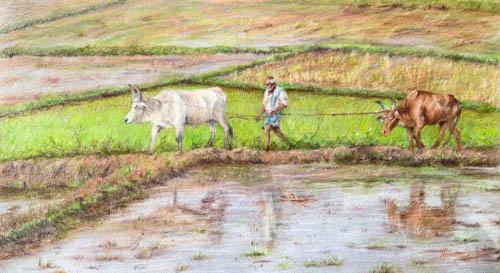
Through the Paddy Field

Through the Paddy Field
Color Pencil
by Melissa Enderle

Paddy fields such as this are very common in South India. I loved seeing the brilliant green of a lush field. Each paddy is rather small and is bordered by a raised mound of dirt. In this color pencil drawing, a farmer leads two of his cows on the narrow raised border of a Tamil Nadu field. Distorted, but discernible reflections of each is found in the flooded field in the bottom portion of the drawing. Measuring only about 24x44 cm, this rather small drawing made it a bit more challenging to render the figures. It did fit well into my suitcase back to Korea though!

Wednesday, January 15, 2014

A Bush for the Seasons

One of the nice things about photographing places in the city in which you live is that you can get similar shots at different seasons. Here we see the pavilion Hyangwonjeong, located on a small island at the Gyeongbokgung Palace in Seoul. Although both scenes are beautiful, I much prefer the spring season.


Monday, January 13, 2014

Friday, January 10, 2014

Snow-Covered Chimney

Now covered with a fresh layer of snow, this chimney next to a palace building in Seoul would have likely looked a bit different when it was being used. Fueled with wood, the floors of this building would have been kept toasty warm even during the cold Korean winter. 

Wednesday, January 08, 2014

Rippled Beauty

The snow blankets the tiled rooftops of a residential building in the Gyeongbokgung Palace in Seoul with beautiful ripples of white. Quite a contrast to the colorful patterning of the rest of the building.

Saturday, January 04, 2014

Gathered Garlic and Flattened Fishies

Markets are one of my favorite places to photograph. Although these images lack the color of many produce stands, I found the arrangements of these two staples of the Korean diet to be dynamic and attractive. 


Thursday, January 02, 2014

Happy New Year - Tamil Style

When teaching in Chennai, the capital city of the southern Indian state of Tamil Nadu, I particularly enjoyed walking the streets during main holidays. On such special occasions,  the daily white rice flour kolams rendered by women In front of homes and some businesses were replaced with colorful designs. On particularly important festivities such as Pongal (harvest festival) and weddings, the particularly large kolam might extend well into the road as well. In the photo above we see a woman working on the kolam she made for New Years. 

Tuesday, December 31, 2013

Gate to the Beyond

For those privileged enough to enter the palace grounds at one of Seoul's palaces, areas that lay beyond certain walls and gates were off limits, except to a very few. Most would have to leave what lay beyond those gates to the imagination and descriptive tales passed on by others. So it is with our lives. As we close up another year and look forward to the next, our future is largely unknown to us. By trusting God who is firmly in control of our lives, I know that the events yet to come will be for our good and His glory.

May all of you have a blessed New Year!

Monday, December 30, 2013

Buddhas and Persimmons

I found this collection of Buddhas behind one of the temple buildings at Bongjeonsa Temple near Andong, South Korea. Behind the colorful and often jolly figures, some fruit including, an Asian pear and persimmon, was carefully placed.   

Saturday, December 28, 2013

Winter Sunset, Wisconsin


Winter in Wisconsin often means grey, overcast days. On those days where it is clear and sunny, bitter cold often accompanies the brightness. Yesterday it was both sunny and pleasant (for Wisconsin winters). The beautiful day was followed by a colorful sunset, which I photographed from the balcony of my condo.