Saturday, September 29, 2012

The Burning of the Souks

The struggle in Syria has now claimed another victim - the ancient souks of Aleppo. Reports are that between 700 and 1,000 of the small shops that have made its commercial and cultural space within the narrow walls of the souks, named as a UNESCO Heritage site, have been burned. Souks, comprising of shops, mosques, homes, and other places so vital to everyday life, are the heart and soul of ancient Arab cities. In Tunis, I loved wandering the medina, enclosed at one time by fortified walls. Wandering through the maze-like streets (with plenty of dead-ends) gave me a chance to catch a glimpse of what it must have been like for centuries, when the main commerce and life took place within these walls. Some traditional crafts were only produced within special lanes within the souks. When you were tired of shopping, you could always find a cafĂ© where you could catch a sweet mint tea topped with pine nuts. Not only did Syria lose some architectural treasures within the walls of the souks, it also likely lost some cultural and artistic gems as well. I pray that some sort of stability and normalcy will return soon to the people of Syria, who have been victimized for all too long. Now there will be more to rebuild - if these heritage areas can rise up from the ashes at all. Read more in the BBC article.

These photos are taken from the Tunis souk. On top is a shop making traditional chechia hats so typical of older Tunisian men. Below is a basket shop found near the main mosque in the medina.

Thursday, September 27, 2012

Precious Peaches

For the harvest festival of Chusok, boxes of fruit are a common gift. Judging from these prices, these carefully wrapped items are indeed a precious gift. The four cantaloupe are going for 55,000 won - $50. The box of 16 apples is double that. Gosh, for those prices, I'd almost be afraid of eating them! So if you get a box of artfully wrapped fruit in Korea, you know you're special. Happy Chusok! 


Tuesday, September 25, 2012

Gwanghyewon, Korea's first modern hospital

On a beautiful fall afternoon, I went for a walk around Yonsei University, located next to Seoul Foreign School where I teach. The gate to some traditional looking buildings was open this time, so I went on in. Nestled in the protection of the tall modern structures belonging to the university and Severance Hospital was Gwanghyeon, Korea's first modern hospital. Founded in 1883 by a Presbyterian missionary, the graceful structure fell into disrepair and was restored in 1987 as part of the university's centennial commemoration project. 


Sunday, September 23, 2012

Ganesh Chaturthi - Seoul-Style

Having read my Facebook post about how different this weekend's cultural experience (seeing the musical Wicked) was from that which took place a year ago (Ganesh Chaturthi in Chennai), a colleague asked if I wanted to go with her to a Ganesh celebration one of her students had told her about. Boarding the back of her scooter, we proceeded down the fairly quiet Sunday morning streets of Seoul until we reached Seoul National University. As we were nearing the building, the number of salwars and saris was a good indicator that we were on the right path. Inside the lecture/performance hall, I was suddenly transported back to India, with women and children (and some men) donning their Indian garb. In one corner of the stage a Brahmin priest from the Mumbai area was chanting some Sanscrit verses, while another priest and a priestess rang the small bell and whisked the multi-wicked lamp around the decorated ivory idol of Ganesh. Around Ganesh were many plates of fruit, sweets, milk, and some roses. Not the elaborate floral decorations of India, but they would have to do. After more chanting and pujas, Hindu devotees came up to pay homage to Ganesh. I stayed for a bit longer, watching some Indian children do some simple dances, recite a poem, some chanting, a very boring speech, and some more chanting. None of the women wore fresh garlands of jasmine in their hair; a couple girls had a white fake set. A meal was to follow (at some point), but knowing that the event was on "Indian Standard Time," I wanted to get home to do some drawing.

From talking to some of those sitting near me, it was apparent that keeping their Hindu culture was important to them, but fairly significant challenge in a place like Korea. Most parents are sending their children in Korea to top international schools, which typically happen to be Christian ones. Interestingly enough, the parents didn't seem to be concerned about having to send their children to a Christian school (as this is a very common practice in India), but that their children were growing up knowing very little about their own culture, traditions, and religion. The small Indian children's group of which the performing children were participants is a helpful part in addressing this, but does not make up for the permeating cultural influence families would have experienced in India. Boring speeches and less-than-smooth performances aside, I hope that the children in the audience had their curiosity at least a bit piqued about some elements that are so much of their tradition.
For those families who are living overseas (especially in cultures so different than their own), how do you seek to ensure that your children experience and understand some vital parts of your traditions, culture, and beliefs?

Friday, September 21, 2012

Rooftop Palace Figures

Perched on the roof of Geunjeongjeon Hall of the Gyeongbokgun Palace are some simplistic, whimsical creatures. As in other palaces, the Japsang are small animal statues that guard palace buildings against evil spirits and ghosts. I wonder if each of these creatures have a name?


Wednesday, September 19, 2012

Haetae - Fire Beast

Prominently featured in front of the Gwanghwamun Gate are several large Haetae figures. Resembling a dog with a lion's mane, this mythical creature is the master of fire and a guardian against this element. Its powers include time travel and the ability to bite the moon, hence causing the waning of the moon or even an eclipse. Haetae sculptures are often placed in front of or inside Korean houses as a protection against destructive natural elements.

Monday, September 17, 2012

Gwanghwamun Gate Procession

Although the Gyeongbokgung Palace was not our destination for the day, our timing to arrive in front of it was impeccable. As if to welcome us, the flag-bearing guards and musicians stepped through the main gate to put on a procession right in front of us. After a few short minutes, the demonstration was done and the brightly clad men marched back into the palace grounds.

Friday, September 14, 2012

The Tunisia I know


These are the memories of Tunisia that I have - the white-washed buildings with blue doors and bougainvillea. Wandering the ancient medinas of Tunis, Sousse, and elsewhere. The clear blue skies and Mediterranean Sea. Its amazing history, as evidenced in spectacular Roman and Byzantine mosaics, coliseums, and aqueducts. Freshly harvested olives and dates. The pit dwellings of Matmata and the vast desert south. Its people, welcoming and warm, graciously serving sweet tea topped with pine nuts. While the majority of Tunisians call themselves Muslim, a much more moderate version was practiced - sometimes more tradition than anything. It was a country that had banned the burqa, with many of its women choosing Western wear and showing off their thick black hair. A favorite vacation destination for French and other Europeans, freely able to relax on the beaches of resorts in their bikinis. A country that was site to many prominent films, often serving as a safe alternative for Middle Eastern country scenes. I remember when the school added extra security measures and even had us practice safety drills, but a bigger concern for members of the ACST community that year was flooding, which affected the school several times. During the two years I was at ACST, the school doubled in size, much of it due to the African Development Bank moving its headquarters from Abidjan (Cote d'Ivoire) to Tunis to have a stable place for operating.

Ten years later, I am sitting in my apartment thousands of miles away in Seoul, Korea. The Tunisia I know looks very different from what just happened at the embassy and nearby school. From my experience, this sounds like the actions of a few radicals, representing a minority or perhaps even led on by outsiders. I pray for the safety of all my friends that still are in Tunisia and that peace, stability, and normalcy will soon return. 

These are two of my artworks, the top being an oil pastel of a scene in Sidi Bou SaĂŻd and the lower one a color pencil drawing of a man in the medina in Sousse.

Thursday, September 13, 2012

Stroll Through the Side Streets

Instead of leaving Korea during the Chusok holiday, I will be staying in Seoul. I'm looking forward to visiting some of Seoul's palaces, museums, as well as strolling through the small streets such as this one in Insa-dong. Seoul may be quite modern now, but you can find some traditional places if you look.

Tuesday, September 11, 2012

Monday, September 10, 2012

Bukak Pavillion

On top of the Bukak Mountain in Seoul stands a pavillion with a traditional Korean design. From here, one has great views of the city. Much like the Hindu temples of Tamil Nadu (south India), I am in awe of the decorative detail work and colorful, aesthetic design of these buildings. Even in the dark, I just had to shoot some photos. 


Saturday, September 08, 2012

Birthday Celebrations Above Seoul

It's amazing where international teaching can take you. One year ago, I certainly didn't expect to be in Seoul, but here I am! Since it was my birthday yesterday, I decided a photo of me was in order. This photo was taken on the Bukak Skyway, which offers beautiful views of Seoul.

Friday, September 07, 2012

Shopping in the Sports Stadium

This is one sports stadium that the women frequent more then men. Although it was built as a stadium for the 2002 Soccer World Cup with a seating capacity of over 66,000, it now houses a 10-screen cineplex, a large discount shopping store, and numerous smaller shops. 

Thursday, September 06, 2012

Locks of Love

Want to publicly profess your undying love for someone while in Seoul? Come to the Seoul Tower, which has evergreen trees and a special wall just for you. As you attach your lock with its message written on it, take a peek at some of the notes already present. Some of the locks were getting rather rusty. I wonder what a rust-eaten attachment signifies. 


Kimonos and Fans

Shops like this are a good indicator that this area of Seoul - Insa-Dong - is frequented by tourists. At least these souvenirs are flat and lightweight. Although I'm sure I'll find some nice momentos for family members here in Korea, I am pretty confident that the variety and quantity won't be equalled by what I found in India. Finding the right gift can be a challenge. It's a good thing I have plenty of time yet before I head back to Wisconsin for the summer. 

Tuesday, September 04, 2012

Wonder Woman Meets Seoul

Somehow this circular sign of Wonder Woman, hanging above a shop in traditional Insa-Dong doesn't quite fit, particularly next to the sign with cute kids. I wonder what she is saying in Korean.

Sunday, September 02, 2012

Minis on a Line

I couldn't resist taking a photo of these miniature crocheted clothes, so lovingly hung from a jute "clothesline" and attached with equally miniature clothespins. The shop in Insa-Dong was closed at the time, so I couldn't go in and take a closer look. I wonder what the story is behind these items....

Saturday, September 01, 2012

Kimchi Traditional Storage

While in the Insa-Dong neighborhood of Seoul, our long-time Seoul resident (a teacher who lived in Seoul with her missionary parents since childhood) pointed out this ceramic pottery set, located next to a restaurant. This, she explained, is a traditional jar in which Korea's national dish, Kimchi, is stored. Such preserving storage was especially advantageous during the winter months. For those of you uninitiated to Korean cuisine, Kimchi is a fermented vegetable dish, mainly comprised of cabbage. It comes in (according to the Kimchi museum in Seoul) 187 different varieties. Not a big fan of the pickled taste, the I've tasted so far haven't sparked an enthusiastic awakening of taste buds, but I'll try some more. Couldn't say to a Korean that I'm not a fan of their favorite dish! 

Thursday, August 30, 2012

Mega Calligraphy

Located at the beginning of the walking street in the Insa-dong section of Seoul is this giant calligraphy brush sculpture. It even comes with a shiny "ink" blot. It signifies the still-present ancient artform, for which one can buy supplies (horsehair brushes, handmade paper, ink, etc.) in small shops in the area.

Tuesday, August 28, 2012

Korean Proud

Koreans are a proud nation. Photographed here are two well-known symbols - the Korean flag and postcards of famous movie stars. What symbols of your country would one find in a souvenir stand?

Sunday, August 26, 2012

Onions in the Alley

Making an onion transaction in the old part of Seoul known as Insa-Dong

Thursday, August 23, 2012

Styrofoam Seafood

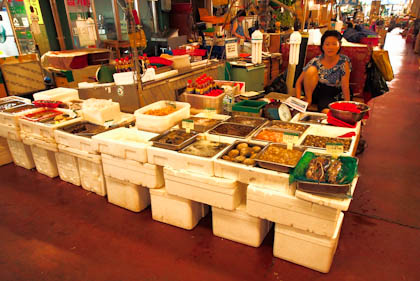
At a local market a few bus stops from school, one can find the fresh fish and seafood section. We arrived later in the afternoon, so many of the stalls were already winding down. It was interesting to see their wares displayed in styrofoam-stacked containers. 

Tuesday, August 21, 2012

Beyond the Hill

Once down the hill from school, a whole new world awaits. Getting to explore different streets is my reward for braving the hill. Beyond the main streets where stores dominate are the residential ones. I enjoy looking at the gates. Here we have an aesthetic combination of decorative gate, brick wall, modernistic house, and the pink soft blooms.

Sunday, August 19, 2012

The HILL

Our school is up on a hill. At one time, it was a cemetery, but it has since been removed. The site offers great view of the city below, but gives one second thought before schlepping stuff when walking back up. Walk up and down (perhaps a few times) this hill, and you have a nice cardio workout. 
There is a grocery store within walking distance, but many teachers choose items at the store and then take advantage of the free delivery. 

Somehow these photos don't quite capture the steepness of the hill, but hopefully you'll believe me anyway.

Bottom of the hill, right by Chicago Pizza (which I hear doesn't really taste like Chicago-style pizza)

Up the first steep portion, looking down. Can't even see the bottom.

After the middle section which gives a short respite, the second steep portion by the school (see the guard's pagoda and the red-striped school building) is yet to come.

To reach the apartments, there are more inclines to go. My apartment building is on the right, pictured here.


Yongsei University, Seoul

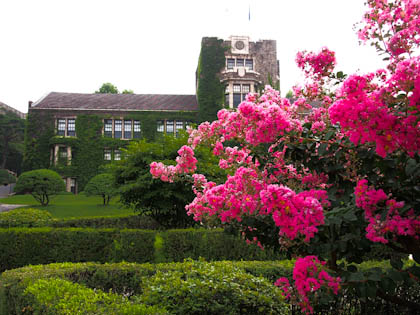
Down the slope of the hill from Seoul Foreign School is Yongsei University. Here we see a brilliant pink flowering tree in front of one of the university's Tudor-style buildings. It's a pleasant walk though well-maintained grounds. I anticipate taking many walks through this campus in different seasons.

Friday, August 17, 2012

Ewha Women's University area - shopping for shoes

Like in most countries, Korean women love shopping for clothing and shoes. The area around Ewha Women's University is no exception, boasting of streets lined with clothing, shoes, and accessories particularly geared towards the female gender. With such a large display item and color to match, no doubt the store next to this mega shoe beckons the average female in search of footwear. Too bad they don't carry my size...

Monday, August 13, 2012

Lotuses at the Bongwonsa Temple


Adorning the grounds of the temple complex were large pots containing lotuses. These were brought here for a special lotus festival. A very common symbol in both Hinduism and Buddhism, it represents spiritual perfection, mental purity, enlightenment, and wisdom. The beauty of the buds, greens, and blooms definitely enhanced the beauty of the place.


Sunday, August 12, 2012

Bongwonsa Temple - Destruction and Reconstruction


Although the Bongwonsa temple was founded in 889 AD, wars and fires resulted in the destruction of several subsequent temples. The main Judgement Hall was built in 1994. Inside this building, some of the 50 resident monks were engaged in a ceremony. A smaller building contained white ceramic oil lamps, neatly arranged. Yet another contained statues of several male figures with pointed beards. Photos of people (perhaps deceased) lined the altar. From the ceiling, papers containing what I presumed were written prayers dangled from the ceiling. 


Saturday, August 11, 2012

Bongwonsa Buddhist Temple


Although it was hot and very humid, a group of colleagues from school went for a hike to visit a nearby Buddhist temple. Traversing through the woods in the hilly area quickly made me feel like I wasn’t in the middle of a megacity. 

The Bongwonsa Buddhist temple contained a series of buildings whose style differed quite a bit from the Buddhist structures I had seen in other countries such as Thailand, Myanmar, and Cambodia. Reminding me of photos I had seen of the Korean palaces, the temple buildings were brightly painted and had roofs that seemed to fan upward. Such beautiful details! I clicked away and captured at least some of the decorations and patterns before the group wanted to move on forward.


Wednesday, August 08, 2012

Seoul Produce market

After school today, a few teachers and I took the bus a few stops down to go to a local market. It was rather quiet at this time of the day. Only a few fish vendors were still around. Chilis, garlic, and large bags of spices used for kimchi were popular items down this aisle. Fruit tended to be rather expensive, particularly items not locally grown in-season.  Guess I got spoiled by prices in India!

Sunday, August 05, 2012

Yoido Full Gospel Church


Early this morning, a number of teachers took the bus in Seoul to the Yoido Full Gospel Church. Located in Daejo-dong on the outskirts of Seoul, this church has grown immensely since its inception in 1958, when it only had five attendees. Today it boasts with a membership of 780,000, making it the world's largest church. We took the elevator to the 4th floor and sat in the foreigner's section. For the 9AM service (one of 5 on Sunday), simultaneous interpretation was offered via headphones in English, Japanese, Chinese, Spanish, French, Russian, and Indonesian. 
Having arrived early (traffic was quite light this morning), we had time to enjoy the pre-service music. The pews below and in the balconies began filling up; at near capacity, Koreans began filling in any empty seat in the foreigner section as well. The massive (and excellent) choir and orchestra led the music worship, with the lyrics being posted on a large screen in multiple languages. Two other large screens displayed different areas of the church, zooming in on sections and worshippers. Several times our section was featured as well. Talk about having to be on your best behavior!


After the sermon (translated through the headphones), a massive Communion was offered to the entire church. A large assembly of white-robed men passed out the tray duet containing crouton-sized bread pieces and another tray containing individual wine cups. Passed from person to person for several rows, the distribution went rather efficiently. After some more hymns (even some we recognized) and some lively prayers (many worshippers and the head pastor were quite charismatic and displayed Pentecostal-style actions), the service was over and we promptly followed the crowd out of the church and waited for our bus to come.  

The Yoido Full Gospel Church has set up 370 domestic churches, nearly reaching its goal of 500. Additional missions are being undertaken in North Korea. Several prayers were related to the people of North Korea and a sincere desire for reunification.

This massive church service was definitely an experience unlike any I had experienced. Next week I'll try out a Lutheran church.


Thursday, August 02, 2012

Hello, Seoul!

Well, after a 9+ hour flight delay in Detroit, I finally made it to Seoul, Korea. So here marks the start of my new adventure, teaching elementary art at Seoul Foreign School. We had some orientation today, along with a walk down to an international hospital for visa medical stuff, a walking tour down to a grocery store (and surrounding area), and then a grill-out in front of one of the school apartment buildings. More to come, when I have the time and am awake!