Friday, June 11, 2010

The Dupatta

While the traditional dress for women of South India would be the sari, the salwar-kameez has become popular throughout India. This pant and tunic ensemble, originally from northern India, is usually accompanied by a scarf known as a dupatta. Made from a length of fabric between 2 1/2 - 3 meters, the dupatta is an indispensable fashion accessory for today's modern Indian woman, worn with both Indian and western-style clothing. In south India, the most common way to wear the dupatta is over the chest, with the tail lengths trailing over the back. Often times it is more gathered together, as shown by the young woman on the right of this photo. When the air conditioner is a bit too high or the temperature drops below 22°C (71°F), the chilled woman can bring the cloth over her arms. Or, the fabric can serve as a slight sun block, mask to cover the face from dust, and much more. Safety pins over each shoulder help prevent the dupatta from flying away - essential if one is riding a motorcycle. The dupatta can also be draped over one shoulder or covering the head - more common in north India.
Dupatta fabric is as varied as Indian textiles used for dresses. It can be printed, embroidered, or plain. The material can be translucent or opaque; lightweight or rather heavy; beaded fringes or straight; stiff or flowing. Typically the dupatta matches the pant in terms of color or pattern. Regardless, the dupatta adds to the already regal look of the modern Indian woman.

This is a photo of two young women in my neighborhood picking through the garbage to find recyclable or usable items. 

In the Skies

Well, with school now officially over, it's time to head for the skies. Tonight, the mass exodus of expats heading out of Chennai and back to their homelands or vacation areas begins. Tomorrow night will be my turn. Looking into the skies over the Theosophical Society as pictured here, perhaps my plane will be spotted...
Upon landing in Wisconsin (many flights later) I know the scene will look very different. No fruit bats, coconut trees, mango trees palms, desert plants, bougainvillea. Plenty of oak trees, apple trees, and all my mom's beautiful flowers.

Thursday, June 10, 2010

Coconut-like Tree


Also on the Theosophical Society grounds was this tree. It had coconut-like balls dangling from vines, as well as orchid-like blossoms. Anyone know what it's called?

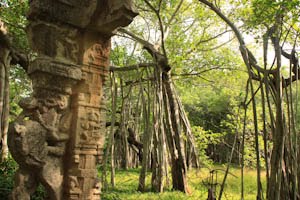
Theosophical Society Banyan Tree

Perhaps the star attraction of the Theosophical Society here in Adyar, Chennai is the Banyan Tree. One of the largest in the world, it measures over 238 feet from north to south, and 250 feet from east to west. In all, it covers over 59,500 square feet. The first time I visited the Theosophical Society, I left wondering exactly where the tree was, expecting to see a massive trunk. In actuality, I had photographed it, with the tree's many prop roots extending downwards from the branches. Over 3,000 are said to be able to fit underneath this 200 year old tree.

Tuesday, June 08, 2010

Indian Flying Foxes

Mango season must make these furry creatures very happy. These are the Indian Flying Foxes, also known as fruit bats. I took this photo at the Theosophical Society in Adayar, Chennai, which is very close to my apartment. This one banyan tree alone held hundreds of these mammals. Since it was daylight, I was surprised by how noisy and active they were. Many were flying to and from the tree. Others were flying out in the open, dwarfing the crows in size. These megabats have a bout a 5 foot (1.5 m) wide wingspan, making them one of the largest types of bats. Unlike their smaller cousins, the flying foxes do not get around by echolocation, instead relying on well-developed smell and eyesight. I recall in Mali (West Africa) seeing fruit bats seemingly dive towards the mangoes on a tree in my yard, expertly crashing into the leaves by the fruit and grabbing the mango. The mangoes that were left had gaping holes in them. So much for sharing with us!

Monday, June 07, 2010

Greeting the Couple

After the formalities of the wedding reception, guests had a chance to walk up the stage to congratulate the wedding couple and have photos taken. It was a great opportunity to see the beautiful saris and jewelry the women were wearing. Such a rainbow of color!

Sunday, June 06, 2010

All in a Row

This photo reminded me of a wedding I attended in Mali (West Africa). At that wedding, all the women were congregated together, dancing, talking, clapping, etc. Huddled to one side were the men. In both weddings, the women were dressed in their finest; men - it varied. 

Saw U Player, Chiang Mai


Saw U Player, Chiang Mai, originally uploaded by melissaenderle.

Here's my latest painting, a watercolor of a young girl playing a traditional Thai instrument. Painted on handmade paper.

Saturday, June 05, 2010

A Chennai Outdoor Wedding Reception

Last night a number of teachers and I attended the wedding reception of Sweety, a co-worker at AISC. The Christian church ceremony happened earlier that afternoon, so most of us weren't in attendance of that. Being that it was a Friday night, getting to the north side of Chennai took about 45 minutes. We joined some teachers already sitting in plastic chairs near the front. The evening air was still and rather hot. Indian women sat next to each other in their gorgeous saris, with garlands jasmine tied in their hair. Gold hung in abundance around the necks and wrists of women.

After a bit, a processional band entered through the entrance gate, announcing the arrival of the bride and groom. Sweety and her new husband (an agreed-upon arranged marriage) then walked through the carpeted middle aisle, beaming with characteristic wide smiles. Sweety was wearing a beautiful silk sari from Kanchipuram (city in Tamil Nadu), gold jewelry, a tiara, and carried a large bouquet of cascading orchids. Her husband Ezhil wore a suit. Both wore large garlands of flowers around their necks - the same type used in Hindu weddings. Ascending the stairs, the couple sat on the throne in the middle of the stage. Special fans on each side provided a bit of cooling.

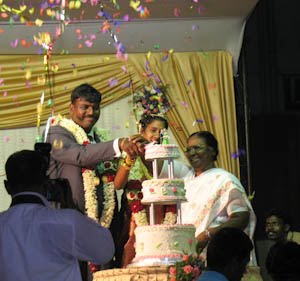
Prayers and kind words about the bride or the groom were offered - sometimes in Tamil, and other parts in English. Colored confetti was released in the air as the couple cut the cake, assisted by a special guest of honor. Guests then began lining up to go on stage to meet and congratulate the new couple. The members on stage then had their photograph taken with the bride and groom.

We then went to eat. Seeing that the long narrow tables were presently occupied by people who had just begun eating, we decided to to to the self-serve area. Briyani (a delicately spiced rice dish - this one had meat) and a few other items were placed on the banana leaf on our plate. In typical Indian fashion, food was eaten with the fingers. A dog sat near us, begging for any scraps. A small container of ice cream served as dessert.  After a long day at school, it was time to leave. Thankfully, traffic was a bit lighter, making the ride home shorter.

Congratulations, Sweety and Ezhil!

Wednesday, June 02, 2010

Backpacks and Braids

Walking home from school today, it was hard not to notice all the giggling girls and smiling boys, all dressed in school uniforms. For girls, the standard issue was a salwar outfit (typically light checkered top and plain pants), and a dupatta (scarf) matching the pants. Hair was shiny and tightly braided, accentuated by bright ribbons - different colors which likely denote grade level. For boys, short sleeved shirts (also light checkered) and solid pants were the uniform. Plain backpacks, "Hello Kitty," Dora, and other cartoon characters were common. Some carried empty lunch containers in plastic mesh baskets. For the local students, June marks the beginning of the new school year. The months of April and May were their summer vacation, avoiding school during the two hottest months of the year - logical, seeing that most schools do not have air conditioning. So as the American International School kids prepare to finish their school year, the local kids are starting theirs. complete with the high academic expectations and rigors so typical of the Indian education system.

Monday, May 31, 2010

Chiang Rai History in Wood


While heading towards the Hill Tribe Museum, several tall totem columns in a park struck my eye. They were intricately carved, some places in rather high relief. Inside a roofed enclosure several young men were passionately carving several more totems, each engaged in different steps of the process. On the one wall, detailed sketch plans were hung. One worker put down his chisels and explained to me that the totems portrayed Chiang Rai’s long, proud history. They were selling smaller pieces to help finance their ambitious project. In many ways, their passionate dedication reminded me of Khositphipha, another local artist who is putting his incredible artistic talent and visionary ideas towards the construction and decoration of the White Temple. If I recall correctly, I believe there were about 20 totems planned. With only about five completed or in process, it will take quite some time to complete these works of art using traditional carving methods.

Tis the Season for Mangoes

The months of April and May are scorchers for a large part of India - Chennai included. Not only does one have to bear the oppressive heat and dew point, resulting challenges such as power outages and water shortages also arise. Perhaps the only redeeming item and reason to look forward to India's summer is the arrival of the mangoes. India grows over 1,500 varieties of mangoes and is the dominant cultivated fruit (42% of fruit trees) of the country. India's climate is ideally suited to growing mangoes, with varieties thriving in the dry states of Gujarat all the way to more lush areas - the main exception being areas over 3,000 feet. Tamil Nadu is one of the mango major growing states - lucky for me. I am not versed on the different types of mangoes found here, but I do love their taste. Hopefully the mangoes will continue to stick around for a couple of weeks - long enough to hold me over until I return back to Wisconsin for the summer and begin to enjoy the strawberries.

Sunday, May 30, 2010

Chiang Rai Night Market

Like its larger neighbor, Chiang Rai also has a night market. Its offerings weren’t nearly as plentiful or as varied as that in Chiang Mai. In addition to souvenir t-shirts, sun glasses, etc., one could also buy bags/purses made by the Hmong and Lisu. Its large food court was a favorite place for eating. Although there were plenty of repeats in toned-down Thai food, I did spot (but did not try) the wiggling variety. Later on, there were music performances on the food court’s stage. For those with larger food budgets and a quest for a more peaceful ambience, the Centrepoint restaurant also supplied quiet guitar music.

Friday, May 28, 2010

Hill Tribe Museum & Education Center, Chiang Rai

A very worthwhile place to visit in Chiang Rai (particularly for those considering hill tribe tours) is its Hill Tribe Museum & Education Center. Although the signs were a bit yellowed and some of the display items could have used a good dusting, the explanations were informative and organized artifacts representative of the different local hill tribes. Both the approximately 20 minute film and display signs gave a rather unsanitized view of how the hill tribes are routinely exploited by the Thai government as well as the tourism industry. It also helped dispel some myths about the different hill tribes. The center actually runs its own hill tribe tours, with the proceeds actually going towards the hill tribes, instead of exploiting them. If I find myself in the region again, I will definitely consider their authentic, educational, and humanistic tours – even if they are a bit more.

After a tour of the museum, take advantage of the air conditioning, fairly good food, and entertainment at the Cabbages & Condoms restaurant, located on the ground level of the building.

Photography was not permitted inside the museum.


Here are some facts I gleaned from the center:
There are 950,000 hill tribe people in Thailand. About 200,000 live in the Chiang Rai province. The Karen people are the largest group, with about 47% - or 440,000. Originally their homes were built out of bamboo, but now lumber is also used. White clothing signifies that the wearer is unmarried, whereas the colored costumes signify marriage. The Karen are known for their weaving skills. The Karen’s history is mostly oral – much of which has sadly been lost. The Karen hill tribe is one that has been particularly exploited, with the Padaung being brought to Thailand to be put on display as “freaks” or “oddities” as the longneck people.

The Hmong, originally from South China, form about 17%, or about 155,000. They tend to have large families. The Hmong grow rice, corn, and soybeans. As there are quite a number of Hmong people now living in Wisconsin, I had a particular interest in this group. Their beautiful needlework/cross stitch textiles as well as their storycloths were quite captivating. At about 105,000 people, the Lahu tribe has about 11% of the total hill tribe population. The museum described the Lahu as fishermen and cultivators of rice. Black and turquoise were favorite colors of the Lahu.

The Akha, with 70,000 people (8%), are one of the smaller major tribes of Thailand. At about 3,000-4,000 feet above sea level, the Akha cultivate corn, rice, soybeans, coffee (recent), and some opium. Poverty remains high for the Akha and other hill tribes.

The Yao hill tribe people comprise about 5% of the population, or about 45,000 people. They are known for their opium growing and expertise at animal rearing. The Yao costume is particularly intricate and may take an entire year to make. I was also impressed by their detailed woven baskets. 

Thursday, May 27, 2010

Chiang Rai City

Located 180 km (111 mi) north of Chiang Mai, the city of Chiang Rai (pop 62,000) has more of a laid-back feeling. About 13% of its population are members of various hill tribes, including the Karen, Akha, Lisu, Lahu, Yao, and Hmong. The city itself felt less touristy, but the many signs in front of businesses revealed that there was a large market for hill tribe, trekking, and Golden Triangle tours. Tattoo and massage parlors were also plentiful, catering to tourists.

I stayed at a quiet guest house with a pleasant garden from where breakfast was served. It was a perfect place to begin a leisurely morning, checking my email and “chatting” with people on Facebook – all from my iPod touch and the guest house’s free wireless.

Although Chiang Rai had its fair share of Buddhist temples (including a few that were replicas of those in Chiang Mai), I found few to be as beautiful or as impressive. No Donald Ducks eating noodles with chopsticks, though… Churches were visible in town and in the outer parts, with hill tribe people comprising a fair amount of the area’s Christians.

Wednesday, May 26, 2010

Golden Triangle, Thailand


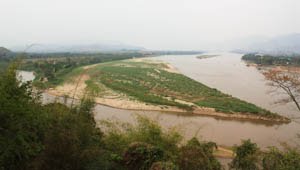
Prior to finishing our journey in Chiang Rai, Tee drove us up to what is known as The Golden Triangle. From this vantage point in the northernmost province of Chiang Rai, one has a view of three countries; Laos, Myanmar, and Thailand. In fact, the Mekong River (which separates it from Laos) delineates half of its northern border. Mountains separate it from Myanmar. At one time, the Golden Triangle was once a production and distribution center for the opium trade. Now, the Golden Triangle is largely a tourist trap.

Tuesday, May 25, 2010

Akha Appliqué and Forest Ceremony


Alas, it was time to leave. After the mother-in-law of the village head showed me the beautiful appliqué work she was working on to form a pair of leggings, we thanked everyone for their hospitality and moved onward.

 On the way back to Chiang Rai, Tee stopped at a nearby village where he showed me an altar that had been constructed as part of a forest ceremony. Accompanied by the symphony of cicadas, the ceremony had recently been performed to honor the forest spirits and ask them for protection. Despite the conversion of many Akha to Christianity, traditional beliefs and/or practices still are present.
In the forest, Tee captured one cicada and demonstrated how loudly just one single insect could “sing” with their timbals. It was amazing how much quieter the symphony was with just one of its members momentarily silenced; I had incorrectly envisioned thousands of cicadas all joining in the song. Tee’s own family enjoyed eating cicadas. During February through April, the children would collect this delicacy, using gum-tipped poles to lance the insects and collect between 1-3 kg (2.2-6.6 pounds) per day. 

Monday, May 24, 2010

A Walk Through Doi Chaang Village

Before we left Doi Chaang, I had a chance to walk through a bit of this hillside village. Homes were very close to each other, with no apparent delineation between where one yard ended and the other began. Most of the homes were built out of wood with a sloped roof constructed of straight or corrugated metal. Some roofs were of a similar style, but constructed of thatch. Windows were small and sparse; many were still shuttered from the night. Tall stilts (some were rectangular columns made out of concrete while others were out of wood) permitted one part to be level with the road and the other to overlook the steep hillside. To get to the main level, one might have to climb a set of wooden (or bamboo) stairs. On the lower stilt level, one portion was often enclosed, with the other open for storage, a place to sit under, etc. Chickens ran freely through the dirt around the homes and onto the steep road. Children played a form of hopscotch on the quieter roads. The dirt around the plastic piping faucet in the yard was wet, with water recently gathered for washing or cooking. Chilies and what looked like halves of bananas dried in shallow woven platters on some rooftops.

Trucks and motorcycles maneuvered their way up and down the steep, winding roads. Vendors also took advantage of the versatile motorcycle, loading woven bags with vegetable, fruits, and bamboo-filled sticky rice. Women carried children tied to their backs with a piece of cloth, just as they had done in West Africa. Some men were already heading up the hill with tools used for the field. Most men, though, gathered on the porches, sipping tea, chewing paan, and engaging in lively discussions.

The Beauty of Black Teeth

At the Akha village, I noticed that most of the older adults had black teeth. I presumed this was due to the habit of chewing paan (easily noticed by the very red tongue, masticating, and occasional spitting). At the Hill Tribe museum back in Chiang Rai, I learned that this was a sign of beauty. The practice of dyeing one’s teeth black is quite old and is practiced in various parts of Asia. It actually helps prevent dental decay, similar to modern sealants.

For more information about the Akha, visit http://www.akha.org/

Friday, May 21, 2010

Akha Coffee and tribe poverty


From there, we walked on a dirt road slanting downward to a neighboring house. Here we saw the cement tanks used to soak and wash the coffee beans. On a large tarp a late batch of coffee was drying – whose late stage typically signifies inferior quality. Here we sampled some of their coffee and cracked open some macadamia nuts. On the way up the hill, Tee pointed out some of the bamboo huts, explaining that many of the Akha are still poor. In fact, many Akha and other hill tribes in Thailand still lack an identity card, making it difficult to receive governmental services! We headed back down the steep cemented main road to the village head’s home and had a breakfast similar to all the other meals. Tea, of course, was plentiful.

Wednesday, May 19, 2010

Akha Village Swing


Up the embankment from the gate was the famous Akha swing. The swing consisted of four thinner tree trunks tied together at the top, sort of like a tepee. Near the top I could see the inner tube swing, its rope now securely tied around one pole. According to an Akha myth, humans came down from heaven through the swing. This swing is used for four days during a festival occurring 120 days after the village has planted its rice. It celebrates the hard work just expended on weeding the rice and tending to other crops. During the festival, villagers of all ages swing fast and high.

Tuesday, May 18, 2010

Akha Village Gate


While breakfast was being prepared, Tee and I went for a short walk. He first took me to the wooden entry gate of the village. Along the top beam and the top parts of the side beams were woven snowflake-like designs – protection symbols. Next to the gate were statues of two couples – one out of cement and the other out of wood, now very weathered and split. The male figure had an enlarged genitalia. These figures represented the original Akha male and his female partner, a forest dwelling creature whom he brought back to be his wife. The gate was built by the male to help the female understand the delineation between the forest and village. This gate and two figures are found at the entrance of every Akha village. Songs are sung as the people pass through the gate, receiving protection from the snowflake like designs.

Monday, May 17, 2010

A Doi Chaang Village Welcome

Just before sunset we arrived at Doi Chaang Village. Meaning “Elephant Village,” Doi Chaang got its name from its elephant-shaped hill. We were to stay at the village head’s house, a typical custom for any guests of to the village. Immediately the wife of the village head and other members of the family began preparing a meal for all. A few more plastic chairs were added to the small table under the overhang. Shortly after we were seated, the meal of rice, pork, greens, bamboo shoots, chilis, and ground soybeans with chilis. Before we began the meal, the mother-in-law, dressed in traditional Akha headgear, presented me with a still-warm hard-boiled egg and tied white embroidery floss around my wrist. This traditional gesture signified welcoming of a guest and wishing them prosperity.

Thin mattresses were laid out for the guests, covered with character bedsheets and a “Hello Kitty” quilt. Through the thin wooden walls, I could easily hear the satellite TV, being watched by the village head’s boys. In the adjoining area, men discussed matters, including how to deal with the skyrocketing prices of property in the village. Finally the sounds died down and I was able to sleep.

Long before it was light outside, roosters once again competed for crowing the loudest. Morning light peeked through the slits in between the wood boards and around the window. Certainly not winter-proofed! From the outside kitchen, I could hear the pounding of a wooden pestle. Over a fire was a large wok. Even the boys were helping out. Once again we were served cups of obligatory local tea.

Sunday, May 16, 2010

Lisu festival meal, Doi Chaang Café

As the sun got more intense, some people moved two tented structures over the area where the dancing was occurring. The dancers barely paused for this and quickly readjusted the size of their circle to accommodate the new space. People would leave and rejoin the circle after eating or taking a short break, but I was amazed at the “die-hards” that were out there. Lunch and refreshments could be purchased inexpensively at several small booths, or you could join the masses near the primary school. Here, long tables were set up with equally long “benches” made from bamboo. A plastic packet of rice was ready at each plate and the servers came around plopping on veggies and pork on each plate. Water, tea, 2 liter bottles of Coke, and fresh ground coffee grown by the Lisu people was also available.

Leaving the festival, we began our drive on a winding, unpaved road at about 1,100 meters in elevation. Along the slopes were organic coffee bushes, planted around 1983 as part of the Royal initiative to provide the Akha people a meaningful income instead of poppies for drugs. Women carrying babies on their backs walked along the side of the road, wearing colorful character socks and sandals. Others were carrying items in woven baskets, including firewood. Along the way to the Akha village, we stopped by the Doi Chaang Café. Here we sampled some of its organic Arabica coffee, grown by the Akha people and part of a joint venture with a small Canadian group. Next to the café were buildings of the coffee academy, where people from all over the world come to learn about coffee growing.

Kaleidoscopes of Jaisalmer

Just finished this oil pastel portrait of a woman from Jaisalmer, located in Rajasthan, India. Choosing a title was difficult. Any suggestions?

Saturday, May 15, 2010

Lisu Kwakie Dancers and their costumes

Both young and old participated in the Kwakie dance, most of them wearing traditional (with contemporary changes) clothing and quite a number donning the traditional huto hat. The long red strings hanging down from the hats traditionally worn by unmarried women reminded me a bit of a Raggedy Ann doll. The hats of the married women were also black and had decorative silver beads, short tassels, and a few pink feathers. Both men’s and women’s hats were donut-shaped, with a large hole in the middle.

The women’s velour-type dresses were multi- colored, had an outer covering similar to a full apron, and “highwater” height pants underneath. Around their waist was a belt, to which a long collection of red strings formed a tassel in the back. Although most of the long red strings are now machine-made, some women braided their own. According to my Lisu acquaintance, a woman would be able to braid up to four strings in one day. Large, heavy multi-layered silver necklaces clanged as they danced. Some women had additional silver ornamentation on their “breastplate” which included extensive use of silver coins and smaller half-sphere pieces. Both men and women carried a pouch, which was draped diagonally across the body.

Friday, May 14, 2010

Tamil Nadu Political News and the Movies

Today's newspaper announced that Ms. Kushboo is joining the DMK political party of Tamil Nadu. Like so many other politicians of the state, Kushboo is an actor - or actress in this case. Both politics and the movie industry are big things in this south Indian state. Billboards and walls are filled with murals or posters of the smiling faces of both groups of people. Therefore, the marriage of the two seems only natural to many, with being in the movie industry a strong indication of political success...
Yet another movie actor-turned-politican

Thursday, May 13, 2010

Lisu Hill Tribe Instruments and Kwakie Dance


Although there were far fewer people in attendance today, there still was a sizeable gathering. Initially people were gathered in the shade, but as soon as a man began playing the fulu (a woodwind instrument made from bamboo and a gourd), quite a number of women and some men gathered and began a circular dance called the kwakie. The dance participants held hands and faced inwards, with the musician swinging in step in the middle of the circle. Just as there was little variation in the musical notes and rhythm, the steps of the dance were also very consistent and repetitive.

Wednesday, May 12, 2010

Arrival at Lisu tribe festival

The next morning after more rice, greens, dried soybeans, and of course more tea, we said goodbye to our hosts and moved onward into the hills. Tee’s father came along, as he wanted to visit some relatives and friends in the hill village. On the way, we stopped to pick up a village resident friend of Tee’s father. Both older individuals shared a fondness of chewing paan, had their teeth blackened, and talked animatedly in the Akha language.

On the way to the Akha village Tee spotted a cloth sign fluttering in the breeze that promoted an annual festival of the Lisu hill tribe people. Able to speak some Lisu, he was able to inquire of some Lisu people walking alongside the road that the festival was indeed happening today. It was the last day of the three-day festival, but there should be some things going on. Traveling on a narrow hilly dirt road, we passed by some trucks with Lisu people in the truck bed who were traveling away from the festival location. Tee explained that some Lisu people would have traveled for over five hours to attend the festival, with some perhaps even coming from Burma (Myanmar). Yesterday, over 3,000 Lisu were in attendance. The school grounds in the village of Ban Doi Lan (meaning “million mountains”) was the site of the festival. Tee introduced me to one Lisu woman who spoke fairly good English. She was one of the organizers of the festival and saw it as a key opportunity to celebrate and promote the Lisu culture. Like Tee, she expressed a concern for the disappearance of her culture and language. One of her ambitions involved utilizing the internet as a tool for educating others about the Lisu culture and as a way for Lisu people to keep in touch with each other.

Tuesday, May 11, 2010

More about the Akha Hill Tribe


Here are some things Tee told me about the Akha people: The Akha hill tribe people are originally from China who then moved to Burma (due to political and human rights issues), with some coming to Thailand as refugees. Currently about 60-80,000 Akha people live in Thailand and over 200,000 in Burma. Four generations of his family have lived in Thailand. Tee expressed concern over the disappearance of the Akha culture, particularly with the young generations. Tee’s own nephews and nieces do not know how to speak the Akha language, as Thai is mandated to be the language of instruction at school. Like many Akha familes, Tee’s family is Christian. He feels that a deep reverence for nature (influenced by the Akha tribe’s traditional animist religion) should still be followed. Through a radio program at the college where Tee teaches, he seeks to have the different hill tribes hear talks in their own language, as well as discussing important topics.

Monday, May 10, 2010

First Night in an Akha Village

On the first night of my hill tribe tour, I stayed at the family home of Tee, the man from the Akha tribe who was taking me around. His village of Kong pa Kam (meaning “hot spring”) was located about 40 km south of Chiang Rai. About 98 families (Akha hill tribe) lived in the village. Tee’s parents, brother, and the brother’s family lived in the house. The front of the house looked more finished and modern (even had a hot shower, computer and TV). The kitchen was dark, made of cement, and very simple. Cooking was mainly over a fire with ashes. Several women helped prepare the meal, which included some greens, rice, fish, bamboo shoots, fresh chili peppers, mangoes, watermelon, ground dried soybeans with chilies, and pork soup with greens. Eating was done with chopsticks; I’m not sure what I feel more awkward with – eating with my fingers (India) or with chopsticks (Thailand). Later we had tea over a campfire, whose heat source came partly from bamboo pieces. The fire felt rather nice in the cool evening as we sat on low stools whose seats were woven out of bamboo strips by Tee’s father. In the open-air bamboo structure right next to the fire, one could see the large stack of woven chicken egg-laying baskets Tee’s father was making for a large order. Only when it got too dark did Tee’s father stop cutting and preparing bamboo strips that would be used for more baskets.

On the farm they had many chickens (the roosters crowed incessantly, which was particularly not welcomed in the wee hours of the morning). A large bamboo open-air shed was ready for several pigs, but none were in the pens at the moment. Various crops were grown. Tee pointed out the grapes (for eating) fields in the distance. In a simple shed there was a tractor and a truck.

Sunday, May 09, 2010

White Temple Toilet

Even the toilet facility at the White Temple in Chiang Rai was flamboyant and unusual. Note the "his" and "hers" painting on the back.