In anticipation of an art exhibition, I wrote a short story about each painting, as if written by the person in the painting. These are all real people, and the stories are based on experience, observation, and representative/factual information typical of someone from that region/profession. Some of these paintings are still available, so if you are interested in purchasing one, please contact me.
For eighty-three years I have trod through the narrow lanes of my small village--first to my parents’ home, and then to my azhu's family farm. I loved living with my nai nai; now I get to enjoy the laughter of my grandchildren as they run through the family courtyard or play with the kittens. Even though my son says I don’t have to go to the market to sell vegetables, I quite like it, for it gives me something to do and a chance to chat with the other women. With a basket securely fastened to my cape, I slowly make my way to the tiny market, chatting with friends along the way.
Nearing lunchtime, this squirrel decided to take advantage of the tart, yellow fruit of the barrel cactus. He scrambled up to the plant, deftly (and quickly) climbed up, and began his snack. Those needles didn't seem to bother him at all; neither was he bothered by the people who stopped to snap a photo. In fact, he seemed to enjoy it, switching poses as he grabbed another fruit and chomp away.
While hiking on the Peralta Canyon Trail in Arizona, we spotted these longhorn cattle. Looking at the spread on their horns, I was somewhat happy to see that there were some cactus plants acting as a barrier between us.
Traveling and living overseas has created a heightened sensitivity and awareness of events that happen outside the border of my home country. Not only am I more knowledgeable about where those events are occurring, but there is a personal connection.
Having lived in South Korea for four years, I have read quite a few books pertaining to the Koreas on both side of the 38th parallel. My collection of read books (and documentaries) on North Korea is getting quite large. Each of the books, such as Barbara Demick's Nothing to Envyand Yeonmi Park's In Order to Live enlightened me on a slightly different aspect of the people and country called North Korea. My latest book I read on the "Hermit Kingdom" was Not Forgotten: The True Story of My Imprisonment in North Koreahad an entirely different perspective. Instead of trying to escape the horrible prison labor camps such as in Escape from Camp 14, Kenneth Bae's true story mainly focuses on the transformations which occurred while a "prisoner of Jesus Christ" in North Korea.
Although I highly encourage you to read the book, here is a basic summary. Kenneth, an American missionary of Korean descent, was arrested after a portable hard drive was discovered in his bag when his tour group arrived in the country from China. Even though he admitted to being a missionary who had made the mistake of accidentally leaving the backup hard drive in his bag, the North Korean government convicted him of the highest level of treason against the country.
Sentenced to 15 years of hard labor, Bae originally prayed and hoped for quick release - even though he knew he was being used as a political pawn. Now he was forced to manual labor from 8am-6pm out in the extreme elements and then subjected to the political brainwashing of the TV in the evening. Prior medical conditions exacerbated the already difficult situation, along with isolation and uncertainty. It wasn't until he asked the Lord to do His bidding and use Bae while "in chains" that things turned around for Bae. This was such a parallel with the Apostle Paul, who while imprisoned for witnessing about Christ, shared the Gospel with the prison guards. A sense of peace enveloped Bae, known as Prisoner 103; "Once I accepted this place as God's will for my life, and I started praying, God use me, instead of God, save me, doors opened". The guards took note and asked why he was so happy and where his hope came from, to which he responded, "God has me in here because he cares for you and all of North Korea. He wants to you to know who he is and how much he loves you."
A citizen of the US but a native South Korean, Bae had a unique opportunity. He was able to communicate directly to the guards and develop special insight. "My two years in North Korea also taught me what it means to have compassion for those who live in darkness. People in North Korea have no access to information from the outside world, no freedom to travel, no freedom to speak their minds, and now way to choose their own religions."
He realized that there was a special sense of safety within a totalitarian regime, and that those who raise questions about the societal structures is a direct threat to the nation. In North Korea, the Kim Jun family is their god.
Kenneth Bae recounted multiple instances of where God seemed to directly intervene or send strong messages that He had not forgotten His missionary. For example, there were times when Bae was at a low point in the hospital when he was craving and had prayed for a particular food; for the next meal, that exact food was brought in from a special restaurant, even though he had not verbalized any request. This happened over 40 times. At the prison, Bae's planted field was spared the flooding that affected all the other fields. When initially held in a cold detention room, his left hand suddenly became warm and the Spirit's presence was felt. At another low point while in the hospital, the Disney movie "Finding Nemo" was on instead of the usual shows venerating the Kim family, providing Bae a connection with America. Also, since it was known that Bae was a pastor and the government wanted to convey to the world that they were being merciful, he was allowed to keep his Bible. Two years after he was arrested, Bae woke much earlier than usual and heard the Spirit of God direct him to open the Bible to Zephaniah 3:20 (Bae had no idea what it would be) - and read: At that time I will gather you; at that time I will bring you home. Four days later, Bae was released.
In the end, Kenneth Bae spent 735 days in detainment - the longest held of any American since the Korean War.
Some interesting things I learned:
In 1907, Pyongyang was known as the "Jerusalem of the East" for having more churches than anywhere else in Asia. Now, there is only one "token church" that is under total control of the government. North Koreans have no knowledge of Jesus. One guard said he had heard of a God, but not this Jesus, asking where Jesus lived - China or North Korea.
The Bible is viewed as a dangerous weapon. North Korea even has a Bible on display at an anti-American propaganda museum that is filled with weapons the US has used against them in the Korean War.
Everyone is expected to contribute to the common good, including manual labor. For instance, Bae witnessed tens of thousands of people (including women with children on their backs) clearing the 200 mile long highway to Pyongyang with snow shovels. Even at the labor camp, the guards had to plant and tend their own fields for their food.
The guards had no conception of how families in South Korea or the USA could own both a car and a home. Years ago, the North Korean government provided families with a modest home, but now that is not typical.
I was amazed how Bae did not hold animosity towards the North Korean government. With a reframing of his outlook, he saw the period of detainment as a wonderful opportunity to witness for Christ, to a nation in the dark about their Savior. Bae continues to pray for the people of North Korea and hopes that one day, the spiritual wall that surrounds the country will fall. "More than a billion people worldwide still have not heard the gospel. We must remember them, pray for them, and build a bridge to them through which we can share God's love and compassion. May God be their God, and may they be his people."
While walking through the Desert Botanical Gardens in Phoenix, this saguaro demanded my attention. On the top of the main trunk was a fan-like protuberance. It stood so regally amongst the other plants in this desert landscape. When one of the garden volunteers came by, I asked him about this formation.
This cactus, he said, was known as a crested saguaro. This beautiful, but rare occurrence, is still a bit of a mystery to scientists. Some say the cresting is due to a genetic formation; others suggest that it is a result of frost or lightning strike. Inquiring online, I found that there even is a Crested Saguaro Society. Its members have been documenting each crested cactus it finds. One passionate veteran of the society theorizes that the cresting is due to a hormone that causes the number of pleats on a cactus to go out of control, observing that some return to normal after years of cresting. Through the society's diligent tracking, they claim to have found over 2, 200 crested saguaros.
Susceptible to frost and poaching, the crested saguaros are highly protected by the Arizona Department of Architecture.
During my time in Arizona, I spotted only one other crested saguaro, located on a trail in Apache Junction near Meridian Drive.
With my time in Arizona setting like the sun, I thought it would be appropriate to dedicate this post to its sunsets (and sunrises). Although I've seen some beautiful sunset(rises) elsewhere, the dramatic colors and frequency of such brilliant displays seems to occur at a much higher frequency.
So what causes these brilliant skies? When the sun sets, light shines through more of the atmosphere, when compared to when the sun is higher in the sky. The light is bent, refracted, and reflected from tiny particles in that atmosphere. A lower frequency results in more warmer colors.
Beyond the basic science, what makes Arizona's sunset(rises) so spectacular? Due to less moisture in the air, the clouds here are much higher. Such higher clouds reflect more light, with dramatic colors.
With reduced levels of pollution, more variation in visible light can be seen, particularly those vibrant colors at the far end of the spectrum. It seems that dust (and pollution) actually diffuses or scatters color, resulting in a dull or muted sky.
The presence of high clouds also greatly chances the chance of dramatic sunset. These higher (and middle) clouds help intercept unadulterated light.
I like how the higher clouds in the photo above reflected the orange color, making it appear as if those clouds were on fire.
For those willing to get up earlier and deal with the cooler early morning temperatures, the winter and fall months provide rewarding painterly effects.
When a friend of my parents recommended that we visit the Eddie Basha Collection, I wasn't sure what to expect. It was free, and the collection was in the corporate office building of Basha's, a supermarket chain in Arizona. Upon entrance into the first gallery room, I could see that this was not going to be a dusty collection with a few kitche pieces.
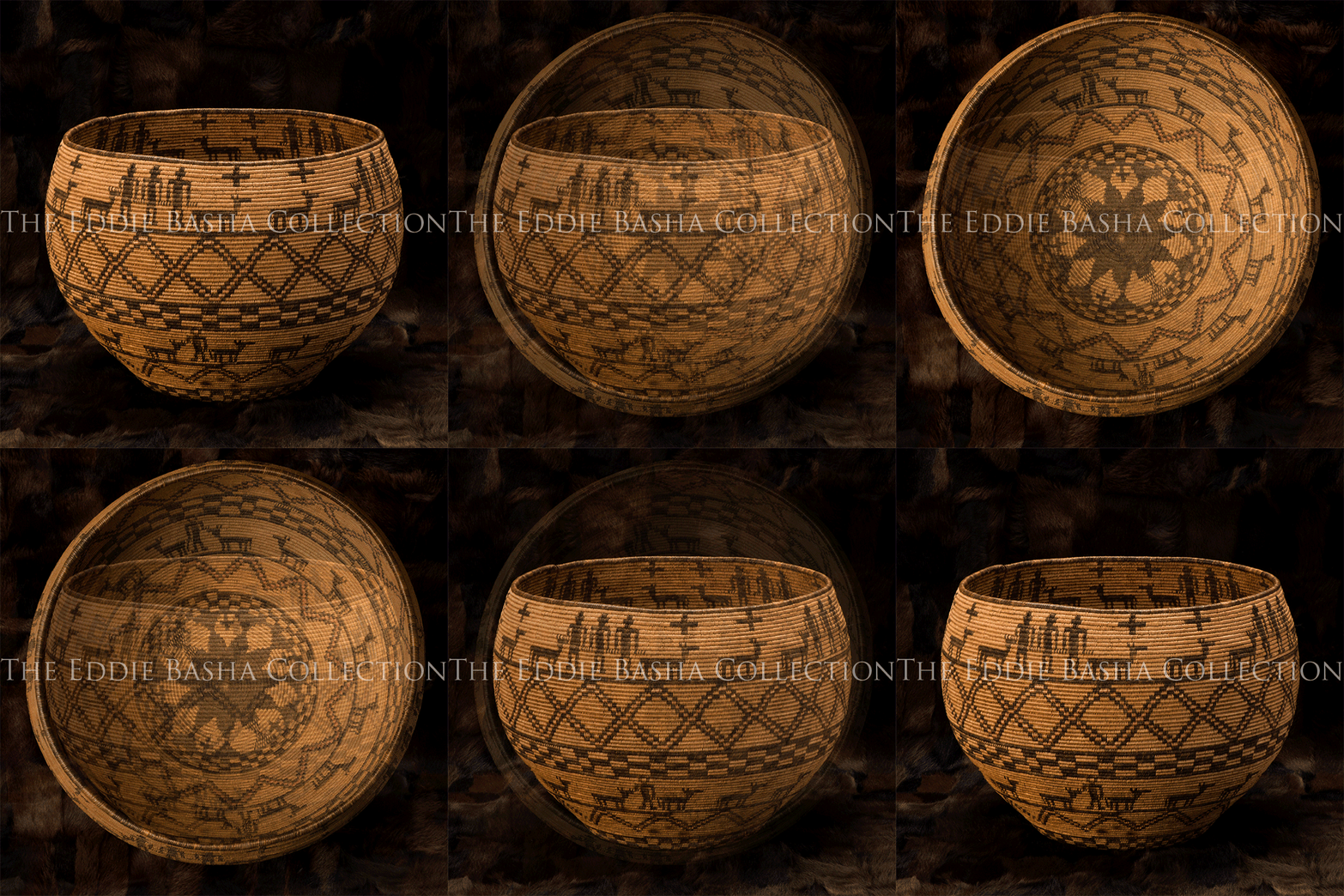
One room alone was dedicated to an expansive collection of woven baskets of varying sizes, mostly between the 19th and 20th centuries.
Apache baskets from the Eddie Basha Collection
Yet another expansive room was filled with over 40 years of over 3,500 collected pieces - paintings, sculptures, jewelry, katsinas, and drawings.
Horse Pirates by Ted Long - Eddie Basha Collection
The collection is considered to be one of the largest private collection of Contemporary Western American and American Indian art. Originally encouraged and guided by his Aunt Zelma, Basha began visiting studios of contemporary artists, kindling friendships and supporting them. He sought to collect pieces of artists he actually met; cowboy artists such as Joe Beeler, John Clymer, David Halbach, and Martin Grelle, as well as contemporary American Indian artists such as David Johns and Larry Yazzie. Absent in his collection are deceased Western artists such as Charles Russell and Frederic Remington, since Basha wanted to focus on contemporary artists he actually met.
Geronimo by Harley Brown - Eddie Basha Collection
Some of the pieces had rather lengthy descriptions. I especially liked the ones written by the artists, vividly describing historical events seen in the images.
Although we spent nearly three hours in the gallery, we did not have enough time to see all artwork. Actually, it was too much to see in one visit. Perhaps it would have been better to focus on one aspect of the collection, such as the bronzes one day, Native American pieces another day, etc.
The gallery is open to individuals or groups (above 25 people requires an appointment) but it is self-guided. We happily placed some money in the donation box, pleased that the proceeds helped support initiatives within the community, including the arts.
This past weekend, we took a 3 1/2 hour drive from Apache Junction to the Fort Apache Reservation in the upper elevations of Arizona. While there, we had a special opportunity to visit an Apache couple. Bonnie is the kindergarten teacher at East Fork Lutheran School. Her husband Francis is an evangelist within the Apache reservation.
Steps in making a cradeboard
First Bonnie showed us how she makes a cradleboard. The slats are made from the stalk of a yucca plant. For the canopy part, the wooden pieces are bnt through heat; sturdy wire is on the underside. The cradleboard fame is made from local wood and is bent with moisture. She uses foam for padding, but traditionally local fibers were used.
Cradleboard with Cabbage Patch Baby
The baby was typically secured with two sets of ties; the lower pair could be loosened to change the baby's diaper without much disruption. Bonnie recalled that most infants were quite content within the cradleboard, finding the swaddling nature very comforting. Mothers either strapped the cradleboard over their shoulders or on their foreheads. This baby carrier enabled mothers to continue their chores while maintaining close contact with their infants.
Beaded Bolo Ties with Christian theme
Bonnie then brought out some beaded pieces; some were done by her, while many others were gifts to her and her husband.
Jesus Wept bolo tie
Bonnie was especially proud of the Christian-themed bolo ties - a beautiful indication of the Christian faith she and her husband shares.
Burden Basket with family name
Bonnie also showed us a few other pieces, including a "burden basket" with the family name. Bonnie explained that the metal "tassels" at the ends once served as alarm signals. While the women were gathering berries or other items with the basket, if the metal began clanking excitedly, the men would know the women might be in some sort of danger (i.e. from warring tribes).
With the football game completed, Francis joined in the conversation, sharing with us his experience coming to faith, as an evangelist to his community, and being a fan of the Green Bay Packers. Both shared some touching personal experiences and their concerns for their Apache brethren. When I later found out that our visit within the home on the reservation was quite unusual, I felt quite honored. Such a personal touch made the experience so much more powerful.
Here is my latest artwork, a color pencil composition of a Gujarat woman inside a Bhunga home in the Gujarat, whose walls were covered with mirror-work known as Lippan. She was wearing a heavy silver necklace, anklets, bangles, and gold earrings and nose ring. Her clothing is in Bandhani tie-dye.
If there was one symbol that defined the Sonoran Desert of Arizona, it would have to be the Saguaro. (Yes, that's me in the photo above, hugging the saguaro. Not something I'd normally do, but this one's base was decaying and had lost its needles).
Here are some interesting facts about the saguaro. Although the cactus can reach up to heights of 40-60 feet (12-18 meters), it is actually rather slow-growing. In its first 8 years of life, the saguaro might only be 1 1/2 inches (3.81 cm) tall. It often starts its life under the protection of an ironwood or mesquite "nurse tree." Once it begins growing, it absorbs the nutrients and water from the nurse tree, thus killing it. The Saguaro has a very shallow root system (4-6 inches), with one root stem going two feet. The root system typically is as wide as the height of the cactus. It can weigh up to 4,800 pounds (2,177 kg).
A Saguaro typically grows its first "arm" at around 50-70 years of age. Up to 25 arms may be found on a saguaro. It first bloom appears around 30 years. At only around 125 years of age is it considered and "adult" saguaro. They generally die around 150-175 years of age, but may reach 200 years. Once the cactus dies, its interior woody ribs can be used to build furniture, fences, or roofs.
On this beautiful December day, we went on a hike in the southwest corner of Superstition Wilderness, a short ride east of Apache Junction. The well-traveled path took us past a wide variety of cactus, shrubs, and rock formations. Still within the Christmas break, people of all ages were returning from a hike - a good indication that the trail's rating of easy-to-moderate was accurate.
As we neared the Hieroglyphics Canyon, the rocks on the path became larger and some climbing was needed. The sounds of rushing water mingled with the squeals of laughter and excitement of kids who were enjoying splashing in the water.
The petroglyphs, etched into the rock by the Hohokam Native Americans who lived in the area from 500-1450 AD. The dark desert varnish patina found on these rocks made an excellent surface for carving the imagery. (Early settlers mistakenly called them hieroglyphics in reference to those linguistic symbols in Egypt, but they are in fact petroglyphs, or rock paintings)
Some of the lower rocks also contained more modern carvings– or should I say, graffiti.
Any symbolic meaning of the petroglyphs has not been determined. I saw what looked like snakes, lizards, and goats.
A blessed Christmas to all! Remembering the birth of our Savior on this Christmas Day.
For to usachildisborn, to usa son is given, and the government will be on his shoulders. And he will be called Wonderful Counselor, Mighty God, Everlasting Father, Prince of Peace.
This past week we went to Mesa for a double-treat; pizza and music. Our destination was Organ Stop Pizza. Waiting for our pizza to be finished wasn't a hardship, with plenty of awesome music to pass the time. From our balcony table, we had a good view of the veteran organist (who was named "Organist of the Year" in 2000 by the American Theatre Organ Society) who commanded mastery over the instrument and its plethora of keys, stops, and buttons. Being right before Christmas, he played plenty of holiday songs. It was amazing to hear him play Mannheim Steamroller's version of "Carol of the Bells" in such a way that he was nearly able to replicate Chip Davis' entire band. Nary a sheet music could be seen, as he expertly switched between a variety of music styles, rhythms, etc.
This is no ordinary organ. Known as a theatre pipe organ, this 1927 Wurlitzer was originally designed to provide background music for silent movies and stage shows. Once an integral part of theatres of every size, these orchestral organs (with plenty of theatrical sound effects) fell out of fashion when talking picture movies became emerged. This particular organ started with 15 ranks/set of pipes, but was rebuilt with parts from other Wurlitzers in the early 1970s to have 23 ranks. In 1997, it was further expanded and now has 78 ranks, 17 tuned percussions, lots of sound effects, and 6,000 pipes. Four large turbine blowers provide the needed wind. The walls of the expansive restaurant are adorned with the pipes and lots of different percussive instruments and lighting designed to complement the music. The curtain in front was opened a couple times to reveal dancing marionette-style cats - perfect for the song "Alleycats." The ornate organ was perched on top of an 8,000 lb rotating hydraulic elevator, enabling all to catch a view of the maestro tickling the keys.
The Superstition Mountains of Arizona are quite picturesque and have many hiking opportunities and of varying levels of difficulty.
Despite less-than-optimal weather conditions, we went further on our hike and were rewarded with some pretty scenes.
Near the end, we saw several longhorn cattle freely roaming about within the park lands. It made me feel like I should have been in Texas! I wondered what the process was for rounding up all the cattle - and what precautions the ranchers must take to protect themselves against those horns. Somehow, within all those prickly cactus and scrubby bushes, the cattle (who looked very well-fed) must find enough to eat. Gosh, if that would have been the Holstein cows we had on our farm in Wisconsin....
In anticipation of an art exhibition, I wrote a short story about each painting, as if written by the person in the painting. These are all real people, and the stories are based on experience, observation, and representative/factual information typical of someone from that region/profession. Some of these paintings are still available, so if you are interested in purchasing one, please contact me.
My husband and I have been invited to perform at the American Ambassador’s residence, along with fellow Tamascheck tribal musicians. Such events give me the opportunity to dress in my flowing Indigo robes and adorn my hair with silver pieces handed down from my grandmother. Most of all, it’s a chance to dance to the slow, flowing, repetitive melodies that are so much a part of our nomadic Saharan heritage. When I close my eyes and focus intently on the music, I almost forget that we are over a thousand kilometers away from our homeland. It is rather fascinating to see Westerners join in on the dancing or even give some of our traditional percussive instruments a try. In this way, we can share our culture with others far beyond our isolated desert village. See more artworks on www.melissaenderle.com.
In anticipation of an art exhibition, I wrote a short story about each painting, as if written by the person in the painting. These are all real people, and the stories are based on experience, observation, and representative/factual information typical of someone from that region/profession. Some of these paintings are still available, so if you are interested in purchasing one, please contact me.
Every week I take my basket of vegetables to sell at a small market outside of Kampong Phuk. I look forward to this time, when I can gossip with my other friends who also spread out their goods to sell. It helps me forget, at least for a little while, all the terrible things I saw and experienced as a young woman when the Khmer Rouge extended their reign of terror over my homeland. It is nice to see smiles once again on the faces of children, who can play games and go to school instead of slaving away and seeing loved ones being killed. The money I make from my little garden isn’t much, but it’s enough for me to buy rice, fish, and a little oil. Today my sales were even better, enough for me to buy some chicken and even a Hello Kitty pouch for my granddaughter. I am happy again.
In anticipation of an art exhibition, I wrote a short story about each painting, as if written by the person in the painting. These are all real people, and the stories are based on experience, observation, and representative/factual information typical of someone from that region/profession. Some of these paintings are still available, so if you are interested in purchasing one, please contact me.
I live in a densely populated fishing villagein Besant Nagar, Chennai. During the December 2004 tsunami, the majority of the thatched huts in our village were either washed away or damaged. The wooden catamarans and fiberglass boats didn’t fare any better, and most had to be replaced. Even though we received funding to buy new boats and fishing nets, we were given no assistance in addressing sanitation issues. Our homes still lack access to clean drinking water, toilets, and drainage. Despite these challenges, the Christian faith of my family, which we can trace back to the apostle St. Thomas, enables us to remain optimistic. We know God is in control and will work even these challenges for our benefit.