Monday, May 30, 2016

Lanterns for Buddha

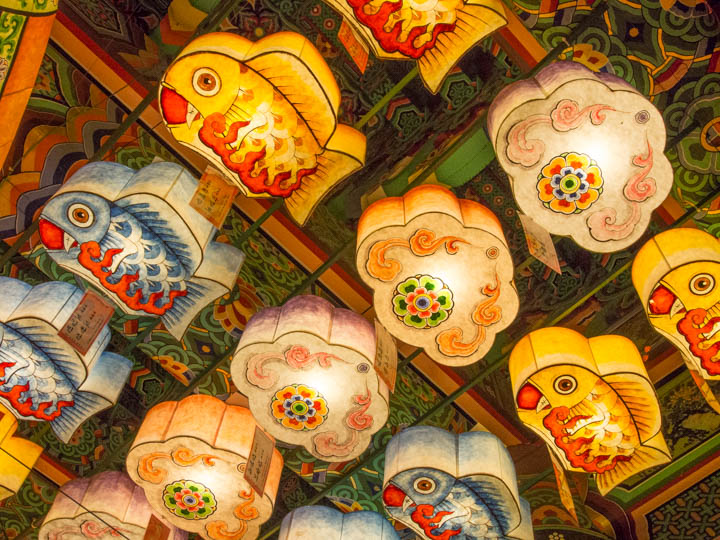
I love the variety of lanterns that line the temples and streets during Buddha's Birthday. Many are made from hanji rice paper. Some of the lotus lanterns below are decorated with silk or tissue paper petals. While pretty during the day, the full beauty may be appreciated when illuminated at night. 
The entrance gate to Jogyesa Temple

On the street near Jogyesa

On the street near Jogyesa, suspended from bamboo poles

A display of children's lantern submissions, next to Jogyesa Temple

Thursday, May 26, 2016

Bathing Baby Buddha

As part of the Buddha's Birthday festivities at Jogyesa Temple, a floral well was erected. In the middle of it was a golden baby Buddha.
Devotees took a special ladle and poured fragrant water over the baby Buddha to bathe it. 

Typically they would pour water over the small figure three times, signifying the washing away of evil thoughts, then cultivation of good ideas, and a desire to save all living beings. 
Nestled amongst the flowers was a coffee cup. The hanbok-clad devotee was a bit embarrassed when she saw that I had noticed the "addition" to the display. Perhaps Buddha would have liked a sip of this oh-so-popular drink of Korea.

Wednesday, May 25, 2016

Leeum Museum, Seoul

Itaewon in Seoul is much more than just its plethora of restaurants. Follow one of the meandering lanes beyond the busy main street, and the wonderful Leeum Samsung Museum awaits your visit.
In 2004, the Leeum museum opened its branch in the Itaewon/Hannamdong area. It is located in a neighborhood with high-end homes and embassies. In a megacity, such individual homes are rather rare.

Comprised of three buildings, the Leeum Museum has a section for traditional, contemporary art, and another dedicated to youth education. I went to the permanent exhibit, which featured many pieces of traditional Korean art, some dating back to the 5th century. Everything was very well displayed and dual-signposted in Korean and English. Photography was not allowed in the exhibits themselves, but we were able to photograph the architecture.

One floor was dedicated to Buddhist art and metalware. The second floor contained traditional paintings and calligraphy. The upper two floors had ceramics, of both the Celadon and Buncheong styles. Quite a number of pieces were indicated as national treasures. You can see much of the collection on the museum's website.


Sunday, May 22, 2016

Curvy Pines and Hammocks

In a city of over 10 million people, it's reassuring to know that forests are not far away; perfect for a late afternoon (or morning) hike. The curvy pines along this path always intrigue me, the way the dappled light interplays with the irregular trunks.
In addition to the well-worn dirt paths, the mountain near our school also has some boardwalk paths. Hikers of all ages enjoy the forest's many paths, outdoor exercise equipment, and badminton courts. 

After a hike up the hill, these hammocks were an inviting place to take a break.

What a great view from the hammock!


Thursday, May 19, 2016

Icheon Ceramics Festival 2016

The center of high-quality ceramics for over 500 years, the village of Icheon, South Korea hosts an annual ceramics festival. Near the entrance to the festival, this rather quirky view welcomes visitors. 

Besides posing by a massive ceramic tile that reminded me a bit of Gumby, visitors can view some live demonstrations by ceramics artists as they form, glaze, or fire their pieces in a traditional Korean kiln.
Although there were some pieces up on exhibition, most were available for purchase. Some were very traditional-looking, while others put a contemporary twist on traditional techniques. 


Just like the beads in Mali that caught my eye, I tended to gravitate towards the higher quality - and expensive ones. I had to resort to just enjoying with the eyes.


Sunday, May 15, 2016

A Tour of the Icheon Traditional Korean Kiln

My dear Korean friend and I took the bus today to the 30th annual Icheon Ceramics Festival. When I stopped to take a photo of the large traditional kiln, a man immediately came up to us and invited us to go with him for a personalized tour. With near giddy excitement, he eagerly shared with us (in Korean) some information about the traditional Korean kiln firing process. Through my friend Hae Jung who interpreted for me, I learned that the firing process is about 20 hours and gets to around 1,200°C.
Our guide was an assistant to a Korean ceramics master. He explained that pine wood is used to heat the kiln. It sounded like the sap of the pine wood is particularly conducive to the firing process. The mounded shape enables air to naturally circulate. The kiln is sloped upward, so as to draw the smoke up the chimney. After the kiln section is loaded with pieces, the opening is closed with bricks. An opening enables checking of the temperature. He was very partial to the traditional kiln firing method and believed it resulted in higher quality ceramics. He also added that the Chinese were very impressed by Korean ceramics and during the Goryeo dynasty, the Chinese came over to Korea to learn about its advanced ceramics techniques.
After a little while, some people began gathering near the kiln. Many were wearing gloves and eagerly watched on as one man took a knife to loosen the bricks around one opening. After the bricks were removed, a man went inside and began unloading the kiln. Gloved artists were giddy with excitement as their pieces were pulled out.

This man inspected one of his master's pieces, which was damaged by high temperature. 
Thankfully, most fared much better. These white porcelain pieces reminded me of the revered baekja pieces dating back to the 14th century.
Our guide remarked that during his visit to the USA, he was treated with kindness and found Americans to be very helpful. He wanted us to come again so he could give us an even more thorough tour and even meet his ceramics Master, followed by lunch. Alas, as my departure is just a few weeks away, I don't think this will be possible. I'm grateful for this tour and will add it to my list of wonderful experiences in Korea.

Monday, May 09, 2016

A Two Day Journey Around the World

This afternoon, I went to the Seoul Friendship Fair. Held since 1996,  this fair is celebrates the sister cities of Seoul from various places around the world. Considering my love of cultures, the lure of traditional music, costumes, as well as traditional food and handicrafts was too much to pass up. For a few hours in the afternoon, I sat on the grass by Seoul City Hall in the bright May sunshine and soaked up not only sun rays, but some wonderful performances.

Belarus
Their costume and singing reminded me of some of the performances I saw in Serbia. Some songs were very happy and one was more somber. The accordion player was very energetic and the roh player was able to get a variety of tones out of the animal horn.


Japan
The Shamisen player from Japan played a few lively, energetic pieces. Two puppeteers also performed a few skits, including one with a lion and some butterflies. The lion reminded me of a larger version seen in some Korean performances.
Lion and human marionettes manipulated by a skilled Japanese puppeteer
Uzbekistan
As there was no shade on this very sunny day, I didn't want to push being too long out in the sun. However, when I saw the beautiful costumes from Tashkent, I decided to stick it out a bit longer. We had to wait for the drumset and other instruments to be assembled and set up, but it was worth it. A clarinet player myself, it was fun to hear the different tones and melodies produced from such common instruments. The male singer was both forceful and tender. The dancers, however, stole the show. In the four or five pieces, different costumes were worn for each one. The dancing and music had a more Middle Eastern feel to it. The dancers were very particular with their hand and arm positions, and their twirling and footwork was great. Imagine twirling and dancing in high heels! 


Each of the dancers had their hair in long braids, which twirled like ribbons as they spun around.

It was an enjoyable afternoon at yet another Seoul festival! #visitseoul
Thursday, May 05, 2016

In Anticipation for the Lotus Lantern Festival

This morning I went over to Jogyesa Buddhist Temple in downtown Seoul. In just a couple of days, it will be a beehive of activity for the annual Seoul Lotus Lantern Festival.  The Lotus Lantern Parade will end at this beautiful, central temple. The figures above will be illuminated and the lanterns glowing. Although the scene will be at its most magnificence at night, during the daytime it has a special quality as well - and lots less people.
Some of the figures that will be on floats for the parade. It amazes me how such beautiful sculptures are made from wire frames and hanji paper.

Monday, May 02, 2016

A Little Symphony at the Pond


One of the places that I was keen to visit within the Garden of the Morning Calm was the pond with pavilion. This area wasn't a part of the winter lighting festival in which I attended this past January. Such an area combines some of my favorite elements; bridges, traditional architecture, a pond, surrounded by spring plant life.
Instead of dragons or lions heading the beginning of the bridge, it sported some stone frogs. Soon this choice would become more evident. I had heard loud croaking but assumed that it was probably piped frog sounds coming from some speakers scattered throughout the pond's edges (I've been to other Korean sites where music is projected from speakers concealed as rocks). 
Lo and behold, it was the real deal! Near the shorelines were some rather long-limbed frogs, blissfully croaking away. It was fun watching them puff out their cheeks like symmetrical barbells. The frogs didn't seem that concerned about the curious onlookers. Perhaps it was mating season and they were more concerned about attracting some lovely lady frogs.


Sunday, April 24, 2016

Springtime at Garden of the Morning Calm


This past weekend, I went with a few friends to the Garden of the Morning Calm. Sure, I had plenty of things to do, but visiting this beautiful garden in spring was on my Korea "bucket list." I first visited this place in January during the winter Lighting Festival. Part of the garden was not included in the winter event, and I wanted to see its springtime transformation. Korea gets gardening right.
The 330,000 sq m. garden is open year round; during the higher season (mid-March - November), it is open from 8:30-sunset. Located about 40 km northeast of Seoul, it is an easy day trip. We took the subway from Hongik University, transferring once and arriving at Cheongpyeong Station. Although a city tour bus was available, we decided to pile into a taxi and shave off a little time, arriving at the entrance about 20 minutes later. Although it was fairly busy, the large area provided ample space to spread out and get some shots without hordes of people. As with any Korean destination, arriving earlier is best. 

Within the grounds, there are 20 different themed areas. Some areas were very manicured, and others felt more natural. Pavilions and other Korean-styled buildings provided shelter, picnic spots, places to eat/drink, purchase plants & gifts, and bathroom facilities. 
One could easily spend half a day, particularly if enjoying all the different paths, boardwalks, greenhouses, and facilities.

I'll be posting more on the garden. For now, here is the link to my Flickr album.

Friday, April 22, 2016

Changdeokgung Moonlight Tour and Injeongjeon Hall

This past week, I went with a few colleagues on the Changdeokgung Moonlight Tour. Held for two nights during the months of April-June and once in March, it is an opportunity for expats to see one of Seoul's favorite palaces in a whole new way. The tour started at 8pm, with the participants (limited to 100 in number) being divided into a number of groups. It was raining a bit, so ponchos were handed out along with LED-illuminated lanterns. After crossing the stone bridge (where a brief intro was given) and through Jinseonmun Gate,  our soft-spoken guide gave us further information at the main Injeongjeon Hall. 
The light rain added some sheen to the stone courtyard in front of the hall. The status markers leading up to the hall were individually illuminated and its ornate exterior glowed in warm light. 
We had a brief peek of the interior, as seen through the opening. 
Ray streamed from beyond the japsang figures on the rooftop of one of the nearby buildings.
With a tight schedule and other groups behind us, we had to move on to the next section of our tour.

See more photos from the Moonlight Tour and other photos of Changdeokgung Palace in my Flickr album

Tuesday, April 19, 2016

Nature's Glow

With the azaleas much farther this week, I decided to go for a walk after school, exploring the color of nearby Yonsei University. I love photographing its well-maintained campus. While walking down one of its many slopes, my eye was drawn to the red glow beneath the shade of some trees. I loved how the red glow was reflected in the window of the Tudor-style building.

It's not the first time I've photographed this area. Below is the same spot in autumn.