Sunday, November 09, 2014

Seoul Lantern Festival 2014

One of my favorite annual festivals in Seoul started this past Friday. The Seoul Lantern Festival, held from November 7-23 at Cheonggye Plaza, transforms the downtown stream into a colorful display for all ages. I went with some colleagues on Saturday night. With no wind and pleasant temperatures, it seemed like all of Korea also thought it was a good night to attend the festival. The line just to get down to the stream was jam packed, snaking up the main sidewalk and all around; thankfully people were civil during the LONG wait.
When we finally got down to the stream, a beautiful array of lanterns were before us, enhanced by music. Many were different from last year, but some of my favorites were there once again. Some such as the Jongmyo musicians were life-size. The leaping fish (larger ones seemed to be made from silk fabric) varied from much larger than life-size to quite small. A few such as the turtle ship were even animated; its sail folded up and down and the dragon head puffed smoke.
The large crowd (made a bit more challenging by very narrow pathways in some points) made it difficult to take the time needed to truly appreciate the intricate craftsmanship of these wire armature works of art covered with handmade hanji paper. Photography was more difficult as well, between the large number of "selfie sticks" competing for space and sheer numbers of people sometimes forcing you to move on. I didn't see anyone fall into the creek, but it wouldn't surprise me if it happened. 
The Seoul Lantern Festival still is a "must see" for me and one I'd recommend to others. However, I'd recommend going on a weeknight or right before it gets dark, in order to avoid the crowds.


Created with flickr slideshow.

Here's a short video by the Globe and Mail on this year's Lantern Festival.

Sunday, November 02, 2014

Gentle Glow

The morning light softly illuminates these autumn leaves, creating a warm, gentle glow. How I wish these colors would last!


Saturday, November 01, 2014

Presenting the Autumn Display

Yonsei University, which shares the "hill" with Seoul Foreign School, takes great pride in its landscape. Because of its beauty, the walk to reach the nearest subway station is so much more engaging.  In Autumn, the vine-covered buildings offer an extra splash of color. The statue of the university's founder H.G. Underwood seems to beckon the colors to come forth.


Wednesday, October 29, 2014

Chrysanthemum Festival, Jogyesa Temple

Fall is not just about leaves in Korea. Another colorful symbol of fall is the chrysanthemum flower. The Jogyesa Buddhist Temple in Seoul holds an annual festival in October featuring this Korean autumn flower. Even some trees get decked out with mums. 


The "flower tree" in the background cascades with clusters of yellow and burgandy mums, but it also looks a bit spider-like. Just as in the temple's lantern festival, tags stick out of the displays, recognizing contributors. It is also a testament to the labor of love for those involved with the festival.

When I traveled to the Andong region, I saw fields of chrysanthemums being harvested. Many will adorn temples and parks within the country. Chrysanthemums are also dried and used to make tea.

Monday, October 27, 2014

Autumn balcony view

I love observing the change of seasons from my apartment balcony in Seoul. Too bad the color doesn't last long! Soon the tree will be bare and I can see the building across from me.


Sunday, October 26, 2014

Cemetery of the Kuroda

Off in one corner of the Tochoji Temple in the welcoming shade of some large trees was a cemetery. Designated a historical and cultural site, the cemetery dates back to the founding of the temple in 806 AD. It is here that the second, third, and eighth lords of the Kuroda family from Edo period are buried. The shapes of the structures, with their rounded tops, bulbous mid-section, and outward-turning portions looked a bit figurative to me.

Friday, October 24, 2014

Tochoji Temple

According to legend, the Tochoji Temple was founded in 806AD. One of its structures houses a giant wooden seated Buddha (photos not allowed). My favorite part was the five-story orange pagoda. With its bright orange paint against the complementary blue sky color, the elegant pagoda contrasted with the tree-framed temple building as well as the modern buildings of the area.

Wednesday, October 22, 2014

Fall Beginnings

The leaves have just begun to change in Seoul. After a couple of rainy days, the sun appeared in its glory today. Can't wait for more color!


Tuesday, October 21, 2014

Not your College Ramen

For our evening meal in Fukuoka, several in our group chose to go to the 5th floor of a mall where all the restaurants there focused on different ramen specialities. This would not be your cheap college meal. 
In front of the particular restaurant we choose, each person tapped the screen to select their desired ramen dish and inserted the correct amount of yen. Ticket receipt in hand, we gave the receipt to the waiter. I would have to say, it was quite tasty!


Saturday, October 18, 2014

Hakata Gion Yamakasa


Amongst the neutral colors of the Kushida Shinto Shrine in Fukuoka, this colorful structure caught my attention.
Standing around 10 meters, the Hakata Gion is one of twelve Yamakasa scattered throughout the city. They are an integral part of a festival said to have originated in the 13th century in attempts to secure protection against the plague. Each July, seven portable (but tall) Yamakasa are carried five kilometers through the city to the Kushida Shrine. With the exception of the ones presently displayed at Kushida, both the portable and non-portable ones are destroyed after the festival. 

The brightly painted figures and ornaments are created by traditional Hakata puppet makers. Inspiration comes from history and myths.

The image above, with its  strong female figure, tiger, and grimacing male figure reminded me of the  Kali Puja displays I saw in Kolkata, India. No string of heads here, but plenty of flamboyant emotion. 
Kali Puja display (detail)


Friday, October 17, 2014

Kurokawa Onsen Village

As part of the trip to Japan, our group visited Kurokawa Onsen. This picturesque town has 24 hot springs for its visitors to enjoy. Scattered around the town, the baths could be found along the river, within the central part of town, further along in the woods, and even in a cave. Rather than be "cookie cutter" settings, each hot spring location had unique features - such as rocky pools, wooden tubs, outdoor secluded setting, facing the mountain, and more. 


Most in our group chose to do the 1,200 yen package, which allowed a visit to 3 hot spring locations. The hot springs all were to have relaxing effects and skin benefits, but the mineral contents of certain ones were said to help treat specific illnesses and conditions. At a temperature between 40°C and 42°C, the springs felt good, but I couldn't stay in that long before it got a bit much. The ones my friends and I chose to go to were smaller and overall felt a bit more intimate. The cave location was very steamy and quite a few nooks & crannies - a great way to get acclimated to the experience. A few had mixed baths, but we didn't feel that adventurous. 

A very unique experience, I would have to say it was quite enjoyable. The time was relaxing, but went rather quickly. After an equally enjoyable lunch (which also served horse meat and ice cream floats), our time was done. Our next destination: Fukuoka.

Wednesday, October 15, 2014

Ice Cream at the Temple

Up and ready with lots of time to spare before breakfast was served, I joined a few others for an early walk. A small tree in the clearing glowed with its early autumn warmth in the early morning rays. A multi-lingual sign indicated that Kongohoji Buddhist temple was just up a short gravel driveway.     

A woman who had been sweeping came to greet us. Although she spoke to us in Japanese, it was clear that she wanted us to follow her. After following her through a few rooms of the contemporary building, she slid a door open and welcomed us to come into the worship room. Each of us was given a candle to light and place before the altar.  
Back in the entry room, the woman gestured for us to sit around the table. She then proudly gave each of us a small soft-serve ice cream. My first at a Buddhist temple. Knowing we had to get going in order to be back at the hotel in time for breakfast, we thanked the woman for her hospitality. What a great start to another beautiful day in Japan.


Monday, October 13, 2014

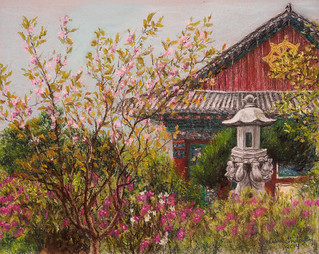
Bongwonsa Temple, Spring


Bongwonsa Temple, Spring
Pastel Painting of Bongwonsa Temple in Seoul, South Korea

See more of my artwork of South Korea on Flickr and www.melissaenderle.com

Sunday, October 12, 2014

Of Buddhist Markers and Suphuric Haze

With the sulphuric gases canceling a cable car ride to the main crater at Mount Aso, I did some walking around the mountain at a lower level. Even at this elevation, the haze from the gases enshrouded the area as if it were a foggy day. Dispersed along various ridges were clusters of Buddhist sculptures and markers. 

A stream from further up the mountain spilled into a series of small greenish pools. Despite the miniature size of the cascades, the sound of the falling water was quite relaxing. Several Japanese families enjoyed a picnic along the rocks. A few even enjoyed a quick dip in the waist-high waters. 


Friday, October 10, 2014

Grassland of a Thousand Ri

Known as Grassland of a Thousand Ri, Kusasenri is part of a 785,000 sq meter grassland formed from the floor of an ancient Japanese volcanic crater. The crater itself is around 1 km wide and has two ponds. 
After a "picnic" lunch comprised of items purchased at a 7-eleven convenience store, we had a little time to walk around or to take a 5-minute horse ride for $15. The mound on the left of photo above was formed by a lava dome. Mt. Eboshidake, pictured in both images, is one of the five peaks of Mount Aso.
The scenic view was also enjoyed by some Harley riders. To my surprise, one of the riders was female.


Wednesday, October 08, 2014

Fish on the Roof

 Having already seen some traditional buildings in (Dazaifu) Japan with ornamental rooftop decoration, it didn't at all surprise me to see mythical ceramic elements at the palace in Kumumato. This creature is known as a Sachihoko, with the body of a carp and head of a tiger. According to Japanese folklore, this the Sachihoko could cause the rain to fall. With fire being a constant danger for such wooden structures, the rain-inducing Sachihoko were believed to provide needed protection.


The placement of the Shachihoko on palace tiles reminded me of the dragons and dolkkaebi on Korean palaces, such as at Gyeongbukgung Palace in Seoul.

Dragon at Gyeongbukgung Palace
Dolkkaebi tile at Seonamsa Buddhist Temple


Monday, October 06, 2014

Shokun Hall, Kumamoto

Visitors to Kumamoto Castle have the opportunity to see part of the interior. Perhaps the most splendid is Shokun Hall found inside the Hon-maru Goten main hall. Palace reconstruction was done using traditional materials and methods. Its lacquer panels feature tales of the Chinese imperial court. 


Equally beautiful was the ceiling, comprised of lacquered squares, each measuring 90cm. The gold leaf and various plants of Japan was truly magnificent. What an incredible room for which to receive guests!

Saturday, October 04, 2014

Visit to Kumamoto Castle


I enjoying traveling to different places and photographing what "speaks to me" at the scene, but admittedly I am not much for having my own photo taken. After taking a few photos for a fellow traveler, I took up the offer to also have my photo taken with these folks dressed in traditional costumes and corresponding props. Combined with the backdrop of the commanding castle in Kumamoto in Japan, it made for a compelling scene. So yes, I was there! 


Thursday, October 02, 2014

Kumamoto Castle, Japan

Main Castle tower and smaller tower
 During my recent trip to Japan, I visited the national historical site of Kumamoto Castle. Considered one of the premier castles of Japan, Kumamoto Castle (named after the city in which it is found) has some impressive architecture, interior decoration, and a museum. Although its construction dates back to 1601 many of its structures were lost by a considerable fire just three days before a siege in 1877. Some parts were never rebuilt, while others were reconstructed as recently as 2005.

Detail - tower
Turret and walls

With its curved stone walls and wooden overhangs designed to repel ninja, it was considered to be a fairly impregnable fortress. The architect Kiyomasa also helped design some castles in Korea.

Monday, September 29, 2014

Critters at the Shrine


With the sculptures of various creatures around the shrine (including the ox previously featured), it felt a bit more like the many Hindu temples of India. True, the creatures at Hindu temples often were of gods or their avatars, but their presence at both added a little dynamism to the scene.

The entrance at most Shinto shrines are guarded by stone statues of a Chinese-like lion or Korean-like dog. Typically appearing in pairs, the curly "dog" with its mouth open is supposed to spit out good luck, while the other paired member has its mouth closed to catch evil.