
Friday, August 30, 2013
Yonsei Grill


Wednesday, August 28, 2013
Mugunghwa - the Hardiness of the Koreans

In addition to dotting the lands of Korea, the Mugunghwa can be found in China, Japan, and northern India.
Sunday, August 25, 2013
Preparing the Fibers - Watercolor

Preparing the Fibers - Suwon, South Korea
Watercolor
© 2013 by Melissa Enderle
My newest painting of a basket maker at the Suwon folk village in South Korea
Thursday, August 22, 2013

Saturday, August 17, 2013
Cookin' with the Kitty
A cartoon character may be considered popular when its image appears on T-shirts and stationery. (See my previous posting on a Hello Kitty shop at Namdaemun). When it is featured on its own airplane and cookware, then it's made it to the big scene. Yes, while at the Tokyo airport, I spotted a Hello Kitty airplane. Hello Kitty fans are encouraged to pitch their boring T-fal cookware and cook with the Kitty. Imagine how much more fun cooking and washing dishes must be when you can stare the cute feline on the bright pink (or magenta) cookware.


If you still haven't had enough of the kitty, or perhaps your cooking made you a bit queasy in the stomach, the Pink can follow you in the "little room" as well.

Thursday, August 15, 2013
Let the School Year Begin
This year marks my 20th year of teaching - hard to believe!
Below are some photos of my art room at Seoul Foreign School where I teach art to students aged 3 through grade 5. Today was our first day of school. Lots of returning, familiar faces as well as about 90 new ones at the school. You're welcome to visit our Artsonia online gallery. There are some very talented kiddos!
 |
| Entrance to our spacious, 4th floor room |
 |
| Yes, ten sinks! |
 |
| New this year: a couch and carpet by an area I'm developing as a center |
 |
| SmartBoard and carpet area, where we begin every class |
 |
| My crayon monitor system, scrap paper trays, and lots of natural light |
 |
| Entrance at the elementary school |
 |
| Looking down the stairs. Being on the 4th floor = good exercise! |
Sunday, August 11, 2013
Early Morning in Seoul

Early yesterday morning, the temps and humidity was actually ok, so I went for a nice walk in the mountain by school. Although the cone flowers and others planted here were pretty much done, the soft early morning light against the green still made for a tranquil scene.
Friday, August 09, 2013
Mopti, City on Three Islands
December 29, 2000

Built on three islands connected by dykes, Mopti is the country's major route intersection. Peoples from many groups call Mopti home, including the Bambara, Songhai, Fula, Tuaregs (and their former slave - the Bellasha), Moors, Bozos, and Dogon. Once a Bozo fishing village, it has the largest river port in what was the French Sudan and now has about 100,000 people. Pirogues and their larger counterparts, pinasses, carry goods up and down the Bani/Niger River. Transport is even possible to Timbuktu during and after the rainy season. While in Mopti, we walked over to the busy port. Here we saw slabs of salt and other items that had come from Timbuktu. People were boarding pinasses and pirogues, for either transportation or fishing.

The Niger river as well as the converging Bani river is much higher than what the Niger is in Bamako. Fishing continues to be of great importance. We also walked through the older part of Mopti. While it too had mud architecture, neither the mosque or houses were as impressive as those in Djenne. On the second day we took a pinasse to the opposite side of the Niger River, to a Tuareg slave village and then to a Bozo village. Drying fish were spread out over the sandy shore. Like children at other villages, the Bozo children followed us, full of curiosity. However, their energy levels and demands for bics (pens) and bonbons far overshadowed any others. In the evening, we were treated to a glorious sunset while traveling by river back to the hotel.

Wednesday, August 07, 2013
Djenné-Jeno, Ancient City

Just 2km from the town of Djenné lies the ancient town of Djenné-Jeno - site of the original Djenné. Although it is difficult to see much more than some remnants of the handmade bricks of a building and tons of pottery shards, the site is the oldest known sub-saharan city - dating back to the third century BC. A highly developed society of about 10,000 inhabitants, the site was mysteriously abandoned in the 14th century. Archaeological excavations reveal a highly urbanized society with domestication of animals and iron production as early as 900 BC. Djenné-Jeno is known for its excellent rice cultivation, signature mud brick architecture, and its finely crafted sculpture, of which I purchased replicas (pictured above).
Prior to visiting the site, we went to the Mission Culturelle, where we saw informative displays including examples of pottery, sculptures, and iron, which helped give an idea of what was discovered at the site in 1977. Although pottery shards dotted the ground at the archaeological site, it was expressly forbidden to remove any of them. Djenné-Jeno has long been a site for looting, with sculptures, pottery, and beads being some of the items taken.
Monday, August 05, 2013
Djenné, City of Mud

Situated on an island in the Niger Inland Delta with a population of around 10,000, Djenné is one of Mali's pre-eminent tourist attractions. Named a Wold Heritage Site in 1988, the city has taken great care to preserve the mud architecture, including the world-famous mosque. You can easily feel what sub-Saharan Africa must have felt like a century or more ago. At one time, Djenné was competing with Timbuktu as the western Sudan's pre-eminent center of trans-Saharan trade and Islamic scholarship. Now it is more of an agricultural (and tourist) town.
 |
| Djenne Mosque and Marché - watercolor by Melissa Enderle |
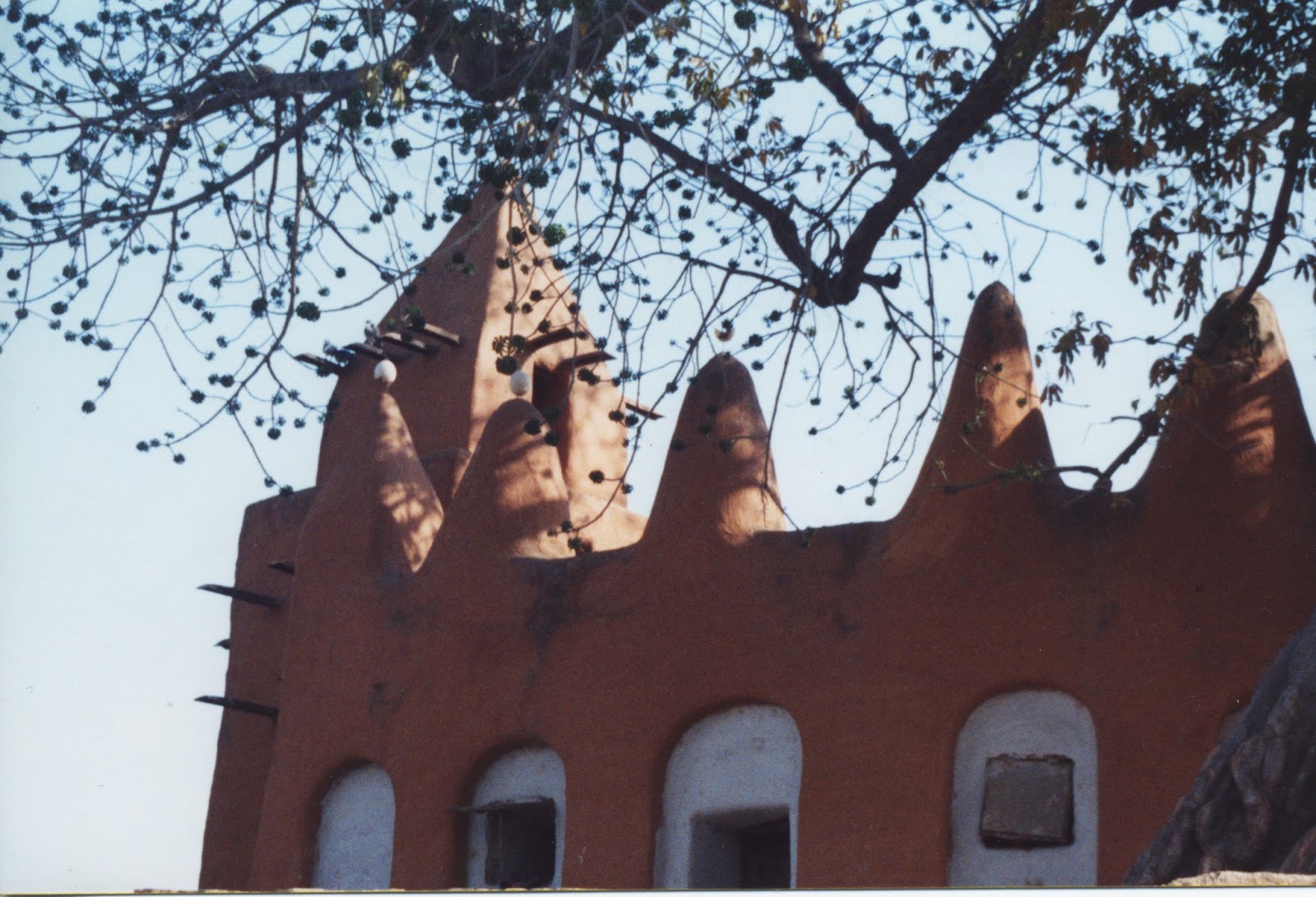
Djenne's most famous (and dominating) site is the mosque. It is actually the third mosque built at the site. The first mosque was built by the Soninke king Koi Kounboro who destroyed his palace in the 13th century for its construction. The second mosque was built in 1834 after the first one was left to ruin after it became "contaminated" by evil practices. The present mosque, built in 1905, is in the style of the original mosque. Three towers, each 11 meters high and topped with an ostrich egg, can be seen from quite a distance. In fact, the mosque is the worlds' tallest mud building. It was built in two years with handmade mud bricks, formed with a banco mixture of soil, water, and straw/grasses which become ripe after one month. Wooden beams protruding from the building serve an aesthetic purpose as well as scaffolding, to repair the building after the rainy season. Every year the surface of the mosque is resurfaced with a fresh layer of mud. Other buildings typically are resurfaced at least every other year. Efforts are being made to help preserve or restore architecturally significant buildings.

We arrived in Djenné on the day of the Ramadan feast. Everyone was wearing their new boubous, hats, and had their hair intricately done. Men had clean new haircuts, while the women and girls braided their hair, often with beads and other ornamental decorations. After walking through the narrow alleys, we climbed up to the top of a few buildings to get an aerial view of the city. From that vantage point, we could see the bustling crowds, the city's many goats, and the mud architecture, either of Moorish or Tukulor types of the Sudanese style. The tops and windows of the buildings were especially impressive. In addition, the Tukulor houses have an overhang over the door, presumably to protect it from the rain.

Djenné was one of my favorite villages in Mali. I would love to return and meander through the narrow streets, surrounded on both sides with its distinctive mud architecture. Visiting Djenné on the Monday market day is recommended for an extra vibrancy. Most visitors stay overnight at one of the five hotels/guest houses.
In 1988, the old city of Djenné and the historical site of Djenné-Jeno were added to the UNESCO World Heritage List.
UNESCO video on Djenné, City of Clay
Read more about Djenné's mud architecture construction at National Geographic

Djenné was one of my favorite villages in Mali. I would love to return and meander through the narrow streets, surrounded on both sides with its distinctive mud architecture. Visiting Djenné on the Monday market day is recommended for an extra vibrancy. Most visitors stay overnight at one of the five hotels/guest houses.
In 1988, the old city of Djenné and the historical site of Djenné-Jeno were added to the UNESCO World Heritage List.
UNESCO video on Djenné, City of Clay
Read more about Djenné's mud architecture construction at National Geographic
Saturday, August 03, 2013
Where the Bambara Kings Once Ruled
December 26, 2001
A small village about 10 km away from Segou along the road to Bamako, Segoukoro is the original site from where Bambara kings ruled a kingdom that stretched for thousands of kilometers across West Africa in the 18th century. A typical Malian Bambara village, composed of walled mud brick houses, the village has around 1500 people. I was surprised to see how simple the village was, being that it had such an important role. Aside from Biton Coulibaly's tomb (founder of the kingdom), there were few signs to indicate the village's importance. We met the chief, a descendant of Coulibaly. Walking through the village, we saw the village's three mosques, one built by Coulibaly for his Islamic mother (the king himself was animist). The newest mosque is used by the people for worship only on Fridays.
Thursday, August 01, 2013
Segou, River City in Mali
December 26, 2000
Segou
About 235 km east from Bamako, Segou is one of Mali's larger, more important cities. Located on the Niger River, Segou has the potential for economic importance. It was the capital for French occupation, the location for the Office du Niger. This project sought to provide France with raw materials such as cotton. Although a dam was built, the canals (which were dug by forced labor) were never finished; cotton was abandoned, with rice and sugarcane being planted in its stead. Segou seemed much less busy than Bamako. Donkey carts hauling sacks of grain were quite common on the streets. Fewer cars and mopeds were present. Especially near the wharf and river, there were several small shops and vendors wanting to sell you arts and crafts, including imitation Dogon pieces. Tuareg vendors were especially prevalent on the streets, wanting to sell small boxes and knives. In the evening we went to the wharf where we saw a rather nice sunset.


Tuesday, July 30, 2013
Our Own Personalized "Marching" Ants
November 21, 2000
Being in Africa, I've had to make some adjustments in how I store food, since there are quite an abundance of small ants. You'll see the tiny critters marching merrily along the cupboards, walls, etc., looking for food. They can even get in what I thought was a sealed ziplock bag! Anyway, it is also not uncommon to see the little critters at school. I even saw a couple crawling inside the clear front label of the new iMac computers. Mentioned it to the director, who didn't seem phased. Today, I went to make a change on an iMac and had to tip it to access the bottom. When doing that, I noticed something dark where a clear plastic cover was. Looking closer, I noticed movement - ants and a whole bunch of eggs - they had made a nest in the computer! That took the director's attention. We think the ants may have entered at the tiny holes in the base. Luckily, the space they were in seems quite well sealed (from the main guts of the computer). I checked a couple more computers next to that one and saw nothing. I then took a closer look at the computer I was projecting from - those couple of ants marching up the ethernet cord didn't look so innocent anymore. Sure enough, another nest. The janitors are going to check the rest tonight. Certainly I never thought of this computer dilemma!
Apologies for no photos
Sunday, July 28, 2013
A Visit to a Malian Christian Family
November 5, 2000
I was invited to go with a fellow teacher and her family to a Malian Christian family in a village about a half hour away from Bamako. As you turn off the main paved road (the road from Bamako is actually MUCH better than many of the roads IN the main part of Bamako itself), you start heading down a maze of narrow dirt roads/paths.
The house compounds are quite near each other, clustered amidst a vast area of savannah and some fields. The houses are small, many perhaps only one room. The houses are made of mud bricks. There are no glass windows, but there is a large metal door. Cooking is done outside. There is no electricity, but recently wells have been upgraded- mounded slightly with concrete and secured with a cover. These two factors have helped in reducing the amount of deaths due to children accidentally falling in open wells. Each house has a wall around its border, providing some privacy - and helping the chickens or other animals to stay in the yard. Sometimes there are several homes, inhabited by extended families.

Next to the house of the family we visited was a small chicken coop, again made out of mud bricks. Also present: an area for trash (sort of a compost heap), a small garden, and a shade tree or two. Most villages of any size have a mosque, however small and humble in appearance. Children could be found throughout the village, rolling a tire with a stick, playing soccer, or riding a bike. As usual, women and girls were more typically found working hard, preparing meals, - gathering food, washing clothes, etc.
The father of the family recounted his early beginnings in life. Like so many others in Mali, he had to deal with death at an early age. In fact, he never knew his father. Unable to provide for her many children, the mother dispersed her children to live with family members or others of the village. He was sent to live with the village chief. Like many in his village, the family held more traditional, or animist beliefs. A mission church settled in the area, spreading the Gospel in the native language of Bambara. The church also began to teach people how to read and write, a luxury not offered by the village. He took advantage of both, learning to read and write as well as learning more about Christ. The teachings appealed to him. All was well until one of his uncles converted to Islam. This uncle suddenly had no tolerance for Christians whatsoever, including his on nephew. At first the young boy did learn about the Islam religion, but soon realized that Christ was the One. Warned of the possible consequences if he did not recant his religious decision, the young boy held firm. One day he found his few belongings outside the house entryway, a direct message that he was to leave and go on his own - at the age of 10. Even now, the father and his family faces persecution (albeit sometimes subtle). They are the only Christian family in the village. The oldest son went and earned a degree in civil engineering, but can't find a job in that profession- the only jobs available are with the government, and they wouldn't hire a Malian Christian. The father is also without a job, and spends a fair amount of time providing food for his family by planting and harvesting fields of millet and other items. Plowing is done with simple plows and a donkey, but the harvesting is done by hand. Despite their many hardships, this family has extended its hand to people even more needy then they. When a child of a relative lost her parents, they took her in and adopted her. More recently, the family took in a large family (children and a widowed mother) who were homeless.

No matter how little food they have, Malian families always make sure that their guests have plenty to eat. For supper we sat on some benches and a small table, sheltered from the sun by a tin roof upheld by wooden poles - their family worship area. After hand washing, everyone gathered around the large bowls of food - some millet couscous, lentil beans, and some chicken smothered in peanut sauce. The mother began scooping heaping portions of the millet in two bowls. The rest of the food was heaped in the middle of each bowl. Gathering around one of the bowls, each person proceeded to eat by scooping with their right hand, eating the food that was in the area just in front of them. The sauce, when poured over the millet, gave the dry textured food some flavor and moistness. More helpings were provided until everyone had their fill. Just when I thought it was finished, they brought out a watermelon grown locally and began cutting it with a rather dull looking small knife. On top of the tender chicken and tasty sauce, we were presented with a large slice of watermelon to eat!
Shortly after all had their fill, we packed up to leave. Kind words were exchanged and photos were taken. Soon the sun would set; much needed to be done yet in the available light. Thanking all for their generous hospitality, we left the small village and headed back towards the sprawling village of Bamako. Although I've seen it before, this visit once again reminded me how people can be happy even though they don't have material things. Family and faith held this man and his family together and made it prosper. While he could have easily given up either as a child or as a adult, this man did not give up and held fast to his faith and family. How blessed we are in the US that we are not persecuted for our beliefs - that we are free to believe as we want! And the family's generosity, extending out a hand to the orphaned girl and a homeless family - when they themselves were poor and on hard times! Indeed, there are many things that I and others in a modem society need to work on. We can learn so much from people in poor, developing countries.
Friday, July 26, 2013
Stumbling Upon a Wedding
November 5, 2000
The day started off peaceful enough, but soon emerged to be a day filled with culture. In the morning, I heard some drumming (which is not unusual). First it sounded rather novice, as if someone was simply plunking on the drum. I continued what I was doing in my home, continuing to keep an ear out just in case there were further developments. Later,the drumming sounded more significant and refined, peaking my interest. With a small digital camera in my hand (just in case), I proceeded to start walking towards the nearby-sounding drumming. After the second turn, I heard my name called out. Here it was Wasa, the downstair teacher's housekeeper. It was not the Wasa I was accustomed to seeing though. Instead of the plain purple overlay that she typically wore, Wasa was dressed up in her finest. A dark green dress (West African style) with multicolored ornamental decorations and a U shaped neck was worn. Around her shoulders draped a white veil-like scarf Most impressive was Wasa's head. Each small section of hair was wrapped in glistening black coils, forming a decorative pattern. By the ears the coils also revealed small golden-yellow small balls, about 4 or so cascading down in an ornamental fashion. In her ears were beautiful gold earrings and around her finger was a matching ring. A headwrap from the same fabric as the dress covered a fair amount of her hair. Around the headwrap was a woven band that I had seen before. Instantly, I knew Wasa was involved with a wedding. Wasa invited me to join her at the wedding and asked me if the downstairs teacher was awake.

I quickly went home to the duplex to get the downstairs teacher and her 4th grade daughter. This time with two cameras, I went back towards the source of the music. Like Wasa, the women were all wearing their finest clothing and jewelry, with the addition of a special hairdo. Underneath the large tent, women began gathering for their portion of a wedding celebration. After we were introduced to several women, Wasa encouraged us to sit down. For the next several hours, I witnessed women celebrating their portion of the wedding celebration under the tent. I will need to find someone who can explain all what occurred, but I will now present my observations. Several other women were also wearing the striped woven band, just as Wasa did. The middle part of the long narrow band which was tied around the forehead revealed the woman's name, carefully woven in capital letters. The bands were golden yellow with another contrasting color such as black, purple, or maroon.

Two female singers and three male drummers provided the music. I am assuming that the singing was either general wedding music or words specifically directed towards the bride, etc. Women would get off their chairs and join a procession of women, already forming a line towards the music. Typically the "train" would repeat its course and go towards the music a few times before the women once again took their seat. Sometimes a few women would then begin doing the energetic West African dancing. It appeared as if the main drummer's hands and the dancers were talking to each other. Typically one woman danced at a time, before the next woman took her short time in the spotlight. Interspersed throughout the time of celebration that I witnessed were a few women who directed some words towards the crowd. I think they might be part of the griot family, which does the storytelling and recounts memories/events. During this talking, the arm of one of the women wearing the bands would have their arm raised by a neighbor, evidently recognizing that person. There was a lot of socializing occurring, women "sharing" the darling little ones with other women, and even some passing of money to a select few women. Some of that money appeared to be given to the drummers, but I'll have to inquire more. I'm sure a lot of the subtleties (and perhaps the not-so-subtle parts of the ceremony) passed by without my knowledge of what I was seeing or perhaps not seeing it at all.
Wednesday, July 24, 2013
Halloween in Mali
October 31, 2000
Mainly for the ex-pats and other families working in Mali, the American Embassy and our school hosted a Halloween trick-or-treat. Homes of expats and around the Badalabougou area volunteered to be a place where the children could stop for treats. The school was the starting point and also had candy. I decided to go and help out at the school, partly because I knew they would need help and also because I have not gone to one of the 2 "supermarche" stores in well over a month.
Kids (mostly those who attended our school) began descending on the school entryway, accompanied mostly by their parent(s) and sometimes by a driver. A few used commercially-made costumes, but many had more creative, individually (perhaps by one of the local tailors) made costumes. Or, they simply improvised with the clothing or materials they had at home. Of course there were quite a few witches, some ghouls and vampires, and a few dressed up as cats or dinosaurs in full costume. Some had makeup on as well. Children were carrying the plastic pumpkin containers or plastic bags It was quite the sight - all the kids in costumes walking through the terra-cotta dirt road - past the goats eating leaves or grass, and past the local people.
For the locals who don't even understand the whole concept behind Halloween and trick-or-treating, you can imagine why they had looks of either puzzlement, surprise, and perhaps more. Why, when you really think about it, would any sweet child suddenly wear plastic fangs in their mouth, garish makeup, and a dark costume. As I began handing out candy, I noticed the local children. Some were playing soccer (they have to be careful where they are playing, for if they hit the ball too far in two directions, the ball could land in the open sewer) and others were either standing around, playing with the handmade toys, or helping at a local produce stand. Knowing that they probably haven't had candy in quite a while (and certainly not Halloween candy), I brought the bowl closer to a few. At my urging they each took a piece. Well, word soon spread, and I was giving a way quite a bit of the candy. You should have seen their faces though - it was if they were given a precious gift!
Monday, July 22, 2013
Walking Past the Voodoo Market

On the way to the Artisan's Market in Bamako, we walked past a street-side display of wares known as the Voodoo Market. Here, sellers had skulls, fur, skins, porcupine quills, and other items on display. Superstition is very much a part of Malian culture and many people still adhere to animist beliefs. Apologies for not getting a better picture, but this was a quick "hip" shot.
Saturday, July 20, 2013
Homes in Bamako, Mali
September 2000
Thought I'd share a few things about how homes are situated here in Bamako. In contrast to many cities that I've visited, I have not seen the "rich" areas and the "poor" areas. For example, when I went to Mexico City, there were some areas especially outside the city that were "squatter" settlements. All the homes there were basically lean-to's created with scraps. Then in other parts of the city, there were lavish homes - almost in an island onto itself.

In Mali, by contrast, you will find a nice house next to a small poor one here. Take for example our duplex. Right across the street is a cement home - small to medium size. There are no glass windows or doors; goats, chickens and other animals run around and do what they please; children there are clothed either with american hand-me-down's or sometimes with only a pair of underwear - or less. A few houses down again is a large home (several stories). Ambassadors live right next to poor houses; they may have open sewer gutters right in front of their homes. In a way, I kind of like it - I get a much better idea of how the common people live and don't feel so separated. Although, I would rather not have the open sewer in front of my house :-* Most of the larger homes are constructed out of cement mixed with sand. Workers create the bricks right in front of the construction. Work seems slow, I think in part to the midday heat. In the villages, the homes may be built out of mud bricks. The roof may be thatched. Some are single one-room round huts, while others are built around a courtyard. I'll have to say, most of the common homes here are nothing of beauty - the home does not seem to be one's castle here.

Thursday, July 18, 2013
Artwork for Sale
On my website http://www.melissaenderle.com/artwork-for-sale.html I have posted some of my artworks that I'd love to sell. Some depict rural Wisconsin scenes (including that of the farmer) and others are related to my travel. Framed ones are indicated. Prices are very reasonable. Shipping is extra.
Contact Melissa via email if interested.
Below are just a few of the pieces found on the website.


Monday, July 15, 2013
Music of Mali
 |
| Hunter Harp Griot Color Pencil by Melissa Enderle |
Music is an integral part of the people. You'd be hard pressed to not find — music occurring somewhere in your surroundings - whether it be a drum, or simply a small radio. What I have noticed is that African music and dancing is not what it initially appears to be - it is not just random beats of a drum or movements. Rather, there are many complex rhythms occurring simultaneously. The dancer, who is trained and is knowledgeable of the many different dance movements, will pick up on a rhythm of the instrumentalists and begin the appropriate or fitting dance steps. The dancing requires precision, endurance, a sense of rhythm, and aerobic ability. Drums vary in size and shape. They are typically played in ensembles - many people playing at the same time. At the artisan market, I saw people smoothing the top of a skin (leather) for a drum head - with the bottom of a glass coke bottle!
I will have to admit, though, that my favorite instrument is the kora. Historically the instrument played by the griots, the kora has 21 strings and is one of the most sophisticated instruments in sub-Saharan Africa. I is a cross between a lute and a harp, with the look more resembling the lute. The main part of the instrument is made of a gourd with leather stretched over the top. The player plucks the strings, with the instrument held upright. It's simply amazing to see how fast notes can be played by using one's thumbs! I do have a picture of a kora player on my zing website. Anyway, the instrument has such a beautiful sound - much like a harp but unique onto itself. I went to a restaurant on Saturday and the kora player had me in a melodic trance. The music was delicate and yet powerful. A common theme and melody was replayed often, with slight variations. The music (he was also singing) told of things such as the great combination of hope, love, and trust. He was so into his music - it just flowed from his fingers. I am seriously looking into learning to play the kora. I did learn to play the kora, along with another teacher while living in Mali. Our teacher, Djelimady Sissoko, was very patient as we learned the fingerings, how to tune (sort of), the accompanying parts, and main melodies of the songs. All music was improvisational and had no written music.
Another stringed instrument is the ngoni which looks a little like a boat-shaped narrow lute. While in Senegal, I also heard some beautiful flute playing - reed flutes that is. Gosh, they were doing acrobatics while playing! The other instrument that I have seen quite often is the balafon - a type of wooden xylophone with keys (15-19) made of hardwood suspended over a row of gourds which amplifies the sounds. Wooden mallets are used to strike the keys.
Music is ingrained in the very blood of Malians. Whether it is playing, singing, dancing, or simply enjoying the music, the tunes of this West African country reverberate throughout the day. All of the weddings and other special functions I attended had live musicians.
Now having taught in five countries and having collected music from around the world, I still have to say that Malian music is some of my favorite.
Some Mali music you might want to find CD's of: Oumou Sangare and Rokia Traoré (female singers of Mali), Salif Keita (male singer), Ali Farka Toure (acoustic guitars), Salif Keita; For Kora, the popular players are Toumani Diabaté (video above), Ballaké Sissoko (brother of my kora teacher), and Mamadou Diabaté; Tuareg music by Tinariwen.
Subscribe to:
Posts (Atom)