Monday, July 22, 2013

Walking Past the Voodoo Market

September 2000
On the way to the Artisan's Market in Bamako, we walked past a street-side display of wares known as the Voodoo Market. Here, sellers had skulls, fur, skins, porcupine quills, and other items on display. Superstition is very much a part of Malian culture and many people still adhere to animist beliefs. Apologies for not getting a better picture, but this was a quick "hip" shot.

Saturday, July 20, 2013

Homes in Bamako, Mali

September 2000
Thought I'd share a few things about how homes are situated here in Bamako. In contrast to many cities that I've visited, I have not seen the "rich" areas and the "poor" areas. For example, when I went to Mexico City, there were some areas especially outside the city that were "squatter" settlements. All the homes there were basically lean-to's created with scraps. Then in other parts of the city, there were lavish homes - almost in an island onto itself. 


In Mali, by contrast, you will find a nice house next to a small poor one here. Take for example our duplex. Right across the street is a cement home - small to medium size. There are no glass windows or doors; goats, chickens and other animals run around and do what they please; children there are clothed either with american hand-me-down's or sometimes with only a pair of underwear - or less. A few houses down again is a large home (several stories). Ambassadors live right next to poor houses; they may have open sewer gutters right in front of their homes. In a way, I kind of like it - I get a much better idea of how the common people live and don't feel so separated. Although, I would rather not have the open sewer in front of my house :-* Most of the larger homes are constructed out of cement mixed with sand. Workers create the bricks right in front of the construction. Work seems slow, I think in part to the midday heat. In the villages, the homes may be built out of mud bricks. The roof may be thatched. Some are single one-room round huts, while others are built around a courtyard. I'll have to say, most of the common homes here are nothing of beauty - the home does not seem to be one's castle here.

Thursday, July 18, 2013

Artwork for Sale

On my website http://www.melissaenderle.com/artwork-for-sale.html I have posted some of my artworks that I'd love to sell. Some depict rural Wisconsin scenes (including that of the farmer) and others are related to my travel. Framed ones are indicated. Prices are very reasonable. Shipping is extra.
Contact Melissa via email if interested.

Below are just a few of the pieces found on the website.


Monday, July 15, 2013

Music of Mali

Hunter  Harp Griot
Color Pencil by Melissa Enderle
Music is an integral part of the people. You'd be hard pressed to not find — music occurring somewhere in your surroundings - whether it be a drum, or simply a small radio. What I have noticed is that African music and dancing is not what it initially appears to be - it is not just random beats of a drum or movements. Rather, there are many complex rhythms occurring simultaneously. The dancer, who is trained and is knowledgeable of the many different dance movements, will pick up on a rhythm of the instrumentalists and begin the appropriate or fitting dance steps. The dancing requires precision, endurance, a sense of rhythm, and aerobic ability. Drums vary in size and shape. They are typically played in ensembles - many people playing at the same time. At the artisan market, I saw people smoothing the top of a skin (leather) for a drum head - with the bottom of a glass coke bottle! 

I will have to admit, though, that my favorite instrument is the kora. Historically the instrument played by the griots, the kora has 21 strings and is one of the most sophisticated instruments in sub-Saharan Africa. I is a cross between a lute and a harp, with the look more resembling the lute. The main part of the instrument is made of a gourd with leather stretched over the top. The player plucks the strings, with the instrument held upright. It's simply amazing to see how fast notes can be played by using one's thumbs! I do have a picture of a kora player on my zing website. Anyway, the instrument has such a beautiful sound - much like a harp but unique onto itself. I went to a restaurant on Saturday and the kora player had me in a melodic trance. The music was delicate and yet powerful. A common theme and melody was replayed often, with slight variations. The music (he was also singing) told of things such as the great combination of hope, love, and trust. He was so into his music - it just flowed from his fingers. I am seriously looking into learning to play the kora. I did learn to play the kora, along with another teacher while living in Mali. Our teacher, Djelimady Sissoko, was very patient as we learned the fingerings, how to tune (sort of), the accompanying parts, and main melodies of the songs. All music was improvisational and had no written music.


Another stringed instrument is the ngoni which looks a little like a boat-shaped narrow lute. While in Senegal, I also heard some beautiful flute playing - reed flutes that is. Gosh, they were doing acrobatics while playing! The other instrument that I have seen quite often is the balafon - a type of wooden xylophone with keys (15-19) made of hardwood suspended over a row of gourds which amplifies the sounds. Wooden mallets are used to strike the keys. 

Music is ingrained in the very blood of Malians. Whether it is playing, singing, dancing, or simply enjoying the music, the tunes of this West African country reverberate throughout the day. All of the weddings and other special functions I attended had live musicians. 
Now having taught in five countries and having collected music from around the world, I still have to say that Malian music is some of my favorite. 

Some Mali music you might want to find CD's of: Oumou Sangare and Rokia Traoré (female singers of Mali), Salif Keita (male singer),  Ali Farka Toure (acoustic guitars), Salif Keita; For Kora, the popular players are Toumani Diabaté (video above), Ballaké Sissoko (brother of my kora teacher), and Mamadou Diabaté; Tuareg music by Tinariwen.

Friday, July 12, 2013

Children in Mali

October 29, 2000
As I was eating supper tonight on my porch, I could easily hear the children (boys) playing soccer in the lot next door. Despite a few obstacles such as large rocks and cinder blocks, the boys had found a good place to play the national sport. A much better location than playing on a street, where an inaccurate kick might send the ball down the open sewers on either side of the streets!

Anyway, I thought I'd write about the children in Mali. Children here begin working at a very early age, whether it is caring for their younger siblings, household chores, or even physical labor. It is quite common to see young girls carrying their youngest sibling, strapped to their back with a wide strip of cloth. Even the youngest children begin practicing the amazing (to me) feat of balancing everything on their heads. First they may steady the load with their hand, but soon carry it with ease. Young girls also begin helping with household chores, such as doing the wash by hand, pounding the millet to make flour, etc. Like their mothers, the girls seem to work longer hours than the male counterparts. Boys also do physical labor that would not be even thought of in the US. But, especially in cases where a parent has died, the children are expected to carry the load.


Children are typically quite inquisitive. Being light skinned and a redhead, I must stick out like a beacon of light. Many simply want to come up to you and gently shake your hand, and say Bonjour. If I am taking photos, they want their photo taken. Luckily I have my digital camcorder, which enables me to take pictures that they can immediately see. For some, it is perhaps the first time they have seen a picture of themselves. Often times then, they coax their older siblings or mother to look at the photos, and perhaps even have a photo taken of them as well. Like the adults though, the children seem very gentle. I have not observed arguing or fighting - or even disagreements.

"Neighborhood Children" Color Pencil
by Melissa Enderle
Appearance-wise, the children vary. Some don't wear any clothes (mostly the youngest ones). Many are wearing western hand-me-downs. Some of the clothes are clean and quite good yet, while other times the clothing is very dirty or torn. Sometimes the clothing is Malian style and is hand-made. Adults tend to be the ones wearing the hand-made clothing though. Belly-buttons are quite interesting here. Most are the "outy" variety, with many sticking WAY out - perhaps 2 inches or so. While you don't see any fat children here, I really haven't seen any children who are gaunt-thinI have heard that many families only eat one meal a day though.You can find boys with tomato cans begging along the roads for money. Often times it is a requirement for their studies in the Koran. There is not much to be found in the line of pre-made toys. You may see boys playing with homemade toys, such as a plastic spool-like thing with wire, allowing the spool to roll as a wheel. Tires are a popular toy, with a stick guiding the tire as it rolls.I've also seen some creative toy cars or similar items made entirely from junk. I haven't seen girls playing much though. I have heard that female circumcision is still practiced in Mali. Hopefully that will change - soon I pray.

Overall, the children seem happy. Even despite the need to work hard at a young age, children, like their adult counterparts, continue to be optimistic and very pleasant to be around.

Wednesday, July 10, 2013

Transportation in Bamako

August 30, 2000

Traveling in Bamako is definitely a unique experience. The levels of technology and who/what you meet while on the road are fascinating. In just my short walk to the school, I encounter many different things. There are a few paved roads in Bamako, but most, especially the side streets, are red dirt. They contain potholes or gullies which are created or enhanced by the intense rain that is occurring this time of year. The potholes fill up with rain, making huge malaria mud puddles that both pedestrians and motorists work very hard to avoid. If the hole is too big to avoid, sometimes tires and junk is thrown into the pit, reducing the depth and perhaps making it possible to drive over. Walking on foot is much less bumpy than by vehicle, but then you have to deal with the dust, mud, and vehicle exhaust. 

The most common vehicles here are bicycles and mopeds. They seem to be the easiest to maneuver through traffic, around potholes, donkeys, or whatever is in the way. If it's a car or truck, it's definitely a
4WD. Good shocks and ability to sustain the conditions of the roads are a must. Public transportation includes either a yellow taxi or bright green converted Peugot 504 and 505s. Those green bachés are very cheap, and deservedly so. The drivers erratically make themselves through the traffic, are filled to the brim with people, and often don't even have a door. The people don't seem to mind. Many are entertained by passengers who drum away on their djembe, or they begin singing and clapping. Expats tend to have a SUV-style vehicle and most have hired drivers. While air conditioning is not always present, an extra tire is a must. Changing tires alongside the road is a very common occurrence. 

Regardless of what type of transport locals take, they can often be seen with animals (dead or alive), produce, or goods piled on top of the vehicle or clutched in the hands of the two-wheeled driver. This makes the roads a bit more "colorful" but not always for the feint of heart.

Monday, July 08, 2013

A Bit of Mali

Beaded Dogon Woman - Oil
by Melissa Enderle
One of my projects this summer involved going through and scanning photos I had taken while living in Mali, West Africa. During the time I had taught there (2000-2002), I did not have a digital camera. So glad that changed, as I have taken a LOT of photos since then! Some of the photos made it into the Shutterfly book I made on Mali, just as I had created for Tunisia, Serbia, India, and my travels in Myanmar and Cambodia.

My time in Mali was also before I began blogging. Only those who were part of my email distribution list received my writings. Reading through some of them, I felt that perhaps a wider audience might be interested in some of my observations and discoveries while teaching and traveling in this poor, but fascinating country.

Stay tuned for more!


Friday, July 05, 2013

Djiguibambo Village, Dogon area

Having just scanned some photos I took in Mali prior to owning a digital camera, I thought I'd share some. Above is a scene from the Djiguibambo Village in the Dogon region of Mali, West Africa. While living in Mali, I traveled to "Pays Dogon" twice. During each trip, we visited different areas and villages. Here we see some granaries and homes within the village, along with the prominent baobab tree. 

Thursday, June 27, 2013

Hello Kitty in Korea

Hello Kitty is a popular character in Korea, whose iconic image is plastered on everything from cell phone covers to hard case luggage. There's even a pink-colored café in Seoul by the same name. It's not just for young girls either. I've seen men (without kids) sporting luggage with the familiar kitty. I have not succumbed to the lure of the pink, nor do I intend to do so.

Tuesday, June 25, 2013

Cutsey or Glitzy?


Cell phone covers and accessories are a big thing in Korea. From glitzy to cutsey to utilitarian, you can find them all, firmly clutched in the hands of smartphone users. Some of the cutsey ones are quite massive and bulky. Not my taste...

Saturday, June 22, 2013

It's Raining Cats in Yangdong

When walking through the Yangdong Village in Korea, I spotted this cat sunning itself on the thatched roof of one of the traditional homes in this UNESCO village. It reminded me of the theories of the etymology for the phrase "raining cats and dogs" in which the animals would sleep on the straw roofs of homes and slide off when wet with rain. Not at all worried about rain, this cat seemed totally relaxed and content. 

Sunday, June 16, 2013

Jongmyo Daeje Royal Ancestral Rite - an Expat's Reflection


Observing the rites and ceremonies happening at both the Yeongnyeongjeon and Jeongjeon halls at Jongmyo Shrine was a mixture of fascination, confusion, and frustration. The highly prescribed rituals were very strict and solemn. I was happy to see the young dancers and musicians of various ages who were eager to learn the music, dance, and songs in order to preserve this national treasure and tradition. Some of the traditional instruments used in the ceremony were unique and those I had not seen before. Elaborately carved and painted, form and function were equally important. With the large expansive courtyard separating the viewers from the main action taking place under the sheltered chamber area, it was difficult or next to impossible to really see what was going on.


 The cameramen with their massive equipment went back and forth, documenting the ceremony but also obscuring any view of spectators. Some wore a blue uniform making them slightly less distracting, but many others wore jeans - marring any photographic shot of the events. Announcements were made throughout the ceremony, but everything was in Korean, so foreigners were even more clueless as to the events and their meanings. To the untrained ears and eyes, things could look and sound rather repetitive and monotonous. The singing was more like chanting and the rhythms and melodies of music very different than that of Western music. This definitely was no farmer or folk masked dance. Still, I understand that the ceremony is not about nor is it for the spectators. This is a deeply traditional cultural ritual with a very solemn tone that needs to be respected and preserved. 

Friday, June 14, 2013

Wine, Prayer and Music - Jongmyo Jerye


In the next stages, three wine offerings are made, with prayers and music happening at distinct times. This was followed by four deep, ceremonial bows made by the officiants. The next stage is called Cheolbyeondu - at which time the ceremonial vessels were collected an moved slightly from their original place on the altar. At this time, the music of Heunganjak was performed by the Upper Terrace Orchestra. The Songsinye -the bidding farewell to the spirits - was the closing part, in which all the officiants offered four more deep, ceremonious farewell bows to the mortuary tablets. The tablets would then be carried back to their original locations in the shrine chambers, at which time the Lower Terrace Orchestra performed the Heunganjak. Finally, the gifts and written prayers used in earlier stages of the ritual would be burned and buried. In the original ceremony, the royal procession would return to the palace, where a post-ritual ceremony would be held to congratulate the king on the successful completion of the rite. 

Wednesday, June 12, 2013

A Ceremonial BBQ at the Jongmyo Shrine


The chief prayer reciter would enter each spirit’s chamber at the Jongmyo Shrine and bring out the mortuary tablets of the king and queen and place them on an altar prepared outside, at which time the first wine signaled the start of the rite. At this time, the Botaepyeong Music and Dance was performed. In the first part of the ritual, incense was burned to invoke the royal ancestral spirits from heaven. Following this, Jinchan, the rite of sacrifice was held. Worshippers offered meat, beef, mutton, and pork to the spirits while praying for the safety and prosperity of the royal dynasty. Each sacrificial table was carefully prepared, arranged in strict prescribed places and in elaborate vessels. On each table were three raw meats, two soups, four wild grains, two rice wines, three alchoholic beverages, six fruits, six cakes, two ried meats, four salted and fermented sauces, four salted vegetables, nuts, and bloody animal skin. Musicians seated on the lower terrace played their instruments at this time. 

Tuesday, June 11, 2013

Regalia of the Jongmyo Jerye


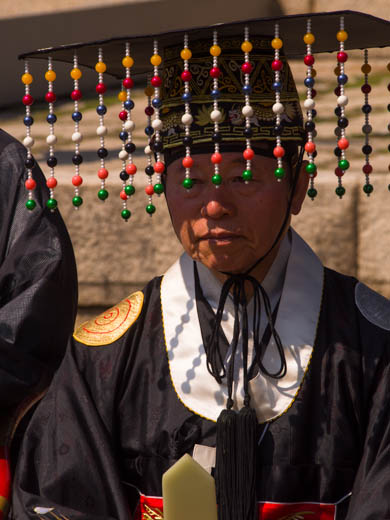
After a while longer, the officiators, all dressed in ritual robes, hats called a coronet, an angled waist belt, rear tasseled trimmings, black & white leather shoes, and carrying a jade tessera, solemnly made their way up the stairs and over to their designated spot by the different royal chambers of the Yeongnyeongjeon hall at Jongmyo Shrine. 
Each of these men would have partaken of a special purification rite beforehand, designed to keep their mind and body clean and pure before the ritual. Participants, including the king, were required to refrain from visiting sick people, listening to music, or even signing a document for a death sentence. 


Monday, June 10, 2013

Dancing with the Dragon Stick

Young people perform with carved dragon sticks as part of the Confucian Royal Ancestral Rite at the Jongmyo Shrine in Soul. This rite has been designated as the Important Heritage Cultural Heritage No. 56 as well as the Oral and Intangible Heritage of Humanity UNESCO list.

Saturday, June 08, 2013

Geogachulgung - Royal Procession to the Jongyo Shrine


While I waiting at the Jongmyo Shrine, the action was taking place elsewhere - at the Gyeongbukgung Palace. Here, the king was escorted into a royal palanquin and accompanied by civil and military officials both in front and back. The king would be surrounded by carriage attendants carrying parasols and fans, as well as a band. Leading the procession were honor guards bearing swords, spears, and flags symbolizing the king. According to the Korean tourism site, over a thousand people would proceed from the palace, go through downtown Seoul via Sejongro, Jongro 1, 2, and 3 streets, and then arrive at Jongmyo. 


Finally the sounds of the band announced the king’s arrival. Once through the gate at Jongmyo, the band and most of the procession went left, while the king’s palanquin kept on going straight. Heeding the advice of a kind Korean professor of English, I kept my spot in the straight ahead path and was able to photograph the palanquin procession, including the descendant of the royal dynasty. 

Friday, June 07, 2013

Sungnyemun Gate - Finished at Last

Ever since the 2008 arson fire that destroyed the wooden portion of Seoul's landmark, the nation has been anxiously anticipating the re-opening of the Sungnyemun Gate. Also known as the Namdaemun Gate due to its proximity with the famous market located nearby, this National Treasure #1 was one of eight gates that comprised the fortress walls originally surrounding the capital of the Joseon Dynasty. Originally constructed in 1398, it was rebuilt in 1447, the Sungnyemun Gate, meaning "Gate of Exalted Ceremonies," was used to welcome foreign emissaries as well as to keep out Siberian Tigers. During the early 20th century, the Japanese colonialists demolished the fortress walls surrounding the gate to ease traffic problems. During the Korean war, the gate was heavily damaged and was restored in 1963. Further renovations were completed just two years prior to the arson.


Adherence to the original colors, carvings, and designs was practiced in reconstruction of the wooden structure. Over 22,000 ceramic roof tiles, fired in a traditional kiln were also included to keep the gate as authentic as possible. In early May, the public opening ceremony was held.

Tuesday, June 04, 2013

Jongmyo Jerye - Ancestral Rite History


Originally, the Jongmyo Jerye, or Royal Ancestral Memorial Rite, was held five times a year - once at each season as well as an annual sacrificial day. It was also performed at auspicious events or in times of national crisis. Now it is held on the first Sunday of May. At this time, songs praising the virtues of the kings are sung, accompanied by music and dance. Two pieces were later refined- the Botaepyeong and Jeongdaeeop, extolling the desire for spiritual unity between the king and its people, as well as for the nation’s prosperity. The entire ritual is complex, solemn and rigidly conformist with specific details. It contains three parts according to Confucian principals; welcoming the spirits, entertaining those spirits, and then ushering the spirits away to heaven. 


Korea is the only country amongst the Confucian states in Asia that has preserved its royal shrine and continues to perform the royal ancestral rites.

Sunday, June 02, 2013

A Visit to the Jongmyo Shrine


This past fall, I visited the Jongmyo Shrine, located close to the Changgyeonggung Palace. Our guide explained how the long buildings were part of the shrine that housed the ancestral tablets of deceased kings and queens of the Joseon Dynasty. Originally built in 1395, Jongmyo was burned down during the Japanese invasion of 1592 and rebuilt in 1608. Throughout the years, the buildings were enlarged to accommodate additional enshrinments of royalty. The buildings themselves are not ornate. Visitors are not allowed to see the enshrined tablets or other items inside the chambers, leaving the contents of the shuttered buildings up to unfamiliar conjectures. 


Facilities at the Jongmyo Shrine all have a very specific purpose and meaning according to Confucian philosophy. For example, Sillo, the long walkway with three parallel stone footpaths leading from the main gate to the two main shrine buildings is the passageway for the spirits of the deceased; The center path is for officiants carrying the tablets, offerings, etc., while the right path is for the king and the left path is for the crown prince. Each path was paved with rough stones, forcing people to walk slowly and solemnly. Special platforms called Panwi denoted where the king and crown prince would stop and pay their respects. The gates to each of the spirit chambers have double doors with one being slightly misshapen, with the crack symbolizing the coming and going of the spirits of the deceased, as well as allowing air to get in and moderate humidity. Special staircases each have a special function and are reserved for specific people to go up and down. But for the most part, Jongmyo, with its massive stone yards surrounded by shuttered buildings, felt empty and lacked the vibrancy of the royal palace grounds. I would have to come back when the ritual ceremony take place. Only then could I begin to appreciate why Jongmyo was inscribed on the UNESCO World Heritage list in 1995 and the rites & ancestral ritual music designated by UNESCO as Masterpieces of the Oral and Intangible Heritage of Humanity in 2001.