Tuesday, August 26, 2008

Bus Ride into Tiruvannamali, Cattle Truck Out


Our vans took us to our final destination of Tiruvannamali, one of the most sacred cities in Tamil Nadu. On our way to our hotel, we saw the towering pyramids of the main temple complex. After a refreshing drink at the hotel, three of us began walking back into town. Realizing that we didn’t have a whole lot of time before we needed to get back for supper, we pondered about faster transportation methods. Seeing the local bus pulling up just ahead, we quickly jumped aboard, happy that it wasn’t full and the cost was only 6 rupees (14 cents). The open bus with its stiff board seats wasn’t a luxury, but it definitely was cheap and convenient.

Walking through the town, I felt the hum of activity around the many shops and in the streets, but it wasn’t nearly as crowded as in Chennai. The slightly slower pace was welcomed. Along the way, people asked if we could take their picture. Music projected from some of the town’s over 100 temples. Small Indian flags fluttered, above the streets, celebrating Independence Day. Along the slightly more pedestrian streets a number of people carried goods on their heads. Some shops sold religious (Hindu) souvenirs and items. Other shops had large bags of spices and hot peppers for sale. Just commenting about how the more pleasurable scents, we suddenly came across some streets with open sewers. Near the temple entrance a grey-bearded religious person clothed in orange cloth approached us and gave us some “advice.” While waiting for a bus, we noticed some people getting into the fenced back of a truck. After asking the driver if he was going past our hotel, we climbed in. When the money collector asked for an absurd amount (80 rupees - $1.84) for the three of us, one elderly man stepped up and said that no, it was only 3 rupees (7 cents) per person. A slight curiosity to have two redheads and one blond females on the back of the truck, we had a nice but short conversation with the people aboard.

At the driveway entrance to our hotel, they bid us farewell. We even had some time to have a drink on one of the hotel’s several balconies, also enjoying the breezes (not common in Chennai), slightly less humid conditions, and sunset. That evening we had a pleasurable meal at a nearby resort hotel.

Monday, August 25, 2008

Gingee Fort - Krishna and Rangantha Temples

From the arched openings of Durbar Hall, I could see the spire of Rangantha Temple. The tiles on the roof had now faded, blending in with the surroundings. I liked how the angular flat roof with its series of squares framed the inner courtyard with its more organic temple spire. In the distance I could see one of the other fortress hills.

Krishna Temple
Nearby was the Krishna Temple with its pyramidal spire. Although some of the gods and other carved figures were in bad condition, I enjoyed looking at the profusion of details contained on this spire with its curved top. I could feel one of the carved dancers jutting her hips in a dance, the gold disc decorations pulsating with movement. Within the temple area were two small stone structures that looked like enclosed altars. Nearby were some large granaries, now very dark and empty.

Banyan Tree Monkeys

Back at the base of the hill, we waited for the rest of our school colleagues to & R. Monkeys played at the roots of the banyan tree while a few baby monkeys were perched in the tree’s crook. Some of us went up one of the other hills a short way, but had to return as it was time to go. In the middle of the lush fields and surrounded by trees, I could see what looked like a small mosque and a hall. Not having enough time to explore the expansive fort, I may have to come back again to see the famed Venkataramana Temple.

Sunday, August 24, 2008

At Gingee Fort, Tamil Nadu, India - Background, Durbar Hall


Gingee Fort - History
About 4 hours and 100 miles (160 km) later, we reached Gingee (pronounced Senjee) Fort, one of the few remaining forts in the state of Tamil Nadu. Dramatically perched on the top of three jutting hills were three citadels. One could immediately see the 65 ft (20 m) thick stone walls surrounding the fort in a triangular-shaped area 7km2( (4.35 mi2). At its height Gingee was rated as the “most impregnable fortress of India,” earning it the nickname “Troy of the East” by the imperialist British. Although the region’s historical importance dates back to before 600AD with some cave temples, what we see today dates back to the end of the 14th century when the Nayyakka rulers established Gingee as their capital. Their strong fort walls, towers, temples, shrines, granaries, and tanks were built from granite.


Up the Granite Stairs
As I began to ascend the formidable-looking number of granite stairs on Krishnagiri Hill, I noticed a few monkeys on some rocks, appearing to watch guard over the great expanse. Near the top were some fortifications, including walls with arrow slits, portals, and lookout areas. Because the buildings were perched on different levels of the stony hill, it took a while to find out the best way to get to each and explore the structures. Some people chose to take the safer more worn paths, while others simply scaled up the steep rock.

Durbar Hall
One of the most prominent buildings on Krishnagiri Hill is Durbar Hall. Its small-domed top and colonnaded balconies were seen from quite a distance. I had to wait to get inside the hall, as a professional photographer was busy taking photos inside and through the windows. Once inside, I admired the ribbed arches, fanning gracefully to the ceiling. The slightly pointed window openings were multi-leveled, giving the hall a great deal of light. From the balconies one had a great view of the region. Through another entry below was a stage-like area with carvings of elephants and a series of flat-sided columns with reliefs of deities and decorative forms on them.

Saturday, August 23, 2008

Trip to Gingee Fort, part 1


As last Friday was Indpendence Day here in India, we had off of school. One of the veteran teachers organized a 2-day trip south of Chennai to Gingee Fort and the town of Tiruvannamalai to see its sacred temples.
This is the first of several blog entries on the trip. Today I will focus on the trip down south and reflect on what I saw from my van window.


After what seemed like a long time, we were finally out of the mega city of Chennai. Now, thatched huts were intermixed with more modern ones made out of concrete. Tropical trees contrasted with dry land. Scattered throughout the flat fields were colorfully clad women, bent over to carry out fieldwork. Occasionally I spotted some smaller tractors, including the recognizable colors and logo of John Deere. Combines were busy harvesting, adding to the quiet bustle. Boundaries of the small fields were mounded up, likely to accommodate rainfall. Sharing the road with motorized traffic were cows pulling loads of straw, sporting differently colored horns adorned with decorative tips.

Monday, August 11, 2008

Bridge Across the Adyar River

On Sunday I took a walk on the bridge across the Adyar River. A lion-like sculpture greeted passersby on each end of the bridge. Rather early on this weekend morning, the traffic wasn't too bad yet. Another plus, the bridge had a sidewalk so I didn't have to compete for space with all the mopeds, auto rickshaws, and other crazy traffic. While the breeze was pleasant, the stench was not. It turns out that much of the city's sewage is pumped through this river, one of two rivers that winds its way through Chennai. Litter, particularly plastic, collected along the river's edges. From the middle, I had a panormic view of my neighborhood as well as the one across the other side. The large Malar Heart Hospital punctured the otherwise rather low skyline, consisting of apartment buildings and palm trees. Near the shore one could see small thatched huts and narrow dirt paths connecting the huts. A long cement fence blocked access to most of the river - not that I would now want to gow down and visit it. In the middle of the river a rowing team practiced its skills. Hopefully the smell was less pungent from their position. So sad, as this river emptying into the Bay of Bengal could be a beautiful walk.

I find it ironic that Chennai's sister city in the US is San Antonio. With its lovely Riverwalk, downtown San Antonio is a pleasant place to go for a stroll, eat by the river, listen to concerts, shop, etc. Perhaps the sistership will provide some assistance and guidance to Chennai for revitalizing its water sources. I heard from a local that Chennai indeed is attempting (or at least talking about) to clean up the Adyar River. Money is a big issue though. Plenty of opportunities for the willing investor...

Tuesday, August 05, 2008

A Guest in a Hut

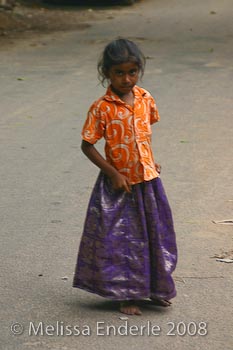
Continuing my exploration of my neighborhood and also seeking a good area for walking, I crossed the busy underpass of the Thiru Vi Ka Bridge and into the section of Arunachala Urur Puram (don’t you love the Indian names?). At first the street was rather quiet (a rarity in Chennai) and paralleled a forested area of the Theosophical Society with its surrounding wall, but then it took a turn. Two cute kids with large dark eyes were there, a little boy squatting (doing his “job”)” and a young girl with a purple skirt out on the road. Suddenly I was once again in a poorer area, a dusty road with thatched huts and simple concrete homes, a few bottomless children playing in the street, and more garbage than normal.

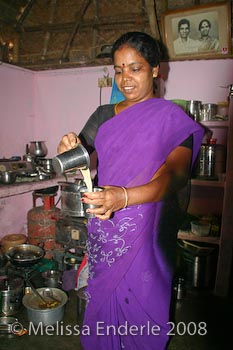
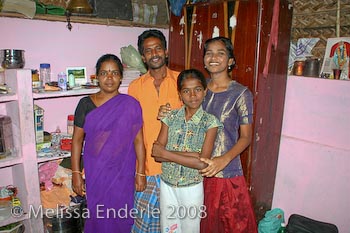
A man with a full head of hair was in a small overhang of his house, leaning into a mirror appearing at first glance to be shaving. Spotting me (very easy to do, as I stick out with my light skin and red hair), he greeted me and invited me into his small home. Kicking off his sandals at lightning speed, he entered the main room and invited me to do the same. Seeing his wife, I also took off my sandals before entering and shook her hand as she greeted me. Immediately a plastic chair was drawn over for me, the only one in the room. After being introduced to the wife and two daughters, the man asked if I would like some fish curry. With an unacclimated stomach, I politely declined, saying that I had recently eaten, even though it was about 2 in the afternoon. He then asked if I would like coffee. I felt that might be safe and simple. The aluminum cup was extremely hot, so the wife smiled, took the cup from me and began pouring the coffee back and forth from another cup from a rather large distance. This action reminded me of the tea preparation in Mali and Tunisia, an expert ritual practice that produced a slight froth on the top.
Cement walls painted in pink formed the lower interior of the house, reaching the height of the rather short (by American standards) man. A few shelves ran around the perimeter of the interior walls, holding the family’s simple belongings. On the entrance side the wife had a collection of various sized aluminum pots and pans and hotplate powered by a gas canister. On the top shelf of the next wall, I spotted a Barbie doll with pigtails sticking up. When I pointed to it, the young daughter smiled in a bashful manner. You could tell that she played with her lone doll a lot, styling the hair like any girl would. Just above the cement wall where the thatched roof began sloping to a peak was a black and white photo of the husband’s parents. A ceiling fan, along with the painted cement floor, kept the room surprisingly cool. In the corner of the room was a battered armoire, perhaps containing the family saris (traditional woman’s dress). The older daughter stood in the doorway of a second tiny room that contained a TV. On the wall next to me was a picture of Jesus with an enlarged glowing heart, along with a rosary with a cross. Asking the husband if they were Christian, he smiled and pointed to the corner of the wall where the shrine of a Hindu god was, explaining that even though they were Hindu, all religions were basically the same and respectable by him. Smiling instead of agreeing with him, I admired his tolerance and respect for other religions.

After some small talk about our families and other simple topics (the husband was the only one who was able to converse in English), I asked them if they would like their photo taken. When the husband asked if I would return again for some fish curry, I replied that I would come back as I lived close and wanted to give them a copy of the photos I had taken. Thanking them for their hospitality, I waved to the family as they stood in front of their home’s entrance and also waved bye-bye. I could tell that they felt honored to have me in their home. I was glad to oblige and do a bit of cross-cultural exchange and meet some locals of Chennai.

Sunday, August 03, 2008

A Trip to Ideal Beach Resort, Mahabalipuram

A mere 3 ½ hours after arriving at my apartment, I was boarding a school bus to the Ideal Beach Resort, located outside the historical city of Mahabalipuram, about 40 km away from Chennai. Following a shaded road to the hotel buildings, we were welcomed with a garland of jasmine flowers. Walking towards the hotel room the school rented for the day, I noticed how new all the buildings looked. This was one of the areas affected by the tsunami of 2004.

Walking along the sandy beach, I scanned the horizon of the sea. In the distance, fisherman braved the rough seas in boats hewn from logs. Along the shore, colorful boats and weathered log boats lined the beach for quite a distance. A few fishermen were mending their nets, using their toes to facilitate the process. Next to the hotel’s’ beach area, small fishermen’s huts were built a distance away from the shore. I wonder if these simple dwellings were all built post 2004, not to mention how the tsunami must have affected the livelihoods of these people dependent on the sea.

Along the warm golden sand, I spotted the carcasses of several ocean creatures, including several puffer fish, red snapper, and eels. Young men posed for a camera with the fish carcass they had used to create their version of a sand castle. Crabs scuttled, camouflaged by the sand, popping into a vast network of small sand holes. Cows lounged around on the beach, also seeming to enjoy a holiday. In the distance, more thatched huts were visible next to a more forested section. A Hindu man with his Christian wife approached us, eager to sell the bedspreads made from used saris (traditional Indian woman's dress). Although colorful and clever, neither one of us had brought any money - an easier (but truthful) way to decline buying anything.

After an enjoyable brunch consisting of both Western and Indian foods, I took a swim in the hotel’s pool – cleaner and free of dangerous rip tides than the nearby sea. Others relaxed in lounge chairs around the large pool. Rather quiet when I arrived, the pool area was later filled with the sounds of multiple languages and children splashing. There were quite a number of Korean families. It is likely that many of these will be attending the American International School in Chennai where I work. Knowing I had enough sun exposure, I decided to sit in the shade for a while. Eyeing an ice cream bar one of the Korean kids was eating, I also decided to get one – a wonderful treat on a humid day.

I then took a walk through the grounds of the resort. Flowers and plants lined the walkways. Palm trees dotted the lush lawn. Large white statues of Hindu gods contrasted sharply from the colorful surroundings, seemingly not part of the same world. Butterflies danced in the air, fluttering to the flowers in the trees and ground. Construction, most of it done by hand, was underway, with more landscaping and buildings developing.


After another walk on the beach and driveway, it was time for us to return to Chennai. I was eager to unpack my suitcases from that morning. With its closeness to Chennai and tranquility difficult to find in the city, this would be a nice place to visit for the weekend. I will then have to visit the famous granite carvings of Mahabalipuram.

Friday, August 01, 2008

Electrical grid in my backyard


This electric grid is in the driveway of my apartment building. Other ones like it are scattered throughout the neighborhood. A bit scary looking to me!

Thursday, July 31, 2008

A Walk Down the Alley

While exploring my neighborhood, I came across an alley. Perhaps this would lead me to the nearby river. Shortly into the narrow path, I met a woman carrying a baby and two other women. Noticing my Digital SLR camera around my neck, they asked if I could take their photo, to which I happily obliged. Immediately a grey-haired woman appeared, also wanting to be in the picture. Showing them the photos, they thanked me and then I moved on.

Reaching the first “intersection,” I immediately realized that I was in a slum area – so close to my nice apartment! Homes were small, trash abounded, and kids were running around scantily clothed. Daily chores were being carried out in the dirt street. I felt a bit uncomfortable, as if I was invading an area that should be closed off from the public. Perhaps seeing my look of surprise, a local helpfully directed me in English which turn to take. That street was a bit cleaner, and I could see a larger main road in the distance, with its vehicles whizzing by. Several times I was approached, each asking if I could take their photo, sometimes requested in English and other times through gestures. All too eager to see the photos, they were excited when the display would finally show the images. One boy requested a photo with his dog, tied up on a short rope near his house. Picking up the dog, the boy proudly smiled has he struggled to hold on to his pet. As I walked along, some of the kids began following me, jumping into subsequent photo poses.

I was pleasantly surprised by the eagerness of the people to have their photo taken. For some, it may have been the first photo they saw of themselves. If this openness continues, I will have many opportunities to get some wonderful shots of the locals. Since I can’t “hide” or blend in, I might as well utilize my foreignness and capture the local people when they are willing. When I get my shipment, I plan on printing photos and giving them to the respective people.

Wednesday, July 30, 2008

My neighborhood of Gandhi Nagar, Adyar - part 2

In the morning I saw many children walking to school wearing school uniforms, some looking slightly more Western and others as identically-colored salwar kemeez (loose-fitting pajama type pants with a long length shirt/dress) and matching scarf. Women also wear these salwar kemeez or the more traditional sari, formed from long lengths of beautiful cloth. They happily chat amongst each other, smiling at me and offering a simple greeting in English. Flip flops or sandals are the footwear of choice for both men and women.

Hearing a few children recite something in a formal manner, I peer through the bar openings in the wall. It is a local elementary school. A sea of black heads with pink & blue uniforms fills the courtyard along with a teacher in a cream-colored salwar. The four young presenters are on a concrete stage with a rooftop. In India, education is seen as very important, a sense of family honor and prosperity.

I can hear the sounds of a bell ringing – not from a church but from a nearby temple. Chennai has a larger percentage of Christians than other areas, but the majority are Hindu. While walking around I see several temples of bright colors, nestled in between the shops and apartments. One is even in the “island” of a road, with traffic splitting and whizzing by. The smell of incense permeates the air.

Occasionally a breeze will offer relief from the humidity and heat. Chennai is along the Bay of Bengal, but I am closer to the Adyar River. Thankfully the skies have been more overcast, also keeping the temperatures down a bit. Rains can happen suddenly, causing a brief but heavy downpour. I am fortunate that I have not gotten caught in it so far!

Monday, July 28, 2008

My neighborhood of Gandhi Nagar, Adyar

Today I was going to write about our trip to the Ideal Beach resort, but I decided instead to write a bit about my neighborhood. This morning before the school bus picked us up, I went for a walk around the immediate neighborhood in hopes of beginning to get acclimated to my surroundings. Then after we were dropped off in the afternoon, I did the same. I didn’t reach one of my destinations I was thinking of perhaps reaching, but I had a memorable experience nonetheless.

My neighborhood is rather residential. As I walk outside the open gate to the apartment entrance, I see the kolam (a decorative symmetrical design made from rice flour) on the freshly cleaned driveway. This symbol of prosperity looks different than the one I saw outside my apartment neighbor’s door, and I look forward to seeing if more variety occurs. (I will talk more about the kolam in another entry, as I think it deserves more attention).

Motorized rickshaws, called tuk-tuks, putter by and sputter, narrowly missing each other. Bicycles, mopeds & motorbikes also fight for space with the smaller cars, many of which are Korean brands and made in Chennai. The sound of a variety of horn toots and honks punctuate the air, each standing for something different – “I see you, get out of the way, I’m going to make a move, ….” Some of the bike/motorcycle drivers are wearing the required helmets, which makes it harder to talk on the cell phone – a good thing considering the dangerousness of the common practice. Many bikes and motorcycles carry several riders, sometimes an entire family. In between this seeming chaos and defensive driving are the pedestrians. One man carries a few knives and a special wheel, calling out something in Tamil which I surmise is an announcement that he is there to sharpen knives. Street dogs of medium size can be found on most streets, but they seem rather passive so far. Although the roads are paved, they are not in top condition. The occasional pothole, cow, speed bump, or darting pedestrian slows down traffic a bit.

Continued tomorrow...

Sunday, July 27, 2008

Arrival, Melissa's apartment in Chennai

Today is now my second day in Chennai. I arrived yesterday morning - EARLY morning, about 2 am. Temperature: 82°F (28°C) and humid. When my two bags finally appeared on the conveyor belt, I noticed that my blue suitcase was taped up, since it too now had its zipper broken. Alas, another victim of baggage handlers. An hour later, I was greeted by a school staff member and he led me past the eager taxi drivers to where the school van was parked. After being given a mini-tour of the apartment and a few tips (i.e. to make an outlet work, you need to turn on a "light switch" next to it), I unpacked a few things and went to bed. I wanted to catch a few hours of sleep before the bus picked us up the next morning at 7:30 for a day trip to a beach resort. (See tomorrow's posting of the Ideal Beach Resort.)

Below are some photos of the interior of my apartment. I was planing to take some photos of the outside, but it decided to rain and then it got dark at about 6:15 (day and night are fairly equal, since Chennai is only about 15° above the equator). My apartment is in the section of Chennai called Adyar, further broken down as Gandhi Nagar. This area is more residential and slightly quieter than other parts. Palm trees line the edge of the wall surround the apartment building. Curved balconies, many with plants, accent each level of the newish building. The ground level is mostly exposed, serving as a protected parking area for cars and mopeds. An elevator is useful for those heavier loads in the 5 story building.


My apartment is on the 2nd floor (2 floors above ground floor) and the entryway opens out to three apartments, each with different doors. My apartment has 3 bedrooms, one of which is empty and will be my art studio. There are three bathrooms, each with Western toilets, a sink, and a recessed tiled area for the shower (no curtains). Each bedroom and the living room have an air conditioner, as well as a celing fan (which I prefer to run). The matress definitely is not Western quality, but I will have to get used to it. The kitchen has a new gas stove/oven, a fairly new refrigerator, a new microwave, and a drinking water dispenser. A door leads to a smaller balcony where the washing machine and clothesline (suspended from the ceiling) are. A larger balcony with French doors opens out from the living room. From here I have a nice view of the apartment building next to me. Knowing how important the Internet is for teachers, they already had DSL up and running - very nice since I could immediately email family letting them know I arrived safely. The school also thoughtfully had some fruit, bread, Corn Flakes, a few place settings, and some other food necessities purchased, carrying me through a few days until I can go to the store.


Since my shipment hasn't arrived, the apartment is rather bare, void of most personal items including my paintings. I have already met one of the neighbor ladies on my level, an Indian who spends part of the year in Chennai and the other in San Francisco with her grown children who work for IT companies. I also met the two fellows who are the "gatekeepers," as well as a young cleaning lady who was sweeping the grounds with a wisk broom. She spoke now English but one of the gatekeepers could speak a few words. I ca't wait until my shipment comes so I can bake them some chocolate chip cookies.


Hopefully tomorrow afternoon when we get done with school obligations I can take a little walk around the neighborhood. The neighbor lady offered to show me where a few stores are. Stay tuned!


Sunday, July 13, 2008

India - Think Diverse

  • India is the second most culturally, linguistically and genetically diverse geographical entity after the African continent.
  • Literacy rate is around 64% (53.7% for females, 75.3% for males)
  • While English is the most important language of commerce and Hindi is the national language (spoken by 30% of the population), there are 21 other official languages and around 844 dialects.
  • Religous makeup: Hindu 80.5%, Muslim 13.4%, Christian 2.3%, Sikh 1.9%, other 1.8%. Four of these (Hinduism, Sikkhism, Jainism, and Buddhism) originated here.
  • There are over 300 million middle class residents and over 400 million cows - one for every 2 people.
  • Over 1/3 of the income is earned by 10% of people; by contrast, 25% live in poverty (less than $0.40 a day). The median age is 25 and life expectancy is around 69 years.

Friday, July 11, 2008

India - Think Big


While doing some reading for my upcoming move to India, I came across these "big" statistics.
  • India is the 7th largest country in the world - about the size of Europe combined and 1/3 the size of the US
  • India is the 2nd most populous country in the world, with over 1 billion people (1,147,000 – 2008 estimate). This includes a birth every 1.2 seconds
  • While it has the 2nd largest growing economy and is 4th largest in purchasing power, it still suffers from large numbers of malnutrition, poverty and illiteracy.
  • It is the world's largest tea producer, 3rd for milk and tobacco, 4th for wheat, coal, nitrogen fertilizers
  • There are 95 peaks above 24,600 feet (7,500 meters)
  • It has the wettest place on earth (Mawsynram), with over 467 inches (11,873 mm) of rain each year - 10x more than New York and 20x more than London
  • By contrast, the Thar Desert is about twice the size of Bangladesh.
  • India is the world's largest democracy
Photo: Creative Commons license

Monday, July 07, 2008

San Antonio River Walk


One of the major attractions of San Antonio is its River Walk. Initially constructed in 1939 as a WPA project, the network of over 17,000 linear feet of walkways and 20 bridges continues to be expanded. Lining the edge of the shallow river were bars, shops, hotels, and restaurants. Pedestrians strolled past full cafés. Guides led boat passengers through portions of the river, revealing a bit of the history and attractions. Water birds paused along the beautifully indigenous landscaped shores. On the opposite side of the narrow river, a flamenco concert was held at an outdoor theatre. Interspersed were a few small waterfalls, adding to the ambience. With the exception of some areas where cafés were right up to the river, railing was absent. This made everything more attractive, but I wonder if people falling in the river has been a problem.

Sunday, July 06, 2008

Mission San José y San Miguel de Aguayo

Having already seen the Alamo, I wanted to further explore San Antonio’s missions. Since my time was limited and the other missions spread a few miles apart from each other, I selected to go to the San José Mission that was on the public bus line and had a visitor’s center. Founded just 2 years after the first mission, San Antonio de Valero (the Alamo), Mission San José once housed up to 350 Indians in 84 2-room apartments. Although rather simple, the apartments were a huge change for the nomadic Indians.
Amidst the mesquite honey trees were remains of workshops and other unidentified buildings. Because no documentation existed on these buildings in the central courtyard, they were not reconstructed.

Limestone Church
Near the far end of the wall was the limestone church, one of the best examples of Spanish colonial Baroque architecture. Built in 1768 at the height of the mission’s development, the church contains a rich collection of statues of the Holy Family and several saints on its façade, a replica of the original richly carved wooden door, and an arched back entrance with carved animals. Pomegranates, a symbol of unity, appeared throughout the relief carvings, much as grape vines did on other churches I’ve seen. The interior of the church, still in use and under the direction of the Catholic Church was much simpler in its decoration, particularly for a Baroque church. Once completely adorned in bold patterns and primary colors, only a small portion of the exterior painting remained. Next to a small tower partially held together by old wooden stairs was the Rose Window. Perhaps the best example of Spanish Colonial ornamentation in America, this richly decorated non-circular window opening remains a mystery as to its sculptor and significance. Next to the church was the Convento, a residence for the missionaries and a place of lodging for visitors. Remnants of a few rooms and the many arches (including a few incorrectly restored as pointed arches by the Benedictine monks) remained.

Just beyond the walls of the structure was the gristmill, which ground wheat to accommodate the residents’ new diet. A park ranger was there to demonstrate the process, increasing the flow of water to the wooden wheel below, which also sped up the grinding. Periodically the church bells rang out, much like they summoned the mission residents to worship three times a day. Back inside the walls, I visited the exhibits and a spacious granary with a barrel-vaulted ceiling.
In the 104 years that San José was a mission, over 2,000 Indians were baptized. Even today, some of the church worshippers can trace their lineage back to the mission Indians.

The Missions of San Antonio


The chain of missions located along the San Antonio River in the 18th century were one of Spain’s most successful attempts to extend the Spanish kingdom northward and establish a concentrated area in which to spread the Catholic faith. In this way, the Franciscans helped expand the Spanish Empire against the encroaching French colonialists and focus on the spiritual conversion of the Native Americans of the region, supported financially by the Spanish Crown and the Catholic Church. Flourishing between 1747 and 1775, these missions also provided food, shelter and protection for the Coahuiltecan Indians. In return, these hunters and gatherers had to give up their nomadic way of life, language, clothing, names, and spiritual beliefs. In addition, they had to learn Latin and Spanish, as well as new jobs. Although European diseases such as smallpox did eventually ravage the mission and others chose to return to their former way of life, the San Antonio missions were considered a success and chartered the spiritual and cultural outcome of the region.

San Antonio de Valero (The Alamo)

Located in the heart of today’s downtown San Antonio and just off the famous River Walk, the Alamo was the first mission on the San Antonio River. Established in 1718, the Alamo was once a walled community constructed out limestone and built under the direction of skilled craftsmen recruited from New Spain (present-day Mexico).

Today little remains other than the small iconic church whose façade we associate with the Alamo. After mission activity began to wane at the end of the 18th century, the Alamo was abandoned and used as a fortress by the Mexican army. Plaques, illuminated in the early night sky, told of the historic struggle of the outnumbered Texas defenders against the advance of the Mexican army in 1835. Now a national historic landmark, the Alamo continues to draw visitors and influence local architecture.