Friday, August 12, 2016

Landap Malong Cloth


While at the Manila Collectible shop near Fort Santiago in Intramuros, Manila, this cloth caught my eye.  According to the informative woman at the shop, this 50+ yr old piece (which I purchased) was hand-woven from Maranao with all natural dyes (tumeric for yellow, cikariro root for the purple) using the ikat weaving technique. When at the National Museum of the Filipino People, I saw the Landap Malong cloth amongst its textile display. From the descriptive label: "Malongs are of several types. One type landap (means 'pure'), consists of three panels of plain, solid colored cloth. Yellow panels are called binaning. The other colors for landap may be green (gadong)  and black (pangelemen). With the color yellow reserved for royalty, this particular malong is exclusively for the members of the Maranao royal family. Tapestry panels called langkit, woven using a specialized tapestry loom, join the solid colored panels. The langkit is what makes the landap type of malong unique among the tubular garments in the Philippines." 

More information on the designs


Tuesday, August 09, 2016

Piña Barong - You can Wear your Pineapple Too

I love pineapples. While visiting some museums in the Philippines, I came across a very sheer blouse that is woven from pineapple fibers. From the description: "The piña fabric for this Barong Tagalog (upper garment) is made in Kalibo, Aklan (one of the centers for piña production in the Visayas). Piña fabrics are woven from fibers processed from the pineapple of the 'Red Spanish' variety. The fabric is then embroidered in Luzon, either in Taal, Bantangas, or Lumban, Languna, hence the term 'Barong Tagalog' to refer to the type of embellishment that completes the fabric for wear (traditionally for men."
The Barong is considered the national dress of the Philippines. It is worn untucked and with an undershirt. Fewer places are weaving the variety made from pineapple fibers, which has made the lustrous cloth very expensive and highly prized. The embroidery style is known as calado. 


After watching a video on the delicate production process, I have even more appreciation for the final product.  It takes over an entire day to make just 1/4 of a yard. While a pure piña barong fabric costs well over $35 per yard, one that is blended with silk or other fibers will bring down the cost. Repackaging the piña cloth as high-end eco fashion has brought about a resurgence. The cloth is also being used for other purposes, such as tablecloths, fans, paper, handkerchiefs, and novelty items.

Saturday, August 06, 2016

The Brickmakers of San Nicolas

On our way to the weavers, our Laoag friends took us to the heritage town of San Nicolas. The area is known for its highly plastic Bantog clay, which is transformed into Banga clay pots, tiles, well braces, and bricks. A special type of molding, known locally as Damili, is utilized. This woman made one brick at a time, pounding the clay with a wooden paddle and then scraping off excess clay around a clamped metal mold.  

I like the interplay of light, shadow, and pattern made on these drying bricks.

All packaged up and ready to go!

We also watched a woman prepare some of the clay for pottery. Using just her hands, she mixed the raw clay with the sandy mixture, wedging and kneading it together on the small wooden board.


Wednesday, August 03, 2016

Get your Frog Purse (or Dried Fish)

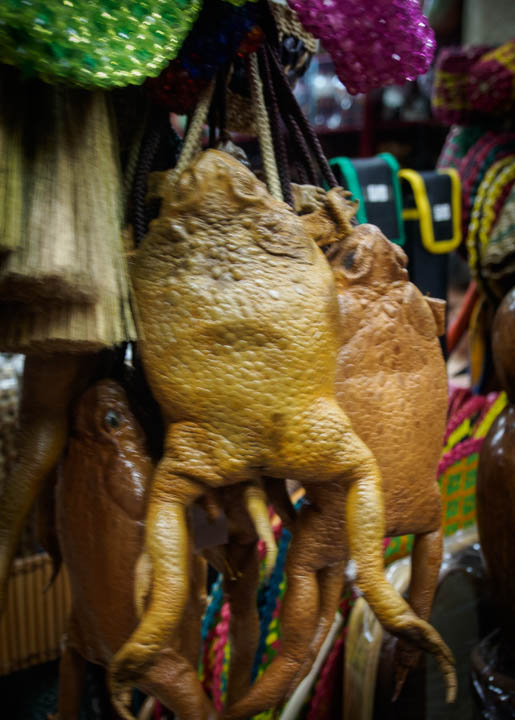
More market photos, this time from Laoag in the Philippines. Aside from the common items such as poultry, fish, and Philippine sausages, one item caught my eye - purses made from frogs. Unique, but not quite my thing. With their leathery, bumpy skin, bulging eyes, and those long legs, they would make an interesting conversation piece. I decided to save my backpack space for textiles.


Gotta love the colorful fresh fruit!
Nicely arranged display of dried fish and eggs


Sunday, July 31, 2016

Santa Monica Church of Sarrat

On our way to a small weaving village, we stopped in Sarrat. Here we visited the Sarrat church, more likely known as Santa Monica, and earlier as San Miguel.  The church was constructed around 1669 in the Earthquake Baroque and Neoclassical styles. Large buttresses give the structure its strength and stability. 
Its 137 meter long nave is the largest in the country. After several devastating fires (the church was rebuilt twice), the church was restored for a June, 1983 wedding of the daughter of Ferdinand Marcos. Just a few months after this massive (and costly) expansion and restoration, a devastating earthquake caused massive destruction of the façade and toppled the bell tower. I wondered how ornate the interior must have been prior to the destruction. 


Grotto outside the main church

Crucifix during Holy Week against the exposed bricks


An open shutter reveals the thick brick walls of the church


A bridge staircase connecting the church to a convent was constructed in 1799. Despite the earthquake and other destructive forces, it was still in rather good condition.

According to our local guide, this was once a torture room.

The church has now been declared by the government as an important cultural heritage property. It is hoped that this will provide funding needed for restoration.

The town of Sarrat is also known as the birthplace for  President Ferdinand Marcos.


Saturday, July 30, 2016

Artwork: With a Begging Bowl and a Toy Car

Here is my latest artwork, a color pencil drawing of a little monk at a Tibetan temple of Zhiyun Monastery, located by Lashi Lake in the Yunnan province. Wearing pink crocs and a red robe, this little monk playfully swung his orange bowl as he passed through the ornamental gate up to the main Buddha Hall. In his other hand he clutched a green plastic toy car. In the massive shade trees near the temple entrance, many young monks engaged in a game of soccer.

Tuesday, July 26, 2016

Sinking Bell Tower

One of Laoag's famous monuments is known as the Sinking Bell Tower. Built around 1707 by Augustinians after an earthquake, it is one of the oldest and most massive bell towers in the Philippines. Standing at 45 meters ( feet) tall, the structure is of the earthquake baroque style, constructed of locally manufactured bricks, joined with molasses and plastered with lime stucco. The massive base whose foundation is 90 meters (300 ft) supports its graduated upper tiers and is topped with a dome and cross. 

Like other earthquake-proof baroque style buildings, the tower has sturdy buttresses and is separate from St. William's Cathedral, which is actually 85 meters (279 ft) away. 


Built on sandy soil, the tower has been sinking at a rate of 2.5 cm (one inch) per year, thus lending its landmark name. At one time, a horse-mounted rider could once enter the vaulted door quite easily; now even a person of ordinary height would have to stoop. Despite its sinking status, the tower still performs its function of calling its Catholic members to mass via massive bells. 
When I visited the Ilocos Norte town, entry inside the tower was not permitted.

Friday, July 22, 2016

Lilies And More at the Centennial Gardens

The Allen Centennial Gardens contains a wide variety of lilies, lovingly tended by a special club dedicated to lilies. Below are some photos of the garden's lilies that I took, along with a few other types of plants and flowers.


Thursday, July 21, 2016

Enjoying a Picnic with E.T.

The lawns of the Madison state capitol became a patchwork of colorful blankets for the evening's Concert on the Square. Around 50,000 attendees attended the free concert featuring well-known movie songs by composer John Williams. It was a great evening to enjoy a picnic dinner, and even some wine. Both young and old (as well as some dogs) were captivated by the well-known songs of the composer whose scores span six decades. Some of the favorites included the Star Wars theme, Indiana Jones, Superman, and ET.

Tuesday, July 19, 2016

Through England and France at the Centennial Gardens

The Allen Centennial Gardens contains several areas, each with their distinct look. In one section, there was a pond, complete with waterlilies and a small wooden bridge, which temporarily transported me to Monet's gardens in Giverny or the Taikobashi Bridge of Dazaifu. It did have some cattails and milkweed, which reminded me that I was indeed in Wisconsin.
Beyond a high hedge was a European-style garden, complete with manicured shaped hedges and sculptures.

With some tweaking on the gazebo, I could have been at the Garden of the Morning Calm near Seoul.
It was fun watching the koi and other fish swim in schools. Such a common sight in Asian gardens.

All in all, a beautiful place to enjoy on a Sunday afternoon!


Thursday, July 14, 2016

Dean's Residence, 10 Babcock Drive

This past weekend, I revisited the Allen Centennial Gardens in Madison. In addition to the beautiful gardens, the UW Madison landmark includes a stately Victorian Gothic house that was once the home of the first four agricultural deans of the university. 

Built in 1889, the house is now on the list of the National Register of Historical Places. Placement on the historical registry helped save the building from the encroaching claws of the ever-expanding university. The structure is currently undergoing renovation and will be repurposed as a student center.


The exterior still has some beautiful details such as this window. I wonder how much of the original interior ornamentation still exists. I hope that when the interior is completed, it will be open to tours. 


Sunday, July 10, 2016

Madison Art Fair on the Square


Mostly blue skies welcomed visitors to Madison's Art Fair on the Square, held July 9-10. Yesterday I went to the annual juried event, set around the beautiful capitol square. Around 500 artists set up booths, exhibiting photographs, ceramics, weavings, jewelry, sculptures, and more. It was enjoyable viewing the varying styles, and I was particularly drawn to the international booths such as Mexican retablo, Chinese embroidery, and Peruvian weavings. 

Visitors to the visually stimulating event could also enjoy plenty of snacks/drinks (including some Wisconsin specialties and free chocolate chip cookies) and listen to live performances. Based on the large crowds I saw on Saturday and the pleasant weather, I wouldn't be surprised if attendance was over the normal 200,000.

Friday, July 08, 2016

Sandboarding down the La Paz Sand Dunes

On my tour of Laoag, my guest house friends took us to the La Paz Sand Dunes. This stretch of coastal sand dunes is an easy 15 minute drive outside of Laoag and spans for about 85 square km (52 miles) along the South China Sea. It is a popular site for films, both Philippine movies and Hollywood. Mad Max and Born on the Fourth of July both shot scenes in this coastal desert. 
Sand dunes can reach up to 90 meters (295 ft) in height, but are constantly changing due to variations in wind, currents, weather, sedimentation, and types of vegetation. 

In one area, adults and kids were sliding down the dunes on boards. It hearkened me back to my snow tobogganing and sled riding days on the glacially formed hills on the family farm in Wisconsin.

Jeeps and 4x4 vehicles could also be seen driving over the dunes.