Melissa Enderle's travelblog on her travels to Mali, Tunisia, Serbia, Eastern Europe, India, South Korea, China, and other places around the world.
Saturday, December 22, 2012
Friday, December 21, 2012
Secret Garden of Changdeokgung Palace
Once past the ticketing gate by Hamyangmun, the beautiful area of Changdeokgung Palace, known as the Secret Garden, beckoned. Revisiting the UNESCO site in fall, I was thrilled when the tour guide (normally mandatory for this section) announced that those who wished to venture off on their own could do so. It would be a bit more like how it was for the royal family of yesteryear, wandering through the hilly but shaded paths of the forest, stopping to enjoy the beauty of the ponds, architecture, and natural landscape.
The first main item of note is the rectangular pond known as Buyongji, framed by the lotus-shaped Buyongjeon pavilion, a small Sajeonggibigak building, and a larger Yeonghwadang Pavilion, where state exams were sometimes held. Opposite the pond with its central tree now ablaze in red, is the Juhamnu Pavilion. Perched many rows of steps up on a hill, this structure commands a fine view of the surroundings. I imagined what joy this scene must have given the royal family when they came here as a retreat or for study. Such harmony of buildings with the natural surroundings.
Walking through paths shaded by fall-colored trees
Thursday, December 20, 2012
Stairs to the Secret Garden
Although today's visitors must pass through metal gates when wanting to visit the Secret Garden of Changdeokgung Palace, royalty once was able to ascend a much more peaceful-looking set of stairs and gate. With such lush greenery beyond the enclosed arched gateway, a walk through the cooler forest beckoned.
Tuesday, December 18, 2012
Daejojeon, Changdeokgung Palace
The queen's residence at Changdeokgung Palace, Daejojeon is one of the few buildings in which one can see furnishings. Above we see some ornate but very hard-looking furniture, decorated in mother-of-pearl. Above the doorway was a beautifully carved phoenix, traditionally a symbol for the Queen. Phoenixes are associated with peace, prosperity, and happiness - a bit ironic, considering that the Daejojeon was the site of the last cabinet meeting of the dynasty in which Japan's annexation of Joseon was deliberated.
Outside of the area buildings was the fire cauldron, meant to quickly help put out fires in the immediate area. I guess it wasn't effective enough, as Daejojeon was destroyed by fire in 1917.
Labels:
architecture,
Japan,
palace,
Seoul,
South Korea,
war
Sunday, December 16, 2012
Black and White on Black
Always on the lookout for interesting decorative tiles and wood pieces of the buildings at Changdeokggung Palace, I always make a point of looking upward. The black and white markings of this bird made it blend in with the black dragon tile on which it had perched.
Friday, December 14, 2012
Simpler Style, Changdeokgung Palace
Located just below the stepped hill where the Samsamwa pavilion is situated, one can find the complex known as Nakseonjae. Built in 1847, it was King Heonjong's favorite place to relax and read. Unlike other structures in the palace that are colorfully and decoratively painted, these buildings retained the simpler brown and white hues. In fact, the interior and exteriors were very similar, as evidenced by these photos. Nakseonjae was used as recently as 1989, occupied by the last crown prince's wife and used as a residence.
The walls currently surrounding the buildings here were restored in 1996, after being removed during Japanese occupation.
Wednesday, December 12, 2012
Crown Prince Residence, Changdeokgung Palace
Just before the entrance to Changdeokgung Palace's famous Secret Garden is a set of buildings that once was the crown prince's residence. Some of the buildings (where the gate entrance for the garden currently is located) were removed in 1891. The only original buildings that remain today are the hexagonal pavilion (Samsamwa) and Seunghwaru. These structures were once connected to Seongjeonggak (originally the crown prince's study and later used as a royal hospital during Japanese occupation) via corridors.
Tuesday, December 11, 2012
Palace House Interior Doors
A few of the buildings at the Changdeokgung Palace allow visitors to peek inside. Typical of the period, the Nakseonjae building's walls, doors, and windows are covered with white rice paper. I love the geometric designs framing the doors. The circle door in the photo above added an artistic, almost modern flair.
Sunday, December 09, 2012
Blue Tiles of Seonjeongjeon
Whereas the main throne hall of Injeongjeon was reserved for VIP events, it was the Seonjeongjeon building where more routine state affairs were handled. Destroyed twice, it was rebuilt in 1647. Unique amongst the buildings at Changdeokgung, its roof is made from blue tiles. Each of the 150,000 tiles was baked individually to give maximum strength and longevity. Once common in roofs of Korea, these blue tiles are now limited to a few places in the country.
Saturday, December 08, 2012
Injeongjeon Throne Hall, Changdeokgung Palace
The throne hall of the Changdokgung Palace, much like that of Gyeongbokgung Palace, has the outer appearance of being two stories, but in actuality is a single floor with a lofty ceiling. Westernized in 1908, it has electric lightling, glass windows, curtains, and wooden floorboards (which replaced baked clay blocks). Coronation of new kings, major political affairs, and receiving of foreign envoys took place here.
See below for a 360°view
Interior of the Injeongjeon (the throne hall), Changdeokgung Palace in Seoul
Thursday, December 06, 2012
Geumcheongyo Bridge, Changdeokgung Palace
The oldest stone bridge in Seoul, the Geumcheongyo bridge was built in 1411 over the auspicious stream Geumcheon. This stream demarcates the outside from the inside of the palace. Like the area of the palace leading up to the main hall, it had three lanes, with the middle one set aside for the king. Two arches of the bridge are met by stone creatures. On the northern side of the bridge is a Hyeonmu (black tortoise) and on the south, a haetae (mythical guardian beast). Faces of guardian animals protrude from just below the railing, meant to ward off evil spirits.
Labels:
bridge,
palace,
sculpture,
Seoul,
South Korea
Location:
Changdeokgung Palace, Seoul, South Korea
Wednesday, December 05, 2012
First Snowfall in Seoul
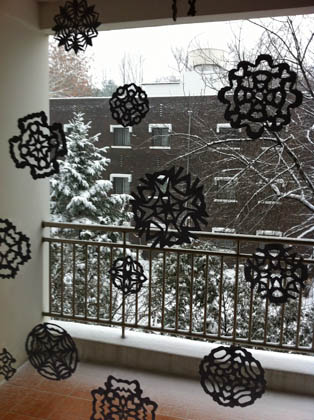
Aside from some remnants of snow on the ground last spring in Kashmir, it's been four years since I've had to deal with the white stuff. Just before noon, flakes began falling in Seoul. The kids were so excited, anxious to get out and play in it. Kids had fun making the slides extra-slick, sort-of making snow balls, and sliding down the hill by the school. For some, it's been a few years since they experienced snow, and there are a few at school who had never been in snow. With the slippery roads, it sure was nice to do the 2 minute walk to my apartment building, instead of dealing with "The Hill." From my balcony window, I had a nice view of the snowfall - all in the comfort of a warm apartment. Just the way I like it.
Tuesday, December 04, 2012
Donhwamun Gate, Changdeokgung Palace
The entry into the Changdeokgung Palace is through a two-story wooden gate called Donhwamun. Built in 1412, it is the largest of all Seoul’s palace gates. It is the gate that the king would use to enter the palace; attendants would enter the western Geumhomun gate. Like nearly all of the palaces, this gate fell victim to Japanese destruction, burned in 1592 and then restored in 1608.
Labels:
architecture,
Asia,
Japan,
palace,
Seoul,
South Korea,
war
Location:
Changdeokgung, Seoul, South Korea
Sunday, December 02, 2012
Changdeokgung Palace, Seoul
Built as a secondary palace to Gyeongbokgung for the Joseon Dynasty in 1405, Changdeokgung became the residential palace and later the main palace. After the Japanese invasion from 1592-1598, it was the palace that was reconstructed (1610) and served as the main palace, until Gyeongbunkgung was finally rebuilt from the ashes in 1868. About 30% of the structures from pre-Japanese times still remain; others have been since restored. Unique amongst the city’s palaces, Changdeokgung was laid out to be harmonious with the topography. Although the palace has some beautiful and naturally arranged buildings, it is the rear garden that steals the show. Recognizing the palace as an “outstanding example of Far Eastern palace architecture and garden design,” it was designated a UNESCO World Heritage site in 1997.
Labels:
architecture,
Asia,
Japan,
palace,
Seoul,
South Korea,
UNESCO World Heritage Site,
war
Location:
Seoul, South Korea
Saturday, December 01, 2012
Wednesday, November 28, 2012
Shopping, Nandaemun-style
Needing to purchase some Christmas lights, I headed over to Nandaemun, a large market area in Seoul. Still early (for Seoul) on a Sunday morning, the streets were rather empty. If you have enough time to look around (and perhaps bargain), one can find quite a bit in Nandaemun and at better prices than department stores. Food can be purchased street-side or in the shops. Something for everyone. If you wait until the afternoon though, the streets may be packed with shoppers and sellers alike.
The Christmas decorations and huge numbers of stalls and stores selling winter jackets was a strong reminder of the season to come. Not sure if I'm ready though...
Labels:
Asia,
Christmas,
Seoul,
shopping,
South Korea
Location:
Seoul, South Korea
Wednesday, November 21, 2012
Reflections of Fall in Korea
Although the chill is fast following the changes in the trees, I definitely must say that fall in Korea is just beautiful. So many of the days are sunny, with clear, blue skies. Add to that the spectacular colors, and you have a splendid recipe!
Below are two photos I took this past weekend, while walking through the Yonsei University campus on the way to my apartment. On the upcoming crisp, grey days, such photos will surely warm me up!
Monday, November 19, 2012
Flaming Bush
Although the peak of fall in Seoul has now past, there still are enough reminders of fall's beauty around. I was drawn to the deep redness of this bush/tree, with its leaves ablaze and cascading towards the ground. Against the sunny clear sky, it was a sight to behold.
Thursday, November 15, 2012
Washed out at the DMZ
After many beautiful weekends, the day our tour to the DMZ between North and South Korea was to take place ended up being a rainy, dreary day. Photographic opportunities were a near zilch, between the steady rain and fog. At the Panmunjeom Joint Security Area occupied and possessed by both the UN and North Korea, the North Korean soldiers were no where to be seen. We couldn't even go into the blue building on that day, which would have enabled us to momentarily step over the line into the North Korean administered area.
At the observatory, fog obscured any view of North Korea. A drive through the DMZ took us through areas that were quite silent and void of any action, on or off the road. While the forested area looked rather serene, our army guide explained that land mines were scattered throughout the region. With the absence in human interference in the 4km wide by 250 km long heavily militarized border, a number of species not seen in other areas have flourished. The guide recalled seeing what is known as a vampire deer. The one place not hampered by the rain was the tour down the Third Infiltration Tunnel. About 1,600 m long and 350 m below ground, this tunnel, discovered in 1978, is only 44km from Seoul and could have accommodated 30,000 troops per hour. A hard hat was a welcome accessory in the rather low-ceilinged tunnel.
We also visited the train station of Dorasan. Hailed as a symbolic place for national unification, this rather new (and well maintained) train station once allowed special travel between the two Koreas, but since 2009, the station has been the final stop, no more entering the northern country. Our guide from the USO in Seoul talked about a factory in North Korea that made a South Korean-brand snack cake and whose workers were given some of the cakes as a bonus. Instead of eating them, the workers would sell the prized snack and use the money for basic necessities.
At the train station, the rain momentarily subsided, granting me the opportunity to take this photo. Indeed, this area of the Koreas is equally as beautiful as what is found down south. It is the fervent hope of many that one day such beauties can be shared with a unified country and re-united family members.
Labels:
North Korea,
Seoul,
South Korea,
war,
weather
Location:
Panmunjeom, Kaesong, North Korea
Wednesday, November 14, 2012
Tuckered Out
After a long stroll through the Gyeongbokgung Palace in Seoul on the day of Chuseok (harvest festival), this young girl succumbed to her need for a nap on the stairs of a building in the queen's quarters.
Labels:
children,
clothing,
festival,
holiday,
palace,
Seoul,
South Korea,
traditional
Location:
Gyeongbok Palace, Seoul, South Korea
Monday, November 12, 2012
Common no More
During the Joseon Dynasty, this scene in the palaces likely would have been rather common - women and men wearing colorful hanbok outfits. Literally meaning "Korean Clothing," the hanbok, with its simple lines, underwent many changes throughout the years - some due to practicality reasons and others influenced by fashion from neighboring countries. Today, however, its use is reserved for only special occasions and TV drama.
Saturday, November 10, 2012
Ten Longevity Chimney
Located on a wall surrounding the rear garden by the Queen Dowager Jo's residence of the Gyeongbokgung Palace is what is known as the Ten Longevity Chimney. It contains ten smoke vents that are connected to each room of the queen's residence, providing the heated floor system known as Ondol. The front of the chimney contains ten longevity symbols, each bestowing wishes for the health and happiness of the queen. Labeled as a historical treasure, it is seen as the finest of all chimneys built during the Joseon period.
Red through the Gold
Located at the rear of the Deoksugung Palace in Seoul, this structure completed in 1900 is a mixture of Western and Korean styles. Whereas I found the Seokjojeon Neoclassical style building to be quite out of place, I rather like the combination here. On this fall day, the golden tree motifs surrounding the veranda, along with the gorgeous flaming tree framed by the veranda scrolled roof made the scene all the more memorable. Hard to believe that skyscrapers and embassies lay just beyond the wall in a city of over 10 million.
Labels:
architecture,
Asia,
fall,
nature,
palace,
Seoul,
South Korea
Thursday, November 08, 2012
The Feminine side of Gyeongbokgung Palace
Located towards the rear of the Gyeongbokgung Palace in Seoul, the area known as Hyangwonjeong is one of the most picturesque areas of the palace. The small pavilion pictured here lacks the imposing feeling of the main throne hall and even the other pond-surrounded pavilion known as Gyeonghoeru. With its collection of water lilies, distant mountains, and a narrow bridge, the area exudes tranquility. In this section of the palace, a separate living quarters known as Geoncheonggung was built in 1873 for the king and queen.
Tragically, Geoncheonggung was the scene of the Japanese assassination of Queen Myeongseong in 1895. After that, many of the buildings were demolished so a Japanese Governor-General's residence could be built. After that, the garden area became residence for the US military-led government, and then as a residence for the Korean president. Restoration of the area was completed in 2007.
Labels:
architecture,
Japan,
palace,
Seoul,
South Korea,
war
Location:
Gyeongbokgung Palace, Seoul, South Korea
Tuesday, November 06, 2012
Mali without Music?
Having lived in Mali, I can attest that music is at the heart of Malian culture. Whether it be in the back of a baché (public transport van), street corner wedding celebration, eating place, or any public gathering location, the incredible melodies played on traditional and Western-style instruments permeate the air. Many of its musicians, particularly those in the south, are multi-generational griots, dating back to times of the Malian kingdoms. Music is society's way of retelling history, celebrating events, sharing ones' woes, praises and testaments of love and whatever forms of expression one needs to communicate.
According to a Public Radio International article I read yesterday, the very future of music in the northern part of Mali is in peril. Following a Tuareg revolt in the north, in March 2012 the government of the country was overthrown in a coup over displeasure of its perceived mishandling of the revolt. Since then, Ansar Dine, a group with reported links to al Qaeda has stepped in to take control over the northern portion of the country, seeking to impose a Sharia Islamic law over its inhabitants. According to this fundamentalist, extremist set of Islamic laws, any music besides devotional music is banned. While this is certainly an unpleasant shock to the everyday life of most citizens in this area, for its musicians, it means a loss of income. Instruments and amplifiers have been burned, and musicians have been threatened with amputation. Some musicians, such as the Tuareg (Tamasheq) group Terakaft have resorted to live outside of their homeland country. Unable to return to their beloved desert lands, these blues singers certainly have something to pine for.
For Mali and the world that has come to love the incredible music of this West African country, the loss of music here and its musicians would be a global tragedy.
See more paintings of Mali by Melissa Enderle at www.melissaenderle.com
Sunday, November 04, 2012
Through the Gate
Right across the pond from the Buyongjeong pavilion is the much larger Juhamnu building. Since we are not permitted to go up to the building, I had to enjoy it from afar. With its rather narrow frame, the gate leading up to Juhamnu feels rather top-heavy when looking at it from straight-on. Get closer and at an angle, and it becomes a soaring beauty. What a view the royal family and its visitors must have had from the balcony of the Juhamnu building. Such tranquil beauty.
Labels:
architecture,
fall,
palace,
Seoul,
South Korea
Location:
Changdeokgung Palace, Seoul, South Korea
Subscribe to:
Posts (Atom)