Thursday, August 18, 2011

Preparing the Banana Leaves

Sitting in the shade of his tiny shop, this man was busy cutting banana leaves into smaller sections. For South Indians, this is the traditional plate, onto which large amounts of rice, dhal, idlies, chutneys, and other favorite dishes are served. Traditional Tamil meals are eaten with the right hand while sitting cross-legged on the floor.

Wednesday, August 17, 2011

Hanging Up the Flag

Early in the morning on India's Independence Day, this couple works on hanging up the country's flag.  Note the double-signage on their shop. This past spring, the state of Tamil Nadu required compliance with the law requiring businesses to include Tamil in their signage. Some simply added a second sign or crammed on the Tamil onto the existing sign.

Tuesday, August 16, 2011

Red on Green

Amidst the fluttering butterflies, I spotted this insect, whose intense red coloring contrasted sharply with the green leaves. 

Monday, August 15, 2011

Remembering Gandhi

While walking in Mylapore (Chennai), I spotted this memorial of Gandhi. An extra large kolam along with smaller ones lead up to his statue, with flower petals adorning the top step. Around his neck is a large garland of flowers, a sign of adoration and honor. 

Sunday, August 14, 2011

Happy Independence Day - India Style

August 15, 2011 marks the 64th anniversary of India's independence from British rule. While one could find the customary flags waving in celebration, I found the garlands of flowers to be much more fitting for India's (particularly here in Tamil Nadu) love of flowers.

Ready to Walk


The roots of banyan trees are fascinating. These appear as if they will suddenly lift out of the ground and walk away.

Wednesday, August 10, 2011

Bounty of Bangles

Indian outfits are all about color. It makes sense then, to accessorize them with matching bangles. Some are plain, while others are studded with mirrors and other decorative elements.

Monday, August 08, 2011

Lone Fisherman

Unlike the group of fishermen working in yesterday's post to remove the fish, this fisherman is working alone. He seems to be in a contemplative mood, deep in thought. Perhaps it was an unproductive fishing trip. 

Medical Tourism in India

Medical tourism continues to grow in India. Latest estimates that this sector will generate around $108 billion by 2015. Around 850,000 foreigners travel to India for access to inexpensive medical care, for a total of around $1 billion in revenue. Areas including cardiology, joint replacement, orthopedic surgery, transplants, and urology are the top draws for medical tourists from the Middle East, Europe, America, and neighboring countries.

Image source: http://images.paraorkut.com/img/pics/images/d/doctors_stethoscope-13168.jpg


Friday, August 05, 2011

Picking Out the Fish

After an early morning fishing excursion, these men are picking out the small fish entangled in their nets.

Wednesday, August 03, 2011

Of Chilies and Limes

Hanging in front of some homes, businesses, and even on some vehicles (particularly those that are new) is a string of chilies and a whole lime. Known as a nimboo-mirchi, its purpose is to ward off the evil eye cast by neighbors, onlookers, and enemies. Likewise, any ill wishes or feelings of harbored jealousy are said to dissipate. Nimbu-mirchis can also remind us of the sweet moments that are sure to follow more sour events in life.

Monday, August 01, 2011

Morning Milk Delivery

For many residents of Chennai, milk delivery is still a part of their daily ritual. Some walk to the distribution corners, such as this one at the end of my street. Others, such as the man by the motorcycle, loads large amounts into bags and then delivers the plastic sachets to customers. All this must be done rather quickly in order to beat the South Indian heat.

Green and Gold- Wisconsin Style


Here's another photo from one of my morning walks by my parents' house in rural Wisconsin. It's even patriotic - that is, the Green & Gold of the state's beloved Packers football team.

Thursday, July 28, 2011

Golden Landscape

The amber fields in Wisconsin offer a warm glow in contrast to the green corn and hay fields. Next week, the tranquility of these fields will be replaced by the chaotic India streets.

Saturday, July 23, 2011

Finishing Touches on Kolam

Finished a color pencil drawing of a young woman working on a kolam (rangoli).

Friday, July 22, 2011

My Mother's Backyard

Gardening and flowers has always been a passion of my mother's. Now that she is retired, she devoted even more time to tending her many gardens and pond nestled around their house in Wisconsin. This coming Tuesday, her efforts will be featured in a garden walk. Congratulations, mom!


- Posted using BlogPress from my iPad

Location:Theresa, Wisconsin

Wednesday, July 20, 2011

Victoria Terminus Interior

After admiring the exterior of the Victoria Terminus Railway building, we ventured inside. As expected, the architecture here was also admirable, filled with lots of details. 
Being as it was only around 8am on Sunday, the platforms weren't as crowded - much to my pleasure. I can't imagine how dense the crowds would be at peak times.

Tuesday, July 19, 2011

Peacock Window

The elaborate Victoria Terminus building also has some beautiful windows, such as this one with a peacock design above it. Very appropriate, as the peacock is the national bird of India.

Monday, July 18, 2011

Victoria Terminus Dome


The Domed structure on the Victoria Terminus building is particularly pretty. Standing on the top is a massive statue of the female figure Progress, holding a spoked wheel and torch.  Note the many gargoyles protruding from the sides, just as in many Gothic cathedrals.

Friday, July 15, 2011

Victoria Terminus Building, Mumbai

The Chhatrapati Shivaji Terminus, formerly known as Victoria Terminus, is one of the busiest railway stations in India. Built in 1887 in a Victorian Gothic style, this structure is to be admired for its beauty as well as how it manages to serve so many people every day. It is now a UNESCO World Heritage Site.

Thursday, July 14, 2011

I'll Have That on Ice

In steamy Mumbai, it's imperative that just-caught fish be cooled down quickly. To transport the fish throughout the city, they are placed in baskets, including these woven ones. Not sure I'd want to carry a loosely woven basket of fish & ice on my head in a hot climate....

Wednesday, July 13, 2011

Making Breakfast the Big Way

This man was busy making breakfast in the area of Mumbai where fish were being packed with ice and distributed. No doubt those porters and fishermen had drummed out a healthy appetite. 

Monday, July 11, 2011

Like Old Times

While visiting a village south of Jodhpur, India, I captured this shot. These two farmers slowly strolled along, engaged in a cordial conversation. Perhaps they were discussing about one of farmers' favorite topics - the weather. Regardless, I really like it how even busy farmers take the time to meet w/ each other while enjoying tea.


- Posted using BlogPress from my iPad

Location:Jodhpur, Rajasthan India

Saturday, July 09, 2011

Head of Fish

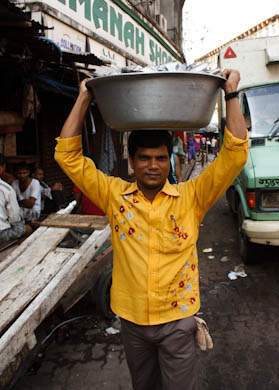
Early in the morning in Mumbai, you can find people walking at a brisk pace, carrying bowls of fish on their head. The fish have just arrived from the sea and scooped into bowls, along with some ice. It is up to these people to take the fish and get them to destinations around Mumbai in a timely manner. This man was walking towards Victoria Terminus.

Friday, July 08, 2011

JD Intarsia on Etsy

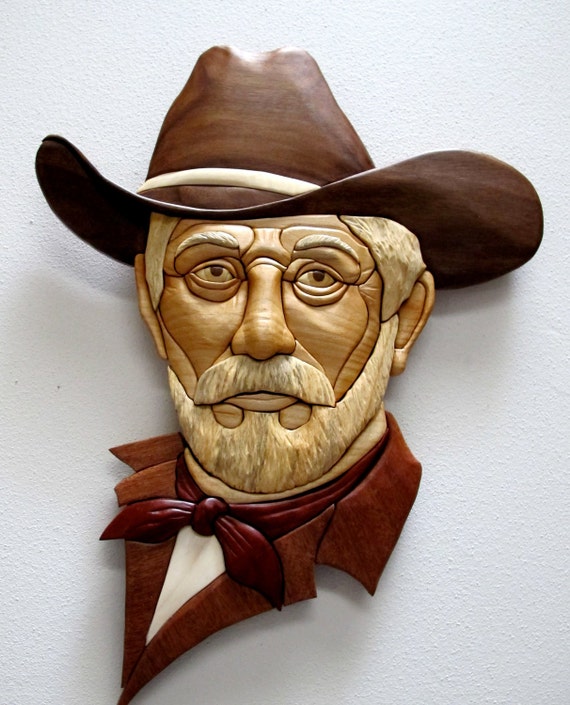
This week I helped my dad set up his entrepreneurial venture on the website Etsy http://www.etsy.com/shop/jdintarsia . On this site, you will find the intarsia pieces that he and my mom have made. Intarsia reminds me of puzzles made of carefully assembled pieces of different types of wood. All colors are from the natural grains/colors of the actual wood. Take a look!

Thursday, July 07, 2011

Adam's Building

Being that Chennai was a mere fishing village until recent history, it has few buildings that could be considered old. Located in the older Georgetown area of Chennai, this building dates back to 1923. I like the decorative wood trimming (which reminds me of the hanging mango leaves you sometimes see over doorways) and balcony.

Tuesday, July 05, 2011

An Electrician's Nightmare

Take a walk through congested areas of most cities of India and you're bound to run into electrical installations or add-ons that are scary - and of dubious legitimacy.

Taking a Cow by its Horns

Maneuvering your cow through the crowded streets of old Georgetown in Chennai can be rather tricky. 

Thursday, June 30, 2011

You Never Know what You'll Pass on an Indian Road

Indian roads are far from dull. There's the constant honking, daredevil passing, selective adherence to road rules/signs, and then there's those who use the roads. Aside from the usual melange of trucks, auto rickshaws, buses, cars, motorcycles, motorbikes, pedestrians, and bicycles, one can also find animals being used as transport vehicles. In South India, that usually is the cow. In northern India, camels are a favored beast. Occasionally though, elephants are also used. Staying observant and keeping the camera handy enabled me to quickly snap this photo as we drove past on the highway to Patan, Gujarat.

Wednesday, June 29, 2011

Men in White

While we baked in the "AC room" of the restaurant that didn't have electricity, these men enjoyed the company of fellow farmers outside. They had gathered to celebrate a birthday of another farmer. The typical uniform for farmers in this region of Gujarat is all white - from the turban down to the pants.

Tuesday, June 28, 2011

Shadowebs

When walking through a small Banni village in remote Gujarat, I was intrigued by the shadows cast by an incomplete conical thatched roof. Many of the buildings (mud and concrete alike) in the Kutch region of Gujarat were flattened during the devastating earthquake in 2001. Many of the mud huts are being rebuilt using concrete. 

Sunday, June 26, 2011

Jasmine-Scented Chennai


Few things are more symbolic and representative of Tamil Nadu than its temples and prolific use of jasmine. This fragrant white flower permeates all of Tamil society. Nearly every street corner has a woman busily stringing together these white buds. From festivities to paying homage, inside temples as well as adorning the virgin Mary, and secured to the braided black hair, the simple jasmine flower can be found. Its life span with maximum fragrance is around 24 hours, requiring a quick turnaround from plucking to customer.

The main source of flowers headed to the main Chennai market of Koyembedu comes from Periapalayam, Oothukottai, Arni, Vengal, Chengalapattu, Madurantakam, and Tiruvannamalai. (Some day I'd love to visit a jasmine farm in one of these towns). A smaller market for jasmine is found in Parry's Corner. These markets are particularly popular with women, who then string them into garlands sold by the mozham, the length between the elbow and fingertips. At about 4AM, the first of the flowers arrive. These early batches command the highest prices. As the day wanes, so does the price. Scent factories have begun purchasing jasmine in bulk during the late afternoon hours, reducing waste and benefitting the farmers. Irregardless of the price, most regular customers wouldn't do without their daily purchase of jasmine. 

Friday, June 24, 2011

Gujarat's Nuclear Power Plants

After the terrible nuclear tragedies in Japan, many counties are reconsidering their nuclear power programs.   Gujarat is one of the states in India that have recently initiated nuclear plant constructions. In a particularly energy-deficient country such as India, what future role will nuclear power play? This plant was photographed in Gujarat near Ahmedabad.

Thursday, June 23, 2011

The Broom Seller

A ritual taking place inside and in front of nearly every home and business in India involves sweeping the area with a natural-bristle broom. These brooms tend to lose their sweeping efficiency rather quickly, so a new purchase is in line. Perhaps this mobile broom store would even deliver a broom right to your doorstop.

Tuesday, June 21, 2011

Reflections: Gujarat


Despite the heat, we had an awesome time in Gujarat. It’s a pity that the neighboring state of Rajasthan commands all of the attention on touristic scene. While Gujarat doesn’t have the sheer numbers of forts and palaces of which Rajasthan can boast, its stark beauty, vibrant rural life, exquisite step wells and Jain temples, incredibly warm, authentic people, and magnificent crafts puts Gujarat on par with its neighbor. Considering that most of the textile pieces I had purchased in Rajasthan were actually from Gujarat, it was only fitting that I traveled to see where they were created. Going into the homes of the artists and seeing the process made me appreciate the demonstrated art form even more. Having a car and driver, along with a knowledgeable guide, enabled us to spontaneously stop or stay longer at things that particularly interested us. While this method is more expensive than traveling by public transport or going on a bus tour, we experienced so much more. Gujarat will forever hold a special place in my heart.

Monday, June 20, 2011

The Kutch Museum, Bhuj


Likely to my father’s delight, he had only been to only one full-fledged museum so far on the trip. Today would visit a second- the Kutch Museum. Established in 1877, it is Gujarat’s oldest museum. Once only for the eyes of the ruler’s guests, it has in its collection ancient Kutchi script writings, local silver, gold, and enameling work, would work, coins, musical instruments, and the ever–present artillery display. My favorite part though was a section devoted to the tribal people and their arts. Life–size dioramas were made depicting the various tribes showcasing their unique clothing, homes, and ways of life. Beautiful examples of the different styles of embroidery and other textile arts were preserved under glass. It made me want to visit the villages all over again and perhaps do a bit of shopping.

Photo from http://gujaratgumo.blogspot.com/2011/05/kutch-museum-bhuj.html, as photography was not allowed.

Sunday, June 19, 2011

Aina Mahal, Bhuj


In the same compound as the Prag Mahal was the Aina Mahal, heavily affected by the 2001 earthquake. A portion of it has been made into a museum. Meaning “palace of mirrors,” the 18th-century palace’s name to fame is its Hall of Mirrors room. Though its splendor didn’t quite match that of the palaces I had visited in Rajasthan (not to mention the earthquake tarnishing some of that beauty), there still was some to see. The wall still contained portions covered with white marble. Gilded mirrors covered the majority of space at eye-level. Venetian glass candelabras and colored glass lamps dangled from the ceiling. For me, the room’s most striking feature was the floor, decorated with blue china tiles manufactured in Bhuj.

Saturday, June 18, 2011

Prag Mahal, Bhuj


Walking past a large mound of rubble from the earthquake (including portions of more colonial sculptures), the first building we saw was the Prag Mahal.
Bui 1865-79, this Gothic-style building was constructed by Italian architects. From the outside, it looked like this part of the Prag Mahal fared better than many buildings in this area. Looking up at the towers, one could see huge cracks zigzagging down the large bricks.

Friday, June 17, 2011

Gateway of the Nagar Khana, Bhuj


On our last day, we visited a part of Bhuj where older buildings still remained, albeit with earthquake damage. Although I would not be able to see the walled city with beautiful palaces and havelis and famous bazaars, as described in older guidebooks, I would try to appreciate what remained. At one time, Bhuj (and the region of Kutch) was a wealthy city due to its sea trade with East Africa and Persian Gulf countries. We started by entering through the arched Gateway of the Nagar Khana that leads to the Prag Mahal (new palace), Rani Mahal (Queen’s Palace), and Aina Mhaal (old palace). Once three-stories high, only the front shell of the second floor remained. A few sculptures on the lower level looked very colonial European – a visual reminder.

Thursday, June 16, 2011

Bhuj - Kutch Area Headquarters


While visiting the various villages in the Kutch area, we used a larger city of Bhuj (population 137,000) as our headquarters. Our hotel was located on a rather drab street, whose stores only sold items such as motorbike parts, hardware, and auto parts. The dusty street was shared by ambling cattle, the occasional camels, cow–pulled carts, tractors, large trucks, and various public transportation vehicles such as trucks, motor bikes modified with a wagon on back. If we wanted to get something to eat at a place other than our hotel, we would need to be satisfied with packaged snacks from the tiny convenience shack. At least there were ATM machines, enabling us to make additional crafts purchases!

Wednesday, June 15, 2011

Rabari Women, Bhujodi


Walking around the village, we met a Rabari woman was sewing on a mirror to an embroidered piece of cloth. Her long, dangling earrings particularly fascinated us. How heavy those earrings must have been to have weighed down her earlobes with such a large hole! Another Rabari woman squatted as she washed metal eating containers outside. She also had the same style earrings, in addition to tattoo tribal designs on her arms, feet, and lower legs.